


Between Scylla and Charybdis: the role of the human immune system in the pathogenesis of hepatitis C
- PMID: 24307779
- PMCID: PMC3848133
- DOI: 10.3748/wjg.v19.i44.7852
Between Scylla and Charybdis: the role of the human immune system in the pathogenesis of hepatitis C
Abstract
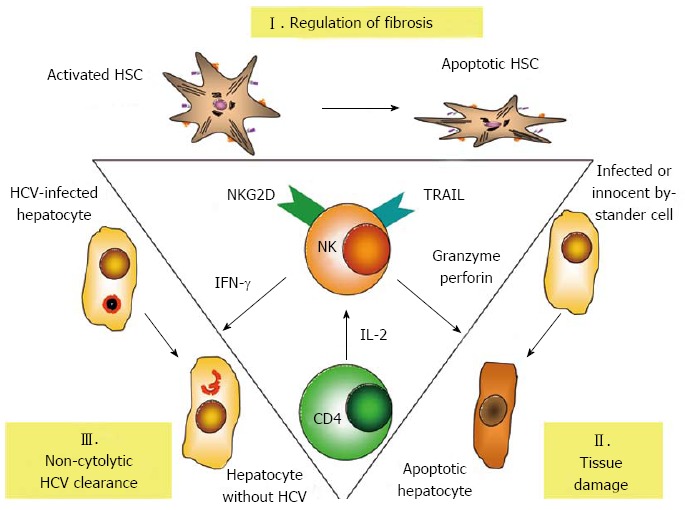
Hepatitis C virus (HCV) frequently elicits only mild immune responses so that it can often establish chronic infection. In this case HCV antigens persist and continue to stimulate the immune system. Antigen persistence then leads to profound changes in the infected host's immune responsiveness, and eventually contributes to the pathology of chronic hepatitis. This topic highlight summarizes changes associated with chronic hepatitis C concerning innate immunity (interferons, natural killer cells), adaptive immune responses (immunoglobulins, T cells, and mechanisms of immune regulation (regulatory T cells). Our overview clarifies that a strong anti-HCV immune response is frequently associated with acute severe tissue damage. In chronic hepatitis C, however, the effector arms of the immune system either become refractory to activation or take over regulatory functions. Taken together these changes in immunity may lead to persistent liver damage and cirrhosis. Consequently, effector arms of the immune system will not only be considered with respect to antiviral defence but also as pivotal mechanisms of inflammation, necrosis and progression to cirrhosis. Thus, avoiding Scylla - a strong, sustained antiviral immune response with inital tissue damage - takes the infected host to virus-triggered immunopathology, which ultimately leads to cirrhosis and liver cancer - the realm of Charybdis.
Keywords: CD4+ T helper cells; Hepatic stellate cells; Hepatitis C; Hepatocytes; Immunoglobulin; Interferon; Natural killer cells; Regulatory T cells; Retinoic acid inducible gene-I; Toll like receptors.
Figures

References
-
- Tillmann HL, Thompson AJ, Patel K, Wiese M, Tenckhoff H, Nischalke HD, Lokhnygina Y, Kullig U, Göbel U, Capka E, et al. A polymorphism near IL28B is associated with spontaneous clearance of acute hepatitis C virus and jaundice. Gastroenterology. 2010;139:1586–1592, 1592.e1. - PubMed
-
- Gerlach JT, Diepolder HM, Zachoval R, Gruener NH, Jung MC, Ulsenheimer A, Schraut WW, Schirren CA, Waechtler M, Backmund M, et al. Acute hepatitis C: high rate of both spontaneous and treatment-induced viral clearance. Gastroenterology. 2003;125:80–88. - PubMed
-
- Brillanti S, Foli M, Gaiani S, Masci C, Miglioli M, Barbara L. Persistent hepatitis C viraemia without liver disease. Lancet. 1993;341:464–465. - PubMed
-
- Alberti A, Morsica G, Chemello L, Cavalletto D, Noventa F, Pontisso P, Ruol A. Hepatitis C viraemia and liver disease in symptom-free individuals with anti-HCV. Lancet. 1992;340:697–698. - PubMed
-
- Farci P, Alter HJ, Shimoda A, Govindarajan S, Cheung LC, Melpolder JC, Sacher RA, Shih JW, Purcell RH. Hepatitis C virus-associated fulminant hepatic failure. N Engl J Med. 1996;335:631–634. - PubMed
Publication types
MeSH terms
Substances
LinkOut - more resources
Full Text Sources
Other Literature Sources
Research Materials
