Clinicopathological characteristics of synchronous and metachronous gastric neoplasms after endoscopic submucosal dissection
- PMID: 24307844
- PMCID: PMC3846994
- DOI: 10.3904/kjim.2013.28.6.687
Clinicopathological characteristics of synchronous and metachronous gastric neoplasms after endoscopic submucosal dissection
Abstract
Background/aims: Endoscopic submucosal dissection (ESD) has become accepted as a minimally invasive treatment for gastric neoplasms. However, the development of synchronous or metachronous gastric lesions after endoscopic resection has become a major problem. We investigated the characteristics of multiple gastric neoplasms in patients with early gastric cancer (EGC) or gastric adenoma after ESD.
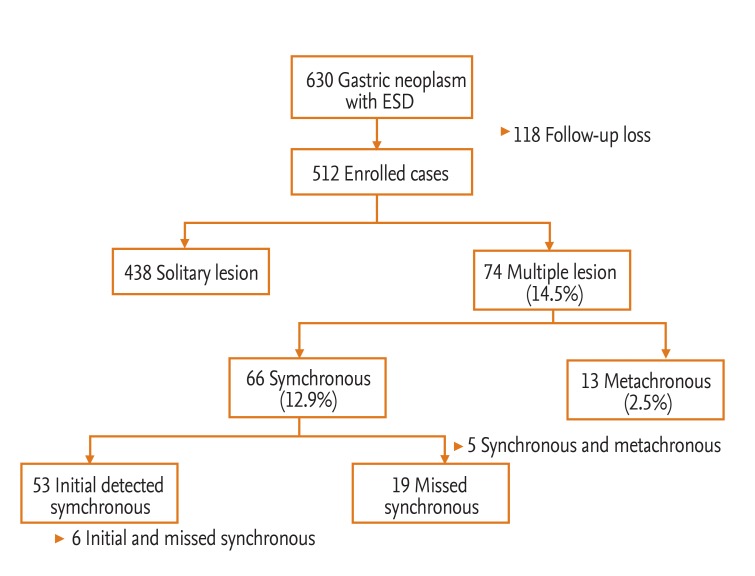
Methods: In total, 512 patients with EGC or gastric adenoma who had undergone ESD between January 2008 and December 2011 participated in this study. The incidence of and factors associated with synchronous and metachronous gastric tumors were investigated in this retrospective study.
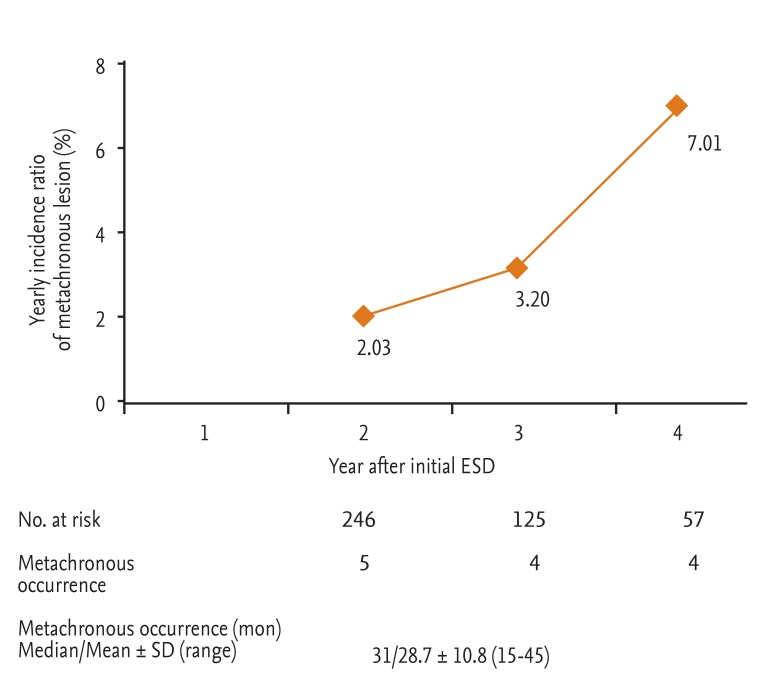
Results: In total, 66 patients (12.9%) had synchronous lesions, and 13 patients (2.5%) had metachronous lesions. Older (> 65 years) subjects had an increased risk of multiple gastric neoplasms (p = 0.012). About two-thirds of the multiple lesions were similar in macroscopic and histological type to the primary lesions. The median interval from the initial lesions to the diagnosis of metachronous lesions was 31 months. The annual incidence rate of metachronous lesions was approximately 3%.
Conclusions: We recommend careful follow-up in patients of advanced age (> 65 years) after initial ESD because multiple lesions could be detected in the remnant stomach. Annual surveillance might aid in the detection of metachronous lesions. Large-scale, multicenter, and longer prospective studies of appropriate surveillance programs are needed.
Keywords: Neoplasms, multiple primary; Neoplasms, second primary; Stomach neoplasms.
Conflict of interest statement
No potential conflict of interest relevant to this article is reported.
Figures
References
-
- Lee H, Yun WK, Min BH, et al. A feasibility study on the expanded indication for endoscopic submucosal dissection of early gastric cancer. Surg Endosc. 2011;25:1985–1993. - PubMed
-
- Isomoto H, Shikuwa S, Yamaguchi N, et al. Endoscopic submucosal dissection for early gastric cancer: a large-scale feasibility study. Gut. 2009;58:331–336. - PubMed
-
- Goto O, Fujishiro M, Kodashima S, Ono S, Omata M. Outcomes of endoscopic submucosal dissection for early gastric cancer with special reference to validation for curability criteria. Endoscopy. 2009;41:118–122. - PubMed
-
- Kato M, Nishida T, Tsutsui S, et al. Endoscopic submucosal dissection as a treatment for gastric noninvasive neoplasia: a multicenter study by Osaka University ESD Study Group. J Gastroenterol. 2011;46:325–331. - PubMed
-
- Chung IK, Lee JH, Lee SH, et al. Therapeutic outcomes in 1000 cases of endoscopic submucosal dissection for early gastric neoplasms: Korean ESD Study Group multicenter study. Gastrointest Endosc. 2009;69:1228–1235. - PubMed
Publication types
MeSH terms
LinkOut - more resources
Full Text Sources
Other Literature Sources
Medical
Miscellaneous