


The role of plasma membrane STIM1 and Ca(2+)entry in platelet aggregation. STIM1 binds to novel proteins in human platelets
- PMID: 24308967
- PMCID: PMC4062937
- DOI: 10.1016/j.cellsig.2013.11.025
The role of plasma membrane STIM1 and Ca(2+)entry in platelet aggregation. STIM1 binds to novel proteins in human platelets
Abstract
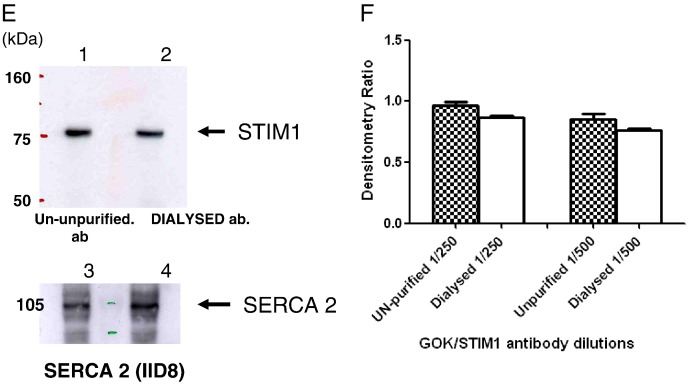
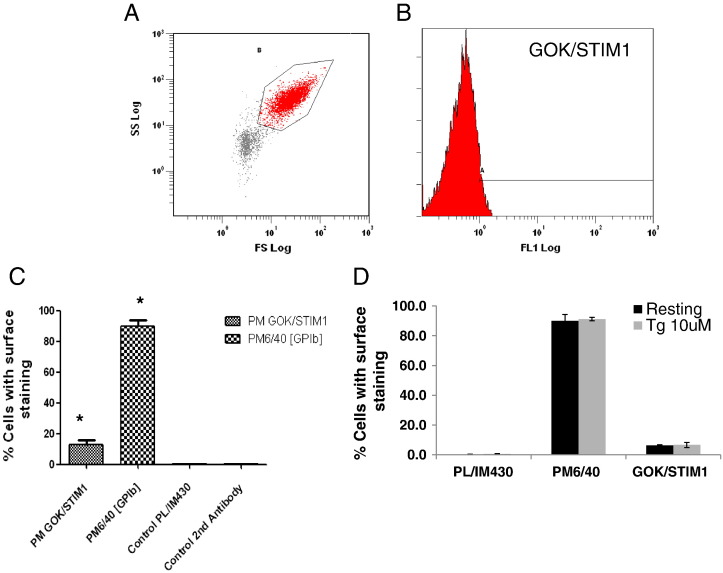
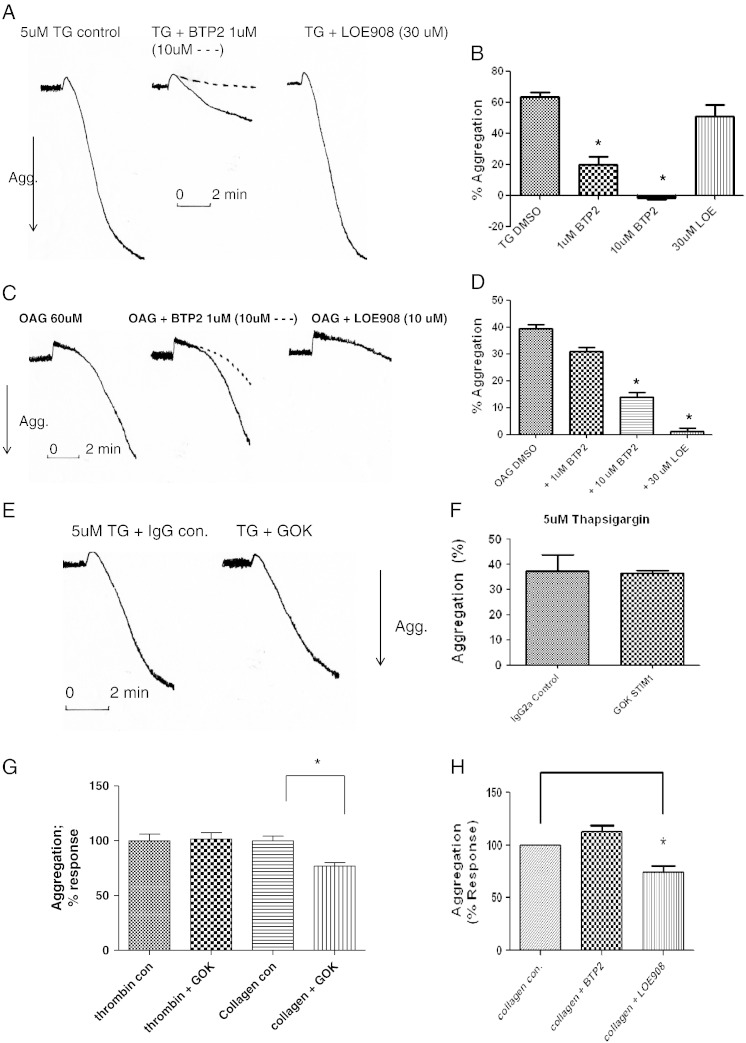
Ca(2+) elevation is essential to platelet activation. STIM1 senses Ca(2+) in the endoplasmic reticulum and activates Orai channels allowing store-operated Ca(2+) entry (SOCE). STIM1 has also been reported to be present in the plasma membrane (PM) with its N-terminal region exposed to the outside medium but its role is not fully understood. We have examined the effects of the antibody GOK/STIM1, which recognises the N-terminal region of STIM1, on SOCE, agonist-stimulated Ca(2+) entry, surface exposure, in vitro thrombus formation and aggregation in human platelets. We also determined novel binding partners of STIM1 using proteomics. The dialysed GOK/STIM1 antibody failed to reduced thapsigargin- and agonist-mediated Ca(2+) entry in Fura2-labelled cells. Using flow cytometry we detect a portion of STIM1 to be surface-exposed. The dialysed GOK/STIM1 antibody reduced thrombus formation by whole blood on collagen-coated capillaries under flow and platelet aggregation induced by collagen. In immunoprecipitation experiments followed by proteomic analysis, STIM1 was found to extract a number of proteins including myosin, DOCK10, thrombospondin-1 and actin. These studies suggest that PM STIM1 may facilitate platelet activation by collagen through novel interactions at the plasma membrane while the essential Ca(2+)-sensing role of STIM1 is served by the protein in the ER.
Keywords: 1,2-diacyl-sn-glycerol; 1-Oleoyl-2-acetyl-sn-glycerol; Aggregation; Ca(2+) entry; Collagen; DAG; OAG; PM; SOCE; STIM1; TG; TRPC; Thrombospondin-1; plasma membrane; store operated Ca(2+) entry; stromal interaction molecule 1; thapsigargin; transient receptor potential canonical.
Copyright © 2013 Elsevier Inc. All rights reserved.
Figures




References
Publication types
MeSH terms
Substances
Grants and funding
LinkOut - more resources
Full Text Sources
Other Literature Sources
Miscellaneous
