Smaller stress-sensitive hippocampal subfields in women with borderline personality disorder without posttraumatic stress disorder
- PMID: 24309162
- PMCID: PMC3937281
- DOI: 10.1503/jpn.130070
Smaller stress-sensitive hippocampal subfields in women with borderline personality disorder without posttraumatic stress disorder
Abstract
Background: Animal and human studies have suggested that hippocampal subfields are differentially vulnerable to stress, but subfield volume has not been investigated in patients with borderline personality disorder (BPD). Based on the putative role of stressful life events as vulnerability factors for BPD, we hypothesized that patients with BPD would exhibit reduced volumes for the stress-sensitive dentate gyrus (DG) and the cornu ammonis (CA) 3 subfields volumes, and that these volumes would be associated with traumatic childhood experiences.
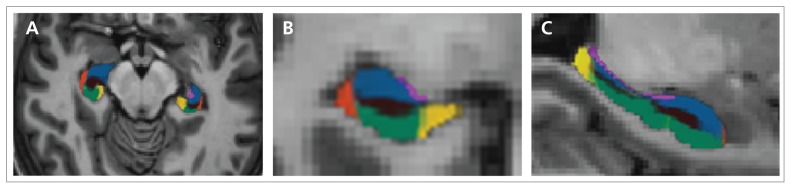
Methods: All participants underwent 3 T magnetic resonance imaging. Hippocampal subfield volumes were estimated using an automated and validated segmentation algorithm implemented in FreeSurfer. Age and total subcortical grey matter volume were covariates. We assessed traumatic childhood experiences using the Childhood Trauma Questionnaire (CTQ).
Results: A total of 18 women with BPD and 21 healthy control women were included in the study. Only 1 patient had comorbid posttraumatic stress disorder (PTSD). The volumes of the left (p = 0.005) and right (p = 0.011) DG-CA4 and left (p = 0.007) and right (p = 0.005) CA2-3 subfields were significantly reduced in patients compared with controls. We also found significant group differences for the left (p = 0.032) and right (p = 0.028) CA1, but not for other hippocampal subfields. No associations were found between CTQ scores and subfield volumes.
Limitations: The self-reported CTQ might be inferior to more comprehensive assessments of traumatic experiences. The sample size was moderate.
Conclusion: The volumes of stress-sensitive hippocampal subfields are reduced in women with BPD without PTSD. However, the degree to which childhood trauma is responsible for these changes is unclear.
Figures
References
-
- Lieb K, Zanarini MC, Schmahl C, et al. Borderline personality disorder. Lancet. 2004;364:453–61. - PubMed
-
- Goodman M, New A, Siever L. Trauma, genes, and the neurobiology of personality disorders. Ann N Y Acad Sci. 2004;1032:104–16. - PubMed
-
- Irle E, Lange C, Sachsse U. Reduced size and abnormal asymmetry of parietal cortex in women with borderline personality disorder. Biol Psychiatry. 2005;57:173–82. - PubMed
-
- Brambilla P, Soloff PH, Sala M, et al. Anatomical MRI study of borderline personality disorder patients. Psychiatry Res. 2004;131:125–33. - PubMed
-
- Tebartz van Elst L, Hesslinger B, Thiel T, et al. Frontolimbic brain abnormalities in patients with borderline personality disorder: a volumetric magnetic resonance imaging study. Biol Psychiatry. 2003;54:163–71. - PubMed
Publication types
MeSH terms
LinkOut - more resources
Full Text Sources
Miscellaneous