


Acute exercise facilitates brain function and cognition in children who need it most: an ERP study of individual differences in inhibitory control capacity
- PMID: 24309300
- PMCID: PMC6987893
- DOI: 10.1016/j.dcn.2013.11.001
Acute exercise facilitates brain function and cognition in children who need it most: an ERP study of individual differences in inhibitory control capacity
Abstract
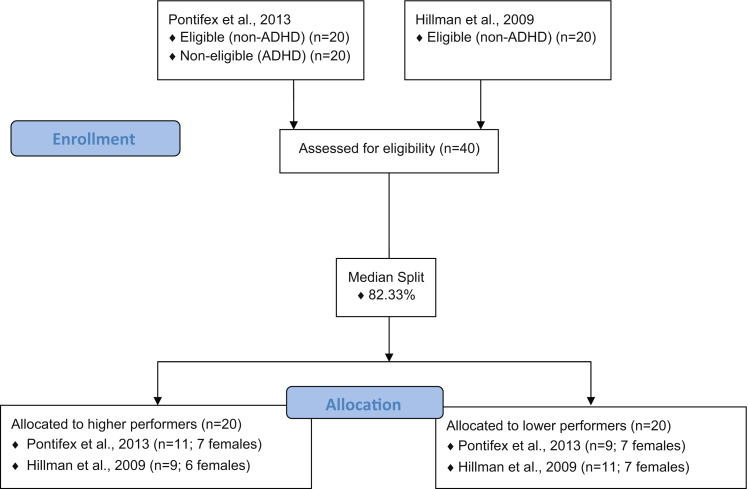
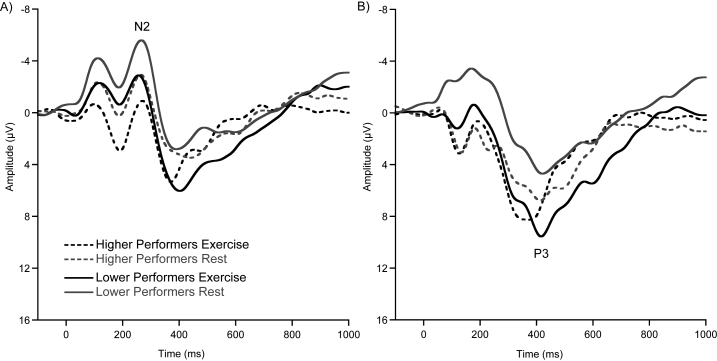
The present study examined the effects of moderate-intensity aerobic exercise on aspects of cognitive control in two groups of children categorized by higher- and lower-task performance. Event-related brain potentials (ERPs) were collected in 40 preadolescent children during a modified flanker task following 20 min of treadmill walking and seated rest on separate occasions. Participants were bifurcated into two groups based on task performance following the resting session. Findings revealed that following exercise, higher-performers maintained accuracy and exhibited no change in P3 amplitude compared to seated rest. Lower-performers demonstrated a differential effect, such that accuracy measures improved, and P3 amplitude increased following exercise. Lastly, both groups displayed smaller N2 amplitude and shorter P3 latency following exercise, suggesting an overall facilitation in response conflict and the speed of stimulus classification. The current findings replicate prior research reporting the beneficial influence of acute aerobic exercise on cognitive performance in children. However, children with lower inhibitory control capacity may benefit the most from single bouts of exercise. These data are among the first to demonstrate the differential effect of physical activity on individuals who vary in inhibitory control, and further support the role of aerobic exercise for brain health during development.
Keywords: Executive function; Flanker; Higher-performers; Lower-performers; Physical activity.
Copyright © 2013 The Authors. Published by Elsevier Ltd.. All rights reserved.
Figures

References
-
- Alloway T.P., Gathercole S.E., Kirkwood H., Elliott J. The cognitive and behavioral characteristics of children with low working memory. Child Dev. 2009;80(2):606–621. - PubMed
-
- American College of Sports Medicine . 8th ed. Lippincott Williams & Wilkins; New York: 2010. ACSM's Guidelines for Exercise Testing and Prescription.
-
- Andersen R.E., Crespo C.J., Bartlett S.J., Cheskin L.J., Pratt M. Relationship of physical activity and television watching with body weight and level of fatness among children: results from the Third National Health and Nutrition Examination Survey. J. Am. Med. Assoc. 1998;279:938–942. - PubMed
-
- Bar-Or O. Springer-Verlag; New York: 1983. Pediatric Sports Medicine for the Practitioner: From Physiologic Principles to Clinical Applications.
-
- Best J.R. Exergaming immediately enhances children's executive function. Dev. Psychol. 2012;48:1501–1510. - PubMed
Publication types
MeSH terms
Grants and funding
LinkOut - more resources
Full Text Sources
Other Literature Sources
Medical
