Review
. 2014 Apr;24(4):247-56.
doi: 10.1016/j.tcb.2013.11.004. Epub 2013 Dec 2.

Broken nuclei--lamins, nuclear mechanics, and disease

Affiliations
Review

Broken nuclei--lamins, nuclear mechanics, and disease

Patricia M Davidson et al. Trends Cell Biol. 2014 Apr.

Abstract

Mutations in lamins, which are ubiquitous nuclear intermediate filaments, lead to a variety of disorders including muscular dystrophy and dilated cardiomyopathy. Lamins provide nuclear stability, help connect the nucleus to the cytoskeleton, and can modulate chromatin organization and gene expression. Nonetheless, the diverse functions of lamins remain incompletely understood. We focus here on the role of lamins on nuclear mechanics and their involvement in human diseases. Recent findings suggest that lamin mutations can decrease nuclear stability, increase nuclear fragility, and disturb mechanotransduction signaling, possibly explaining the muscle-specific defects in many laminopathies. At the same time, altered lamin expression has been reported in many cancers, where the resulting increased nuclear deformability could enhance the ability of cells to transit tight interstitial spaces, thereby promoting metastasis.

Keywords: cell mechanics; cytoskeleton; gene regulation; laminopathy; protein assembly/structure.


Figures

Figure 1
Figure 1
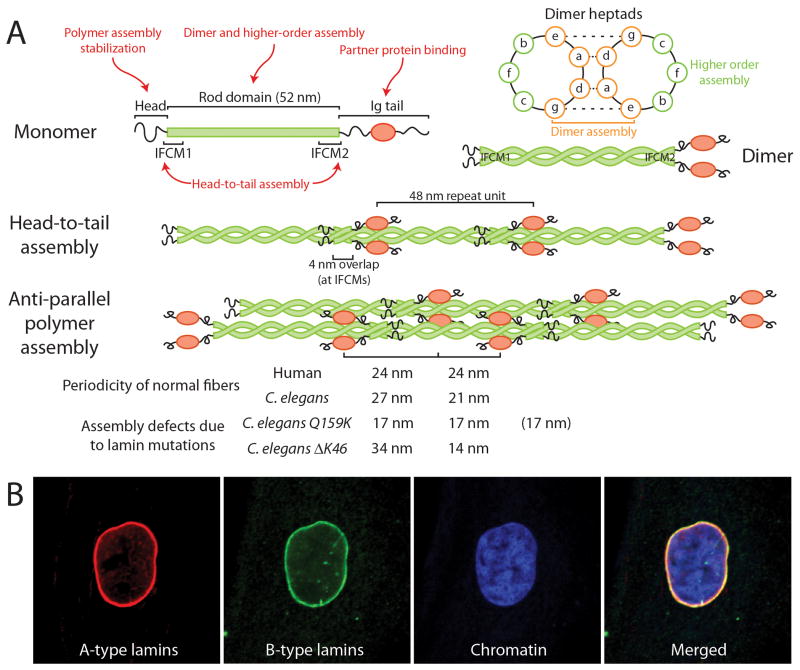
Lamin assembly and defects caused by lamin mutations. (A) Experiments with mutated and truncated lamins suggest that different parts of the lamin proteins play distinct roles in lamin assembly (red text). Two parallel lamin monomers (top left) form dimers (top right) through coiled-coil interaction of the heptad repeats in their central rod domains. These dimers assemble head-to-tail by overlapping their rod domains at the two IF consensus motifs (IFCM). The head-to-tail assemblies form non-polar protofilaments composed of two anti-parallel polymers, which then laterally assemble to form mature filaments (and paracrystals) with specific repeat units, visible by electron microscopy and identified as the site of the globular Ig-fold motif. Defects in lamin assembly can be identified in vitro as changes in the spacing of the repeat unit, as demonstrated for two mutants in C. elegans (bottom), or by failure to form lamin filaments or paracrystals. Note that in the case of the Q159K mutation, it is likely that the spacing is 17/17/17, approximately corresponding to the 48 nm repeat unit, indicating a combination of three overlapping polymers instead of two. Inset, top right: a cross-section view of the heptad repeats of the coiled coil illustrates how the inner amino acids play a role in the dimer assembly, whereas amino acids that point outwards can affect higher order assembly. (B) Immunofluorescence images of human skin fibroblasts stained for lamins A/C (red), B-type lamins (green), and DNA (blue).
Figure 2
Figure 2
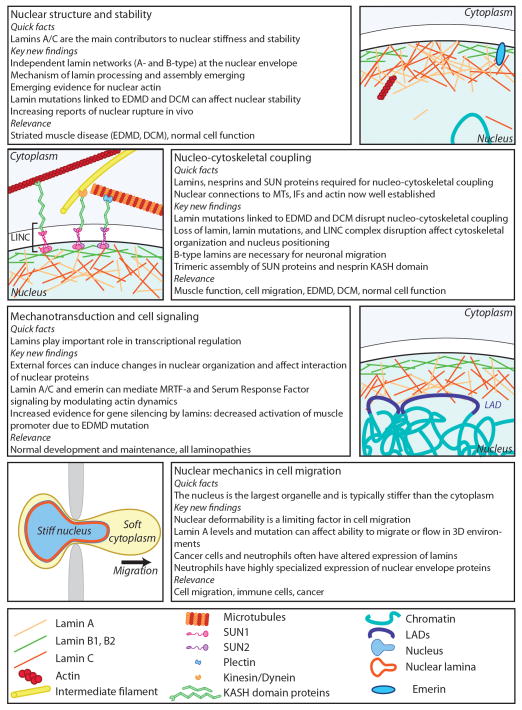
Overview of the diverse functions of lamins in nuclear and cellular mechanics and mechanotransduction.

References

    1. Bonne G, et al. Mutations in the gene encoding lamin A/C cause autosomal dominant Emery-Dreifuss muscular dystrophy. Nat Genet. 1999;21:285–8. - PubMed
    1. Schreiber K, Kennedy B. When Lamins Go Bad: Nuclear Structure and Disease. Cell. 2013;152:1365–1375. - PMC - PubMed
    1. Wolf K, et al. Physical limits of cell migration: Control by ECM space and nuclear deformation and tuning by proteolysis and traction force. J Cell Biol. 2013;201:1069–1084. - PMC - PubMed
    1. Rowat AC, et al. Nuclear envelope composition determines the ability of neutrophil-type cells to passage through micron-scale constrictions. J Biol Chem. 2013;288:8610–8. - PMC - PubMed
    1. Hanif M, et al. Differential expression of A-type and B-type lamins during hair cycling. PLoS One. 2009;4:e4114. - PMC - PubMed

Publication types

LinkOut - more resources