


Lisdexamfetamine dimesylate augmentation in adults with persistent executive dysfunction after partial or full remission of major depressive disorder
- PMID: 24309905
- PMCID: PMC3988542
- DOI: 10.1038/npp.2013.334
Lisdexamfetamine dimesylate augmentation in adults with persistent executive dysfunction after partial or full remission of major depressive disorder
Abstract
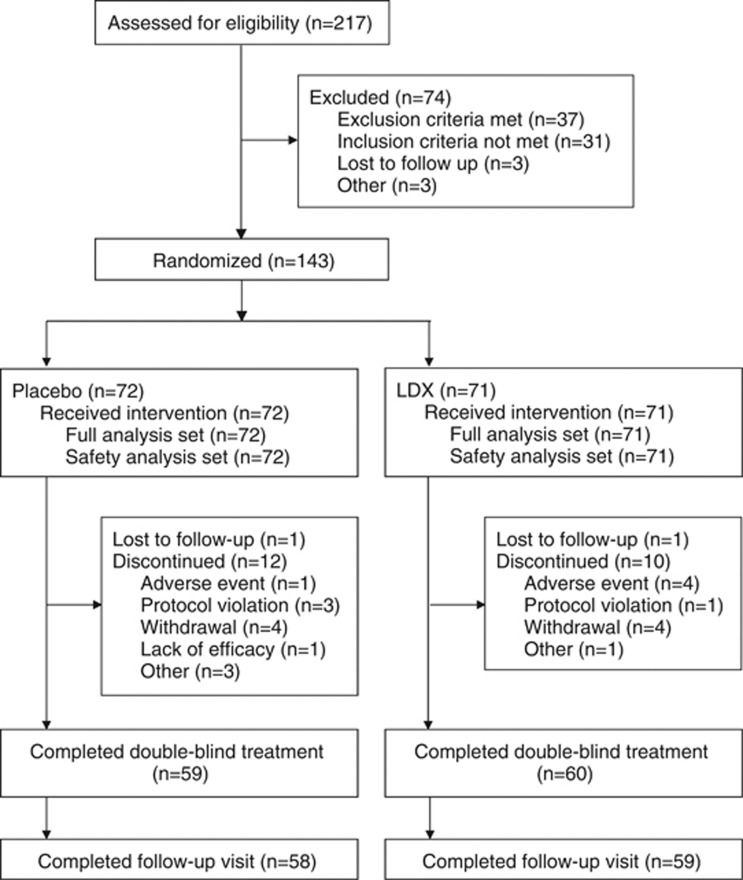
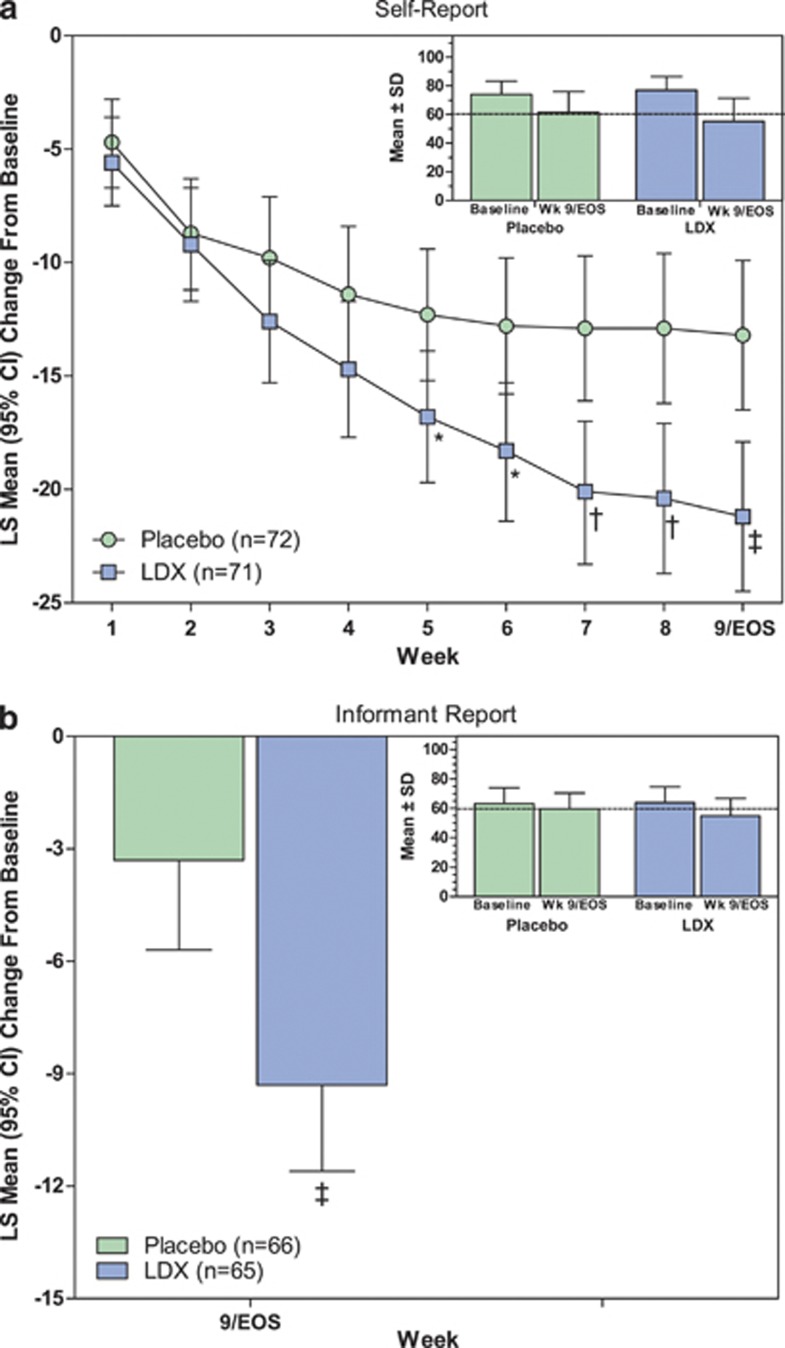
Evaluate lisdexamfetamine dimesylate (LDX) augmentation of antidepressant monotherapy for executive dysfunction in partially or fully remitted major depressive disorder (MDD). This randomized, placebo-controlled study (NCT00985725) enrolled 143 adults (18-55 years) with mild MDD (Montgomery-Åsberg Depression Rating Scale (MADRS) score ≤ 18) and executive dysfunction (Behavior Rating Inventory of Executive Function-Adult Version (BRIEF-A) Self-Report Global Executive Composite (GEC) T score ≥ 60) on stable antidepressant monotherapy for ≥ 8 weeks. After 2 weeks of screening, participants were randomized to 9 weeks of double-blind LDX (20-70 mg/day) or placebo augmentation, followed by 2 weeks of single-blind placebo. The primary end point was change from baseline to week 9/end of study (EOS) in BRIEF-A Self-Report GEC T score; secondary assessments included the BRIEF-A Informant Report, MADRS, and treatment-emergent adverse events (TEAEs). Of 143 randomized participants, 119 completed double-blind treatment (placebo, n=59; LDX, n=60). Mean ± standard deviation (SD) BRIEF-A GEC T scores decreased from baseline (placebo, 74.2 ± 8.88; LDX, 76.8 ± 9.66) to week 9/EOS (placebo, 61.4 ± 14.61; LDX, 55.2 ± 16.15); the LS mean (95% CI) treatment difference significantly favored LDX (-8.0 (-12.7, -3.3); P=0.0009). The LS mean (95% CI) treatment difference for MADRS total score also significantly favored LDX (-1.9 (-3.7, 0.0); P=0.0465). TEAE rates were 73.6% with placebo and 78.9% with LDX; serious TEAE rates were 4.2 and 2.8%. In this trial, LDX augmentation significantly improved executive dysfunction and depressive symptoms in participants with mild MDD. The safety profile of LDX was consistent with prior studies in adults with attention-deficit/hyperactivity disorder.
Figures
References
-
- American Psychiatric Association . Diagnostic and Statistical Manual of Mental Disorders. Fourth Edition, Text Revision. American Psychiatric Association: Washington, DC; 2000.
-
- Arnsten AF. Stimulants: therapeutic actions in ADHD. Neuropsychopharmacology. 2006;31:2376–2383. - PubMed
-
- Arnsten AF, Li BM. Neurobiology of executive functions: catecholamine influences on prefrontal cortical functions. Biol Psychiatry. 2005;57:1377–1384. - PubMed
-
- Brooks BL, Sherman EM. Computerized neuropsychological testing to rapidly evaluate cognition in pediatric patients with neurologic disorders. J Child Neurol. 2012;27:982–991. - PubMed
Publication types
MeSH terms
Substances
Associated data
LinkOut - more resources
Full Text Sources
Other Literature Sources
Medical
