Level of asthma control and its impact on activities of daily living in asthma patients in Brazil
- PMID: 24310625
- PMCID: PMC4075876
- DOI: 10.1590/S1806-37132013000500002
Level of asthma control and its impact on activities of daily living in asthma patients in Brazil
Abstract
Objective: To evaluate the impact of asthma on activities of daily living and on health status in patients with controlled, partially controlled, or uncontrolled asthma in Brazil.
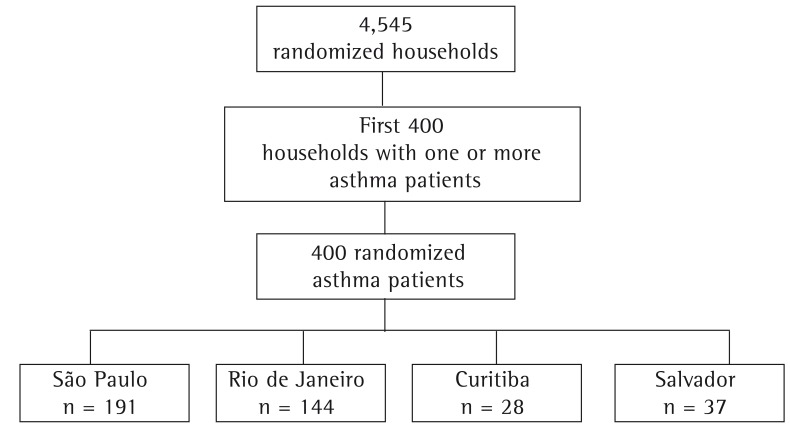
Methods: We used data related to 400 patients in four Brazilian cities (São Paulo, Rio de Janeiro, Salvador, and Curitiba), obtained in a survey conducted throughout Latin America in 2011. All study subjects were > 12 years of age and completed a standardized questionnaire in face-to-face interviews. The questions addressed asthma control, hospitalizations, emergency room visits, and school/work absenteeism, as well as the impact of asthma on the quality of life, sleep, and leisure. The level of asthma control was determined in accordance with the Global Initiative for Asthma criteria.
Results: Among the 400 respondents, asthma was controlled in 37 (9.3%), partially controlled in 226 (56.5%), and uncontrolled in 137 (34.2%). The numbers of patients with uncontrolled or partially controlled asthma who visited the emergency room, who were hospitalized, and who missed school/work were higher than were those of patients with controlled asthma (p = 0.001, p = 0.05, and p = 0.01, respectively). Among those with uncontrolled asthma, the impact of the disease on activities of daily living, sleep, social activities, and normal physical exertion was greater than it was among those with controlled or partially controlled asthma (p < 0.001).
Conclusions: In Brazil, asthma treatment should be monitored more closely in order to increase treatment adherence and, consequently, the level of asthma control, which can improve patient quality of life and minimize the negative impact of the disease.
OBJETIVO:: Avaliar o impacto da asma nas atividades da vida diária e na saúde em pacientes com asma controlada, parcialmente controlada ou não controlada no Brasil.
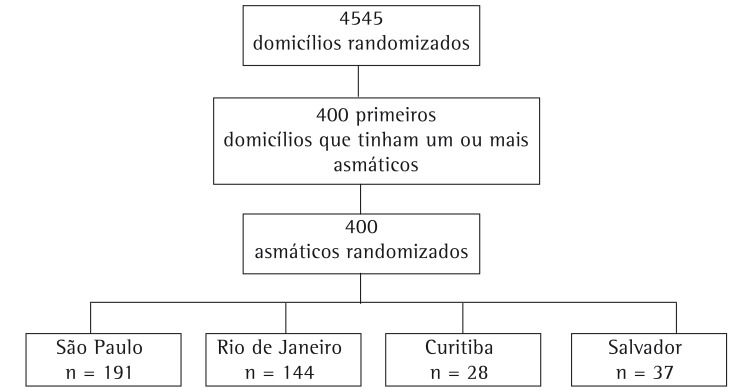
MÉTODOS:: Foram utilizados dados de 400 pacientes de quatro cidades brasileiras (São Paulo, Rio de Janeiro, Curitiba e Salvador) obtidos em um inquérito realizado em países da América Latina em 2011. Todos os indivíduos do estudo tinham idade > 12 anos e responderam a um questionário padronizado por meio de entrevista presencial. As questões abordavam o controle da asma, número de hospitalizações, de consultas de urgência, absenteísmo na escola/trabalho e impacto da asma na qualidade de vida, sono e lazer. O nível de controle da asma foi verificado segundo os critérios da Global Initiative for Asthma.
RESULTADOS:: Entre 400 entrevistados, a asma estava controlada em 37 (9,3%); parcialmente controlada, em 226 (56,5%); e não controlada, em 137 (34,2%). O número de pacientes com asma não controlada ou parcialmente controlada que apresentaram hospitalizações, visitas ao pronto-socorro e faltas na escola/trabalho foi maior do que o daqueles com asma controlada (p = 0,001, p = 0,05 e p = 0,01, respectivamente). Os participantes com asma não controlada apresentaram um maior impacto da doença em atividades da vida diária, sono, atividades sociais e esforço físico normal do que aqueles com asma parcialmente controlada ou controlada (p < 0,001).
CONCLUSÕES:: Medidas terapêuticas devem ser mais intensamente adotadas em nosso país para melhorar o controle da asma e estimular a aderência ao tratamento. Isso, seguramente, proporcionará uma melhor qualidade de vida aos pacientes e uma redução do impacto negativo da doença.
Figures
References
-
- Asher MI, Montefort S, Björkstén B, Lai CK, Strachan DP, Weiland SK, et al. Worldwide time trends in the prevalence of symptoms of asthma, allergic rhinoconjunctivitis, and eczema in childhood: ISAAC Phases One and Three repeat multicountry cross-sectional surveys. Lancet. 2000;368(9537):733–743. - PubMed
-
- Sociedade Brasileira de Pneumologia e Tisiologia Diretrizes da Sociedade Brasileira de Pneumologia e Tisiologia para o Manejo da Asma 2012. J Bras Pneumol. 2012;38(Suppl 1):S1–S46.
-
- Solé D, Wandalsen GF, Camelo-Nunes IC, Naspitz CK, ISAAC - Brazilian Group Prevalence of symptoms of asthma, rhinitis, and atopic eczema among Brazilian children and adolescents identified by the International Study of Asthma and Allergies in Childhood (ISAAC) - Phase 3. J Pediatr (Rio J) 2006;82(5):341–346. - PubMed
-
- Worldwide variations in the prevalence of asthma symptoms: the International Study of Asthma and Allergies in Childhood (ISAAC) Eur Respir J. 1998;12(2):315–335. http://dx.doi.org/10.1183/09031936.98.12020315 - DOI - PubMed
-
- Eagan TM, Gulsvik A, Eide GE, Bakke PS. The effect of educational level on the incidence of asthma and respiratory symptoms. Respir Med. 2004;98(8):730–736. http://dx.doi.org/10.1016/j.rmed.2004.02.008 - DOI - PubMed
Publication types
MeSH terms
LinkOut - more resources
Full Text Sources
Other Literature Sources
Medical