


Triclosan/copolymer containing toothpastes for oral health
- PMID: 24310847
- PMCID: PMC6775959
- DOI: 10.1002/14651858.CD010514.pub2
Triclosan/copolymer containing toothpastes for oral health
Abstract
Background: Periodontal disease and dental caries are highly prevalent oral diseases that can lead to pain and discomfort, oral hygiene and aesthetic problems, and eventually tooth loss, all of which can be costly to treat and are a burden to healthcare systems. Triclosan is an antibacterial agent with low toxicity, which, along with a copolymer for aiding retention, can be added to toothpastes to reduce plaque and gingivitis (inflammation of the gums). It is important that these additional ingredients do not interfere with the anticaries effect of the fluoride present in toothpastes, and that they are safe.
Objectives: To assess the effects of triclosan/copolymer containing fluoride toothpastes, compared with fluoride toothpastes, for the long-term control of caries, plaque and gingivitis in children and adults.
Search methods: We searched the Cochrane Oral Health Group's Trials Register (to 19 August 2013), the Cochrane Central Register of Controlled Trials (CENTRAL) (The Cochrane Library 2013, Issue 7), MEDLINE via OVID (1946 to 19 August 2013), EMBASE via OVID (1980 to 19 August 2013), and the US National Institutes of Health Trials Register (clinicaltrials.gov) (to 19 August 2013). We applied no restrictions regarding language or date of publication in the searches of the electronic databases.
Selection criteria: We included randomised controlled trials (RCTs) assessing the effects triclosan/copolymer containing toothpastes on oral health.
Data collection and analysis: Two review authors independently assessed the search results against the inclusion criteria for this review, extracted data and carried out risk of bias assessments. We attempted to contact study authors for missing information or clarification when feasible. We combined sufficiently similar studies in meta-analyses using random-effects models when there were at least four studies (fixed-effect models when fewer than four studies), reporting mean differences (MD) for continuous data and risk ratios (RR) for dichotomous data.
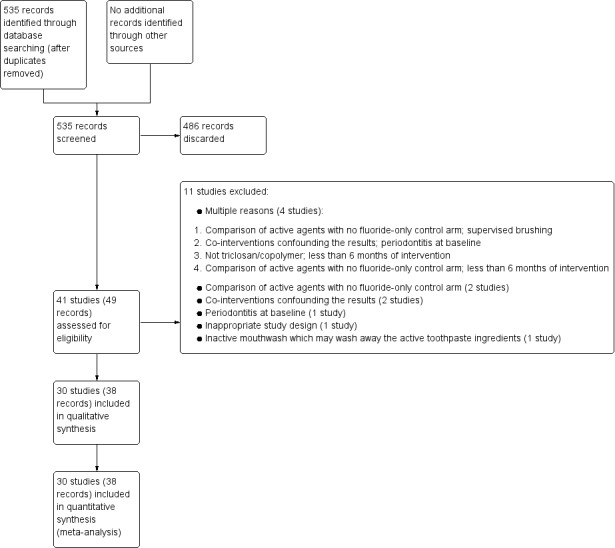
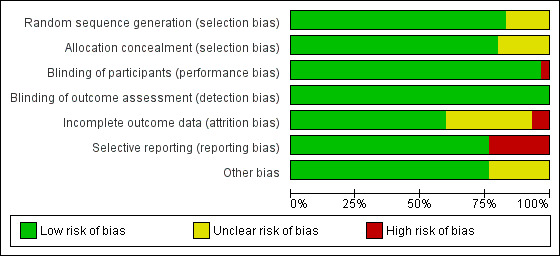
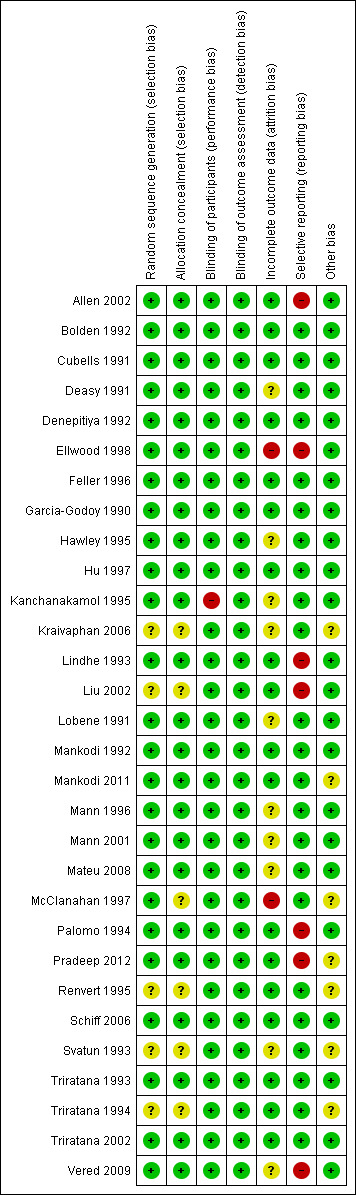
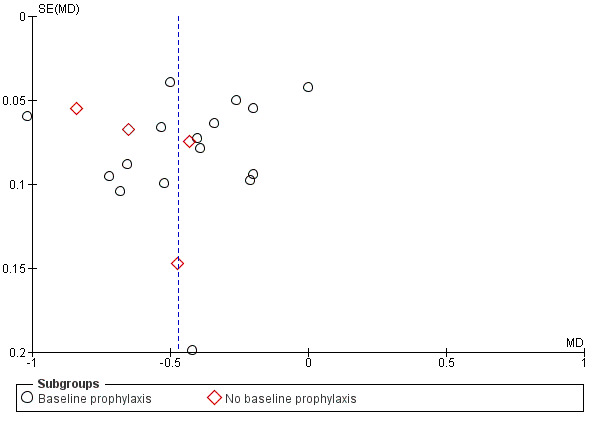
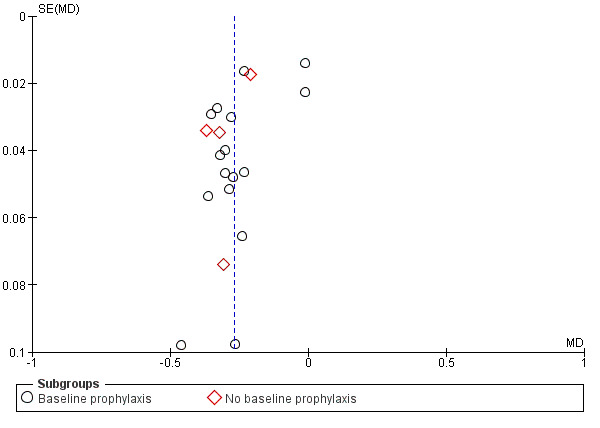
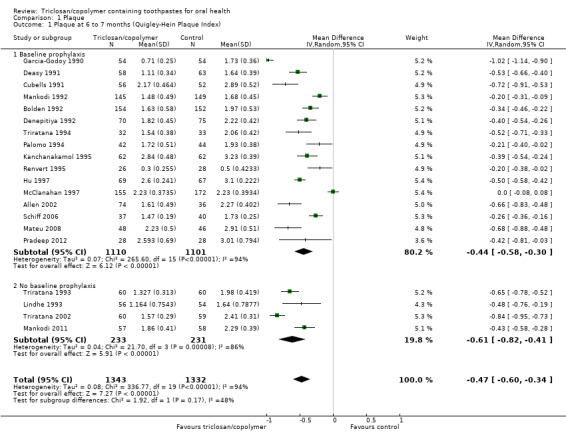
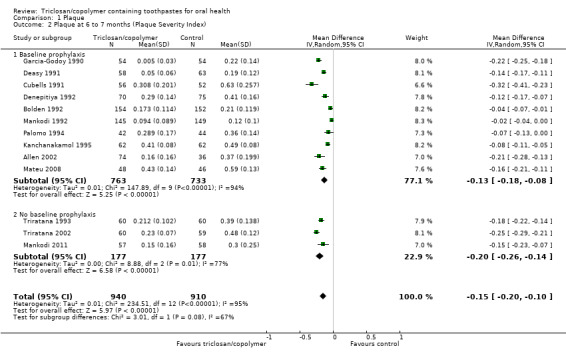
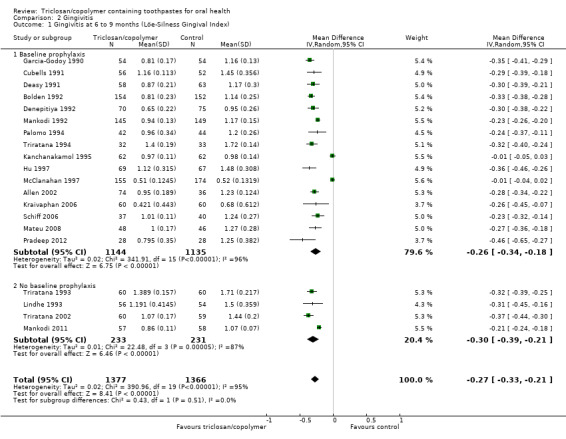
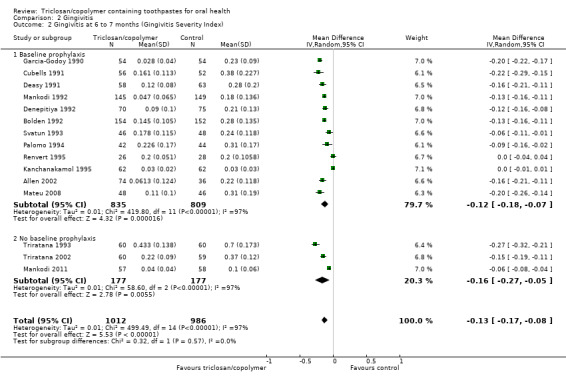
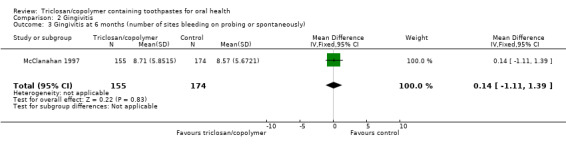
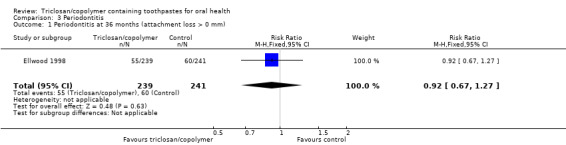
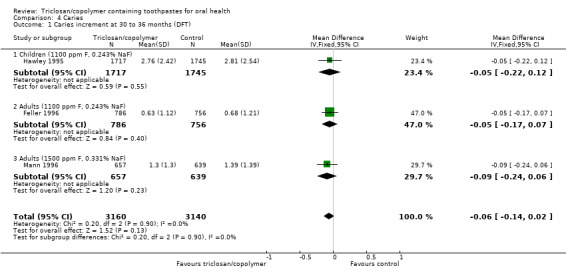
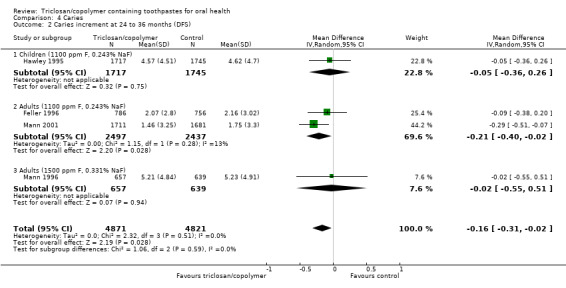
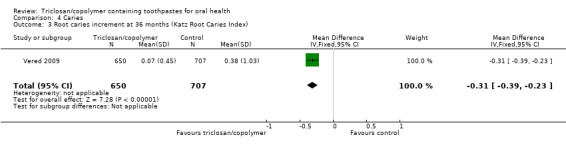
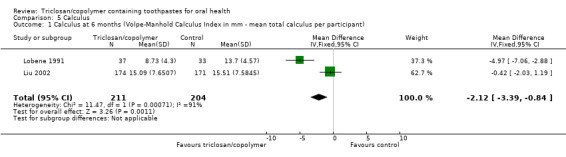
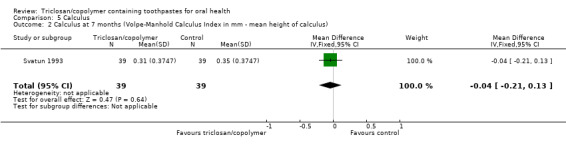
Main results: We included 30 studies, analysing 14,835 participants, in this review. We assessed 10 studies (33%) as at low risk of bias, nine (30%) as at high risk of bias and 11 (37%) as unclear. Plaque Compared with control, after six to seven months of use, triclosan/copolymer toothpaste reduced plaque by 0.47 on a 0 to 5 scale (MD -0.47, 95% confidence interval (CI) -0.60 to -0.34, 20 studies, 2675 participants, moderate-quality evidence). The control group mean was 2.17, representing a 22% reduction in plaque. After six to seven months of use, it also reduced the proportion of sites scoring 3 to 5 on a 0 to 5 scale by 0.15 (MD -0.15, 95% CI -0.20 to -0.10, 13 studies, 1850 participants, moderate-quality evidence). The control group mean was 0.37, representing a 41% reduction in plaque severity. Gingivitis After six to nine months of use, triclosan/copolymer toothpaste reduced inflammation by 0.27 on a 0 to 3 scale (MD -0.27, 95% CI -0.33 to -0.21, 20 studies, 2743 participants, moderate-quality evidence). The control group mean was 1.22, representing a 22% reduction in inflammation. After six to seven months of use, it reduced the proportion of bleeding sites (i.e. scoring 2 or 3 on the 0 to 3 scale) by 0.13 (MD -0.13, 95% CI -0.17 to -0.08, 15 studies, 1998 participants, moderate-quality evidence). The control group mean was 0.27, representing a 48% reduction in bleeding. Periodontitis After 36 months of use, there was no evidence of a difference between triclosan/copolymer toothpaste and control in the development of periodontitis (attachment loss) (RR 0.92, 95% CI 0.67 to 1.27, one study, 480 participants, low-quality evidence). Caries After 24 to 36 months of use, triclosan/copolymer toothpaste slightly reduced coronal caries when using the decayed and filled surfaces (DFS) index (MD -0.16, 95% CI -0.31 to -0.02, four studies, 9692 participants, high-quality evidence). The control group mean was 3.44, representing a 5% reduction in coronal caries. After 36 months of use, triclosan/copolymer toothpaste probably reduced root caries (MD -0.31, 95% CI -0.39 to -0.23, one study, 1357 participants, moderate-quality evidence). Calculus After six months of use, triclosan/copolymer toothpaste may have reduced the mean total calculus per participant by 2.12 mm (MD -2.12 mm, 95% CI -3.39 to -0.84, two studies, 415 participants, low-quality evidence). The control group mean was 14.61 mm, representing a 15% reduction in calculus. Adverse effects There were no data available for meta-analysis regarding adverse effects, but 22 studies (73%) reported that there were no adverse effects caused by either the experimental or control toothpaste.There was considerable heterogeneity present in the meta-analyses for plaque, gingivitis and calculus. Plaque and gingivitis showed such consistent results that it did not affect our conclusions, but the reader may wish to interpret the results with more caution.
Authors' conclusions: There was moderate-quality evidence showing that toothpastes containing triclosan/copolymer, in addition to fluoride, reduced plaque, gingival inflammation and gingival bleeding when compared with fluoride toothpastes without triclosan/copolymer. These reductions may or may not be clinically important, and are evident regardless of initial plaque and gingivitis levels, or whether a baseline oral prophylaxis had taken place or not. High-quality evidence showed that triclosan/copolymer toothpastes lead to a small reduction in coronal caries. There was weaker evidence to show that triclosan/copolymer toothpastes may have reduced root caries and calculus, but insufficient evidence to show whether or not they prevented periodontitis. There do not appear to be any serious safety concerns regarding the use of triclosan/copolymer toothpastes in studies up to three years in duration.
Conflict of interest statement
Philip Riley: no interests to declare. Thomas Lamont: no interests to declare.
Figures

Comment in
-
Triclosan produces statistically significant reduction in plaque, gingivitis and caries but not clinically important benefit.Evid Based Dent. 2014 Mar;15(1):6-7. doi: 10.1038/sj.ebd.6400980. Evid Based Dent. 2014. PMID: 24763165
References
References to studies included in this review
Allen 2002 {published and unpublished data}
-
- Allen DR, Battista GW, Petrone DM, Petrone ME, Chaknis P, DeVizio W, et al. The clinical efficacy of Colgate Total Plus Whitening Toothpaste containing a special grade of silica and Colgate Total Fresh Stripe Toothpaste in the control of plaque and gingivitis: a six‐month clinical study. Journal of Clinical Dentistry 2002; Vol. 13, issue 2:59‐64. - PubMed
Bolden 1992 {published and unpublished data}
-
- Bolden TE, Zambon JJ, Sowinski J, Ayad F, McCool JJ, Volpe AR, et al. The clinical effect of a dentifrice containing triclosan and a copolymer in a sodium fluoride/silica base on plaque formation and gingivitis: a six‐month clinical study. Journal of Clinical Dentistry 1992; Vol. 3, issue 4:125‐31. - PubMed
Cubells 1991 {published and unpublished data}
-
- Cubells AB, Dalmau LB, Petrone ME, Chaknis P, Volpe AR. The effect of a triclosan/copolymer/fluoride dentifrice on plaque formation and gingivitis: a six‐month clinical study. Journal of Clinical Dentistry 1991; Vol. 2, issue 3:63‐9. - PubMed
Deasy 1991 {published and unpublished data}
-
- Deasy MJ, Singh SM, Rustogi KN, Petrone DM, Battista G, Petrone ME, et al. Effect of a dentifrice containing triclosan and a copolymer on plaque formation and gingivitis. Clinical Preventive Dentistry 1991; Vol. 13, issue 6:12‐9. - PubMed
Denepitiya 1992 {published and unpublished data}
-
- Denepitiya JL, Fine D, Singh S, DeVizio W, Volpe AR, Person P. Effect upon plaque formation and gingivitis of a triclosan/copolymer/fluoride dentifrice: a 6‐month clinical study. American Journal of Dentistry 1992; Vol. 5, issue 6:307‐11. - PubMed
Ellwood 1998 {published and unpublished data}
-
- Ellwood RP, Worthington HV, Blinkhorn AS, Volpe AR, Davies RM. Effect of a triclosan/copolymer dentifrice (Colgate Total) on the incidence of periodontal attachment loss in adolescents. International Dental Journal 1999;49(5):294.
-
- Ellwood RP, Worthington HV, Blinkhorn AS, Volpe AR, Davies RM. Effect of a triclosan/copolymer dentifrice on the incidence of periodontal attachment loss in adolescents. Journal of Clinical Periodontology 1998; Vol. 25, issue 5:363‐7. - PubMed
Feller 1996 {published and unpublished data}
-
- Feller R, Kiger R, Triol C, Volpe A, Garcia L. Anticaries efficacy of a triclosan/copolymer dentifrice [abstract]. Journal of Dental Research 1993;72(Spec Iss):248 (Abstract No 1159).
-
- Feller RP, Kiger RD, Triol CW, Sintes JL, Garcia L, Petrone ME, et al. Comparison of the clinical anticaries efficacy of an 1100 NaF silica‐based dentifrice containing triclosan and a copolymer to an 1100 NaF silica‐based dentifrice without those additional agents: a study on adults in California. Journal of Clinical Dentistry 1996;7(4):85‐9. - PubMed
Garcia‐Godoy 1990 {published and unpublished data}
-
- Garcia‐Godoy F, DeVizio W, Volpe AR, Ferlauto RJ, Miller JM. Effect of a triclosan/copolymer/fluoride dentifrice on plaque formation and gingivitis: a 7‐month clinical study. [Erratum appears in American Journal of Dentistry 1991;4(2):102]. American Journal of Dentistry 1990; Vol. 3 Spec No:S15‐26. - PubMed
Hawley 1995 {published and unpublished data}
-
- Hawley GM, Hamilton FA, Worthington HV, Blinkhorn A, Davies RM. The clinical anti‐caries efficacy of a triclosan/copolymer/NaF dentifrice. Journal of Dental Research 1994;73(Spec Iss):240 (Abstract No 1106).
-
- Hawley GM, Hamilton FA, Worthington HV, Davies RM, Holloway PJ, Davies TG, et al. A 30‐month study investigating the effect of adding triclosan/copolymer to a fluoride dentifrice. Caries Research 1995; Vol. 29, issue 3:163‐7. - PubMed
Hu 1997 {published and unpublished data}
-
- Hu D, Zhang J, Wan H, Fan X. Efficacy of a triclosan/copolymer dentifrice: a six month study in China. Journal of Dental Research 1998;77(Spec Iss B):897 (Abstract No 2122).
-
- Hu D, Zhang J, Wan H, Zhang Y, Volpe AR, Petrone ME. Efficacy of a triclosan/copolymer dentifrice in the control of plaque and gingivitis: a six‐month study in China. Hua Xi Kou Qiang Yi Xue Za Zhi [West China Journal of Stomatology] 1997;15(4):333‐5. - PubMed
Kanchanakamol 1995 {published and unpublished data}
-
- Kanchanakamol U, Umpriwan R, Jotikasthira N, Srisilapanan P, Tuongratanaphan S, Sholitkul W, et al. Reduction of plaque formation and gingivitis by a dentifrice containing triclosan and copolymer. Journal of Periodontology 1995; Vol. 66, issue 2:109‐12. - PubMed
-
- Kanchanakamol U, Umpriwan R, Jottkasthira N, Srisilapanan P. Reduction of plaque formation and gingivitis by a dentifrice containing triclosan/copolymer [abstract]. Journal of Dental Research 1995;74(Spec Iss):590 (Abstract No 1514). - PubMed
Kraivaphan 2006 {published data only}
-
- Kraivaphan P, Amornchat C, Triratana T, Leethochawalit U. Clinical effect of a triclosan containing dentifrice on gingivitis during pregnancy and post‐partum. Southeast Asian Journal of Tropical Medicine and Public Health 2006; Vol. 37, issue 4:820‐5. - PubMed
Lindhe 1993 {published and unpublished data}
-
- Lindhe J, Rosling B, Socransky SS, Volpe AR. The effect of a triclosan‐containing dentifrice on established plaque and gingivitis. Journal of Clinical Periodontology 1993; Vol. 20, issue 5:327‐34. - PubMed
Liu 2002 {published data only}
-
- Liu H, Segreto VA, Baker RA, Vastola KA, Ramsey LL, Gerlach RW. Anticalculus efficacy and safety of a novel whitening dentifrice containing sodium hexametaphosphate: a controlled six‐month clinical trial. Journal of Clinical Dentistry 2002; Vol. 13, issue 1:25‐8. - PubMed
Lobene 1991 {published and unpublished data}
-
- Lobene RR, Battista GW, Petrone DM, Volpe AR, Petrone ME. Clinical efficacy of an anticalculus fluoride dentifrice containing triclosan and a copolymer: a 6‐month study. American Journal of Dentistry 1991; Vol. 4, issue 2:83‐5. - PubMed
Mankodi 1992 {published and unpublished data}
-
- Mankodi S, Walker C, Conforti N, DeVizio W, McCool JJ, Volpe AR. Clinical effect of a triclosan‐containing dentifrice on plaque and gingivitis: a six‐month study. Clinical Preventive Dentistry 1992; Vol. 14, issue 6:4‐10. - PubMed
Mankodi 2011 {published and unpublished data}
-
- Mankodi S, Chaknis P, Panagakos FS, DeVizio W, Proskin HM. Comparative investigation of a dentifrice containing triclosan/copolymer/sodium fluoride and specially‐designed silica and a dentifrice containing 0.243% sodium fluoride in a silica base for the control of established supra‐gingival plaque and gingivitis: a 6‐month clinical study. American Journal of Dentistry 2011; Vol. 24 Spec No A, issue Spec No A:21A‐7A. - PubMed
Mann 1996 {published and unpublished data}
-
- Mann J, Karniel C, Triol CW, Sintes JL, Garcia L, Petrone ME, et al. Comparison of the clinical anticaries efficacy of a 1500 NaF silica‐based dentifrice containing triclosan and a copolymer to a 1500 NaF silica‐ based dentifrice without those additional agents: a study on adults in Israel. Journal of Clinical Dentistry 1996;7(4):90‐5. - PubMed
-
- Mann JKCTCVAGLMJ, Mann J, Karniel C, Triol C, Volpe A, Garcia L, et al. Clinical caries study of a triclosan/copolymer dentifrice. Journal of Dental Research 1993;72(Special Issue IADR Abstracts):248 (Abstract No 1158).
Mann 2001 {published and unpublished data}
-
- Mann J, Vered Y, Babayof I, Sintes J, Petrone ME, Volpe AR, et al. The comparative anticaries efficacy of a dentifrice containing 0.3% triclosan and 2.0% copolymer in a 0.243% sodium fluoride/silica base and a dentifrice containing 0.243% sodium fluoride/silica base: a two‐year coronal caries clinical trial on adults in Israel. Journal of Clinical Dentistry 2001; Vol. 12, issue 3:71‐6. - PubMed
Mateu 2008 {published and unpublished data}
-
- Mateu FA, Boneta AE, DeVizio W, Stewart B, Proskin HM. A clinical investigation of the efficacy of two dentifrices for controlling established supragingival plaque and gingivitis. Journal of Clinical Dentistry 2008; Vol. 19, issue 3:85‐94. - PubMed
McClanahan 1997 {published data only}
-
- McClanahan SF, Beiswanger BB, Bartizek RD, Lanzalaco AC, Bacca L, White DJ. A comparison of stabilized stannous fluoride dentifrice and triclosan/copolymer dentifrice for efficacy in the reduction of gingivitis and gingival bleeding: six‐month clinical results. Journal of Clinical Dentistry 1997;8(2 Spec No):39‐45. - PubMed
Palomo 1994 {published and unpublished data}
-
- Palomo F, Wantland L, Sanchez A, DeVizio W, Petrone M, Volpe A, et al. Plaque/gingivitis efficacy of triclosan dentifrices. Journal of Dental Research 1993;72(Special Issue IADR Abstracts):334 (Abstract No 1849).
-
- Palomo F, Wantland L, Sanchez A, Volpe AR, McCool J, DeVizio W. The effect of three commercially available dentifrices containing triclosan on supragingival plaque formation and gingivitis: a six month clinical study. International Dental Journal 1994; Vol. 44, issue 1 Suppl 1:75‐81. - PubMed
Pradeep 2012 {published data only}
-
- Pradeep AR, Agarwal E, Naik SB. Clinical and microbiologic effects of commercially available dentifrice containing aloe vera: a randomized controlled clinical trial. Journal of Periodontology 2012; Vol. 83, issue 6:797‐804. - PubMed
Renvert 1995 {published data only}
-
- Renvert S, Birkhed D. Comparison between 3 triclosan dentifrices on plaque, gingivitis and salivary microflora. Journal of Clinical Periodontology 1995; Vol. 22, issue 1:63‐70. - PubMed
Schiff 2006 {published and unpublished data}
-
- Schiff T, Proskin HM, Zhang YP, Petrone M, DeVizio W. A clinical investigation of the efficacy of three different treatment regimens for the control of plaque and gingivitis. Journal of Clinical Dentistry 2006; Vol. 17, issue 5:138‐44. - PubMed
Svatun 1993 {published data only}
-
- Svatun B, Sadxton CA, Huntington E, Cummins D. The effects of three silica dentifrices containing Triclosan on supragingival plaque and calculus formation and on gingivitis. International Dental Journal 1993; Vol. 43, issue 4 Suppl 1:441‐52. - PubMed
Triratana 1993 {published and unpublished data}
-
- Triartana T, Tuongratanaphan S, Rustogi K, Petrone M, Volpe A, Petrone D. Plaque/gingivitis effect of a triclosan/copolymer dentifrice. Journal of Dental Research 1993;72(Special Issue IADR Abstracts):334 (Abstract No 1850).
-
- Triratana T, Tuongratanaphan S, Kraivaphan P, Rustogi KN, Volpe AR. The effect on established plaque formation and gingivitis of a Triclosan/copolymer/fluoride dentifrice: a six month clinical study. Journal of the Dental Association of Thailand 1993;43(1):19‐28.
Triratana 1994 {published data only}
-
- Triratana T, Amornchat C, Kraivaphan P, Tandhachoon K. Clinical study of a triclosan/copolymer dentifrice on plaque formation, gingivitis and streptococci mutans level in saliva. Journal of the Dental Association of Thailand 1994; Vol. 44, issue 1:27‐31.
Triratana 2002 {published and unpublished data}
-
- Triratana T, Rustogi KN, Volpe AR, DeVizio W, Petrone M, Giniger M. Clinical effect of a new liquid dentifrice containing triclosan/copolymer on existing plaque and gingivitis. Journal of the American Dental Association (1939) 2002; Vol. 133, issue 2:219‐25. - PubMed
Vered 2009 {published and unpublished data}
-
- Vered Y, Zini A, Mann J, DeVizio W, Stewart B, Zhang YP, et al. Comparison of a dentifrice containing 0.243% sodium fluoride, 0.3% triclosan, and 2.0% copolymer in a silica base, and a dentifrice containing 0.243% sodium fluoride in a silica base: a three‐year clinical trial of root caries and dental crowns among adults. Journal of Clinical Dentistry 2009; Vol. 20, issue 2:62‐5. - PubMed
References to studies excluded from this review
Archila 2004 {published data only}
-
- Archila L, Bartizek RD, Winston JL, Biesbrock AR, McClanahan SF, He T. The comparative efficacy of stabilized stannous fluoride/sodium hexametaphosphate dentifrice and sodium fluoride/triclosan/copolymer dentifrice for the control of gingivitis: a 6‐month randomized clinical study. Journal of Periodontology 2004; Vol. 75, issue 12:1592‐9. - PubMed
Bogren 2007 {published data only}
-
- Bogren A, Teles RP, Torresyap G, Haffajee AD, Socransky SS, Wennström JL. Clinical and microbiologic changes associated with the combined use of a powered toothbrush and a triclosan/copolymer dentifrice: a 3‐year prospective study. Journal of Periodontology 2007; Vol. 78, issue 9:1708‐17. - PubMed
Bogren 2008 {published data only}
-
- Bogren A, Teles RP, Torresyap G, Haffajee AD, Socransky SS, Jönsson K, et al. Long‐term effect of the combined use of powered toothbrush and triclosan dentifrice in periodontal maintenance patients. Journal of Clinical Periodontology 2008; Vol. 35, issue 2:157‐64. - PubMed
Boneta 2010 {published data only}
-
- Boneta AE, Aguilar MM, Romeu FL, Stewart B, DeVizio W, Proskin HM. Comparative investigation of the efficacy of triclosan/copolymer/sodium fluoride and stannous fluoride/sodium hexametaphosphate/zinc‐lactate‐ dentifrices‐for‐the‐control of established supragingival plaque and gingivitis in a six‐month clinical study. Journal of Clinical Dentistry 2010; Vol. 21, issue 4:117‐23. - PubMed
Charles 2001 {published data only}
-
- Charles CH, Sharma NC, Galustians HJ, Qaqish J, McGuire JA, Vincent JW. Comparative efficacy of an antiseptic mouthrinse and an antiplaque/antigingivitis dentifrice. A six‐month clinical trial. Journal of the American Dental Association 2001;132(5):670‐5. - PubMed
Cullinan 2003 {published data only}
-
- Cullinan MP, Westerman B, Hamlet SM, Palmer JE, Faddy MJ, Seymour GJ. The effect of a triclosan‐containing dentifrice on the progression of periodontal disease in an adult population. Journal of Clinical Periodontology 2003; Vol. 30, issue 5:414‐9. - PubMed
de la Rosa 1992 {published data only}
-
- Rosa M, Schoroeder KL. Effects of a triclosan dentifrice on plaque and gingivitis in adolescents. Journal of Dental Research 1992;72(Spec Iss):583 (Abstract No 544).
Dóri 1999 {published data only}
-
- Dóri F, Gera I, Szabó G, Keglevich T, Nagy E. Laboratory and clinical investigation of multifunctional dentifrices. Clinical study of a new triclosan‐containing toothpaste. Fogorvosi Szemle 1999;92(3):67‐78. - PubMed
Kocher 2000 {published data only}
-
- Kocher T, Sawaf H, Warncke M, Welk A. Resolution of interdental inflammation with 2 different modes of plaque control. Journal of Clinical Periodontology 2000; Vol. 27, issue 12:883‐8. - PubMed
Mankodi 2002 {published data only}
-
- Mankodi S, Lopez M, Smith I, Petrone DM, Petrone ME, Chaknis P, et al. Comparison of two dentifrices with respect to efficacy for the control of plaque and gingivitis, and with respect to extrinsic tooth staining: a six‐month clinical study on adults. Journal of Clinical Dentistry 2002; Vol. 13, issue 6:228‐33. - PubMed
Winston 2002 {published data only}
-
- Winston JL, Bartizek RD, McClanahan SF, Mau MS, Beiswanger BB. A clinical methods study of the effects of triclosan dentifrices on gingivitis over six months. Journal of Clinical Dentistry 2002; Vol. 13, issue 6:240‐8. - PubMed
Additional references
Ababneh 2012
Alexander 2012
-
- Alexander DC. Selecting the right toothbrush for optimal patient care. Compendium of Continuing Education in Dentistry 2012;33(7):548‐52. - PubMed
Blinkhorn 2009
-
- Blinkhorn A, Bartold PM, Cullinan MP, Madden TE, Marshall RI, Raphael SL, et al. Is there a role for triclosan/copolymer toothpaste in the management of periodontal disease?. British Dental Journal 2009;207(3):117‐25. - PubMed
Brown 2002
-
- Brown LJ, Johns BA, Wall TP. The economics of periodontal diseases. Periodontology 2000 2002;29:223‐34. - PubMed
Ciancio 2007
-
- Ciancio SG. Improving our patients' oral health: the role of a triclosan/copolymer/fluoride dentifrice. Compendium of Continuing Education in Dentistry 2007;28(4):178‐83. - PubMed
CONSORT 2010
-
- Schulz KF, Altman DG, Moher D, CONSORT Group. CONSORT 2010 statement: updated guidelines for reporting parallel group randomised trials. International Journal of Surgery 2011;9(8):672‐7. - PubMed
Dalwai 2006
Davies 2004
-
- Davies RM, Ellwood RP, Davies GM. The effectiveness of a toothpaste containing triclosan and polyvinyl‐methyl ether maleic acid copolymer in improving plaque control and gingival health: a systematic review. Journal of Clinical Periodontology 2004;31(12):1029‐33. - PubMed
Egger 1997
Elbourne 2002
-
- Elbourne DR, Altman DG, Higgins JP, Curtin F, Worthington HV, Vail A. Meta‐analyses involving cross‐over trials: methodological issues. International Journal of Epidemiology 2002;31(1):140‐9. - PubMed
Fejerskov 2008
-
- Fejerskov O, Kidd EAM, Nyvad B, Baelum V. Defining the disease: an introduction. In: Fejerskov O, Kidd E editor(s). Dental Caries: The Disease and its Clinical Management. 2nd Edition. Oxford: Blackwell Munksgaard, 2008:3‐6.
García‐Conde 2010
-
- García‐Conde GG, Santillana IA, Martínez‐Arroniz F, Huerta‐Herrera N, Islas‐Márquez AJ, Medina‐Solís CE. Periodontal treatment needs in adults from Mixteca rural area in Puebla State, Mexico. Revista de Salud Pública 2010;12(4):647‐57. - PubMed
GRADE 2004
Gunsolley 2006
-
- Gunsolley JC. A meta‐analysis of six‐month studies of antiplaque and antigingivitis agents. Journal of the American Dental Association 2006;137(12):1649‐57. - PubMed
Higgins 2011
-
- Higgins JPT, Green S (editors). Cochrane Handbook for Systematic Reviews of Interventions Version 5.1.0 [updated March 2011]. The Cochrane Collaboration, 2011. Available from www.cochrane‐handbook.org.
Lang 2009
-
- Lang NP, Schätzle MA, Löe H. Gingivitis as a risk factor in periodontal disease. Journal of Clinical Periodontology 2009;36 Suppl 10:3‐8. - PubMed
Li 2010
-
- Li Y, Lee S, Hujoel P, Su M, Zhang W, Kim J, et al. Prevalence and severity of gingivitis in American adults. American Journal of Dentistry 2010;23(1):9‐13. - PubMed
Löe 1965
-
- Löe H, Theilade E, Jensen SB. Experimental gingivitis in man. The Journal of Periodontology 1965;36:177‐87. - PubMed
Marsh 1994
-
- Marsh PD. Microbial ecology of dental plaque and its significance in health and disease. Advances in Dental Research 1994;8(2):263‐71. - PubMed
Marsh 2006
Marthaler 2004
-
- Marthaler TM. Changes in dental caries 1953‐2003. Caries Research 2004;38(3):173‐81. - PubMed
Mayo 2010
-
- Mayo Clinic. Gingivitis, 2010. www.mayoclinic.com/health/gingivitis/DS00363 (accessed 19 November 2013).
McCarney 2007
Morris 2001
-
- Morris AJ, Steele J, White DA. The oral cleanliness and periodontal health of UK adults in 1998. British Dental Journal 2001;191(4):186‐92. - PubMed
Mustafa 2005
-
- Mustafa M, Wondimu B, Yucel‐Lindberg T, Kats‐Hallström AT, Jonsson AS, Modéer T. Triclosan reduces microsomal prostaglandin E synthase‐1 expression in human gingival fibroblasts. Journal of Clinical Periodontology 2005;32(1):6‐11. - PubMed
Needleman 2004
-
- Needleman I, McGrath C, Floyd P, Biddle A. Impact of oral health on the life quality of periodontal patients. Journal of Clinical Periodontology 2004;31(6):454‐7. - PubMed
Needleman 2005
-
- Needleman I, Suvan J, Moles DR, Pimlott J. A systematic review of professional mechanical plaque removal for prevention of periodontal diseases. Journal of Clinical Periodontology 2005;32 Suppl 6:229‐82. - PubMed
Neely 2005
-
- Neely AL, Holford TR, Löe H, Anerud A, Boysen H. The natural history of periodontal disease in humans: risk factors for tooth loss in caries‐free subjects receiving no oral health care. Journal of Clinical Periodontology 2005;32(9):984‐93. - PubMed
NICE 2012
-
- National Institute for Health and Care Excellence (NICE). NICE Clinical Knowledge Summaries. Gingivitis and Periodontitis, 2012. http://cks.nice.org.uk/gingivitis‐and‐periodontitis#!backgroundsub:10 (accessed 24 January 2013).
Petersen 2003
-
- Petersen PE. The World Oral Health Report 2003: continuous improvement of oral health in the 21st century ‐ the approach of the WHO Global Oral Health Programme. Community Dentistry and Oral Epidemiology 2003;31 Suppl 1:3‐23. - PubMed
Petticrew 2003
Pitts 2004
-
- Pitts NB. Are we ready to move from operative to non‐operative/preventive treatment of dental caries in clinical practice?. Caries Research 2004;38(3):294‐304. - PubMed
RevMan 2012 [Computer program]
-
- The Nordic Cochrane Centre, The Cochrane Collaboration. Review Manager (RevMan). Version 5.2. Copenhagen: The Nordic Cochrane Centre, The Cochrane Collaboration, 2012.
Riley 2011
-
- Riley RD, Higgins JP, Deeks JJ. Interpretation of random effects meta‐analyses. BMJ 2011;342:549. - PubMed
Rücker 2008
-
- Rücker G, Schwarzer G, Carpenter J. Arcsine test for publication bias in meta‐analyses with binary outcomes. Statistics in Medicine 2008;27(5):746‐63. - PubMed
Schulz 1995
-
- Schulz KF, Chalmers I, Hayes RJ, Altman DG. Empirical evidence of bias. Dimensions of methodological quality associated with estimates of treatment effects in controlled trials. JAMA 1995;273(5):408‐12. - PubMed
Schulz 2002
-
- Schulz KF, Grimes DA. Generation of allocation sequences in randomised trials: chance, not choice. Lancet 2002;359(9305):515‐9. - PubMed
Selwitz 2007
-
- Selwitz RH, Ismail AI, Pitts NB. Dental caries. Lancet 2007;369(9555):51‐9. - PubMed
Seymour 2007
-
- Seymour GJ, Ford PJ, Cullinan MP, Leishman S, Yamazaki K. Relationship between periodontal infections and systemic disease. Clinical Microbiology and Infection 2007;13 Suppl 4:3‐10. - PubMed
Simpson 2010
SPIRIT 2013
WHO 2012
-
- World Health Organization (WHO). Oral Health: Key Facts, 2012. www.who.int/mediacentre/factsheets/fs318/en/index.html (accessed 25 January 2013).
Zhang 2010
-
- Zhang J, Xuan D, Fan W, Zhang X, Dibart S, Vizio W, et al. Severity and prevalence of plaque‐induced gingivitis in the Chinese population. Compendium of Continuing Education in Dentistry 2010;31(8):624‐9. - PubMed
Publication types
MeSH terms
Substances
LinkOut - more resources
Full Text Sources
Other Literature Sources
Medical
