NK4 antagonizes Tbx1/10 to promote cardiac versus pharyngeal muscle fate in the ascidian second heart field
- PMID: 24311985
- PMCID: PMC3849182
- DOI: 10.1371/journal.pbio.1001725
NK4 antagonizes Tbx1/10 to promote cardiac versus pharyngeal muscle fate in the ascidian second heart field
Abstract
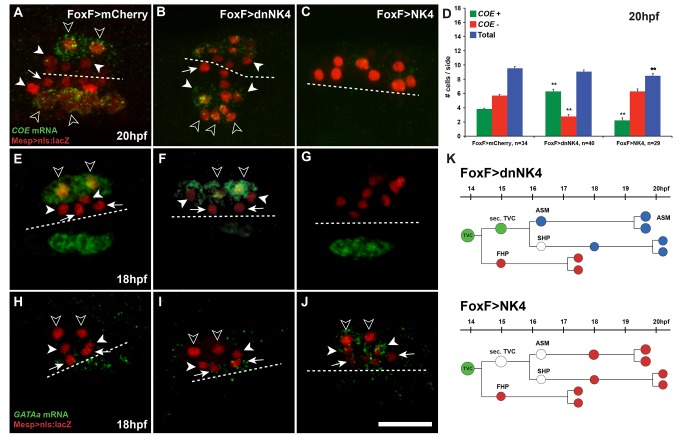
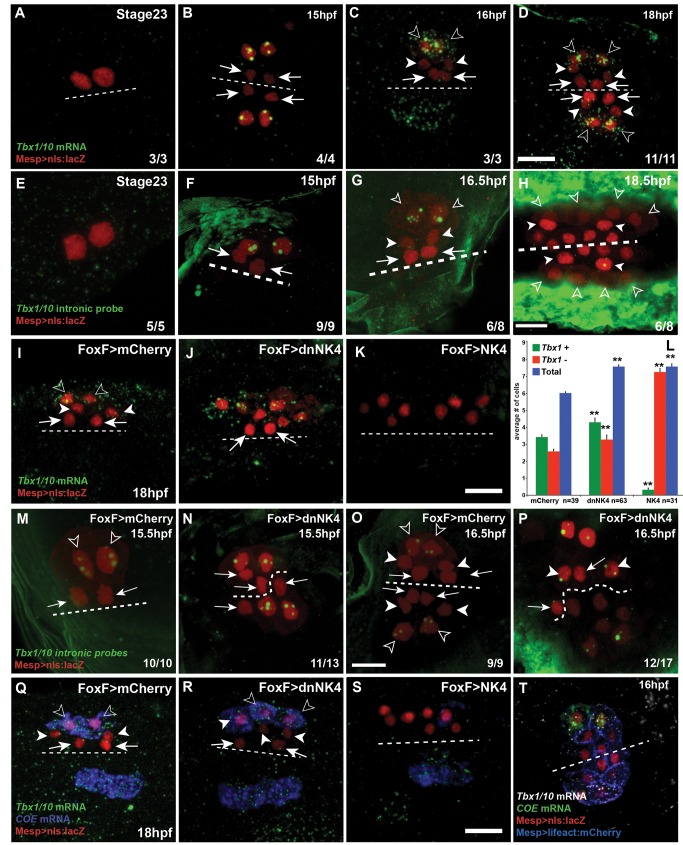
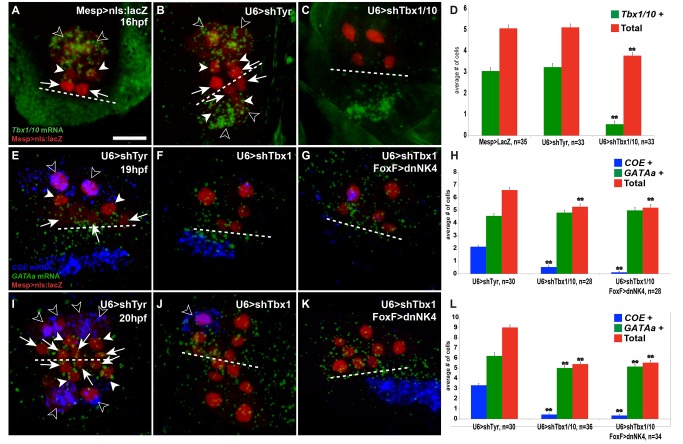
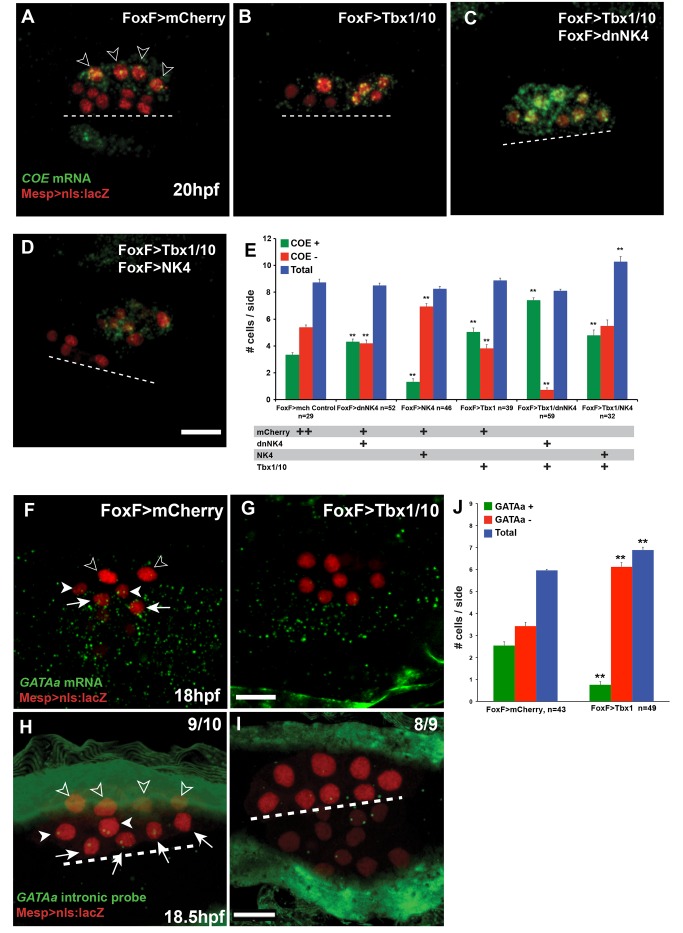
The heart and head muscles share common developmental origins and genetic underpinnings in vertebrates, including humans. Parts of the heart and cranio-facial musculature derive from common mesodermal progenitors that express NKX2-5, ISL1, and TBX1. This ontogenetic kinship is dramatically reflected in the DiGeorge/Cardio-Velo-Facial syndrome (DGS/CVFS), where mutations of TBX1 cause malformations in the pharyngeal apparatus and cardiac outflow tract. Cardiac progenitors of the first heart field (FHF) do not require TBX1 and segregate precociously from common progenitors of the second heart field (SHF) and pharyngeal muscles. However, the cellular and molecular mechanisms that govern heart versus pharyngeal muscle specification within this lineage remain elusive. Here, we harness the simplicity of the ascidian larva to show that, following asymmetric cell division of common progenitors, NK4/NKX2-5 promotes GATAa/GATA4/5/6 expression and cardiac specification in the second heart precursors by antagonizing Tbx1/10-mediated inhibition of GATAa and activation of Collier/Olf/EBF (COE), the determinant of atrial siphon muscle (ASM) specification. Our results uncover essential regulatory connections between the conserved cardio-pharyngeal factor Tbx1/10 and muscle determinant COE, as well as a mutual antagonism between NK4 and Tbx1/10 activities upstream of GATAa and COE. The latter cross-antagonism underlies a fundamental heart versus pharyngeal muscle fate choice that occurs in a conserved lineage of cardio-pharyngeal progenitors. We propose that this basic ontogenetic motif underlies cardiac and pharyngeal muscle development and evolution in chordates.
Conflict of interest statement
The authors have declared that no competing interests exist.
Figures

References
-
- Jerome LA, Papaioannou VE (2001) DiGeorge syndrome phenotype in mice mutant for the T-box gene, Tbx1. Nat Genet 27: 286–291. - PubMed
-
- Merscher S, Funke B, Epstein JA, Heyer J, Puech A, et al. (2001) TBX1 is responsible for cardiovascular defects in velo-cardio-facial/DiGeorge syndrome. Cell 104: 619–629. - PubMed
-
- Kelly RG, Jerome-Majewska LA, Papaioannou VE (2004) The del22q11.2 candidate gene Tbx1 regulates branchiomeric myogenesis. Hum Mol Genet 13: 2829–2840. - PubMed
-
- Lindsay EA, Vitelli F, Su H, Morishima M, Huynh T, et al. (2001) Tbx1 haploinsufficieny in the DiGeorge syndrome region causes aortic arch defects in mice. Nature 410: 97–101. - PubMed
Publication types
MeSH terms
Substances
Grants and funding
LinkOut - more resources
Full Text Sources
Other Literature Sources