. 2013 Nov 4:4:136.
doi: 10.3389/fphar.2013.00136. eCollection 2013.

P-glycoprotein mediated efflux limits substrate and drug uptake in a preclinical brain metastases of breast cancer model

Affiliations

P-glycoprotein mediated efflux limits substrate and drug uptake in a preclinical brain metastases of breast cancer model

Chris E Adkins et al. Front Pharmacol. .

Abstract

The blood-brain barrier (BBB) is a specialized vascular interface that restricts the entry of many compounds into brain. This is accomplished through the sealing of vascular endothelial cells together with tight junction proteins to prevent paracellular diffusion. In addition, the BBB has a high degree of expression of numerous efflux transporters which actively extrude compounds back into blood. However, when a metastatic lesion develops in brain the vasculature is typically compromised with increases in passive permeability (blood-tumor barrier; BTB). What is not well documented is to what degree active efflux retains function at the BTB despite the changes observed in passive permeability. In addition, there have been previous reports documenting both increased and decreased expression of P-glycoprotein (P-gp) in lesion vasculature. Herein, we simultaneously administer a passive diffusion marker ((14)C-AIB) and a tracer subject to P-gp efflux (rhodamine 123) into a murine preclinical model of brain metastases of breast cancer. We observed that the metastatic lesions had similar expression (p > 0.05; n = 756-1214 vessels evaluated) at the BBB and the BTB. Moreover, tissue distribution of R123 was not significantly (p > 0.05) different between normal brain and the metastatic lesion. It is possible that the similar expression of P-gp on the BBB and the BTB contribute to this phenomenon. Additionally we observed P-gp expression at the metastatic cancer cells adjacent to the vasculature which may also contribute to reduced R123 uptake into the lesion. The data suggest that despite the disrupted integrity of the BTB, efflux mechanisms appear to be intact, and may be functionally comparable to the normal BBB. The BTB is a significant hurdle to delivering drugs to brain metastasis.

Keywords: autoradiography; chemotherapy; drug resistance; fluorescence microscopy; tumor.


Figures
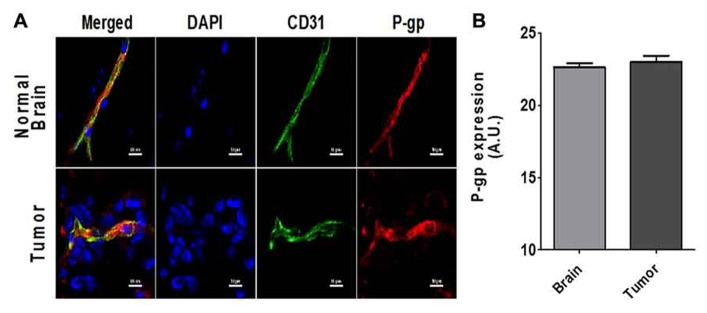
FIGURE 1
FIGURE 1
(A) Representative images of the co-localized expression of P-gp (red) in a capillary in normal brain (top row) and a blood vessel in a 231Br brain metastasis (bottom row) are shown. Endothelial nuclei as well as the nuclei of the 231Br lesions are shown in blue (DAPI). Blood vessels (CD-31 expression) in both sections are shown in green (Alexa Fluor 488). P-gp expression is shown in red (Alexa Fluor 594). (B) The bar graph shows the relative P-gp expression per vessel as defined by CD31 stained regions. Mean + SEM; BTB; n = 756 vessels and BBB n = 1214 vessels).
FIGURE 2
FIGURE 2
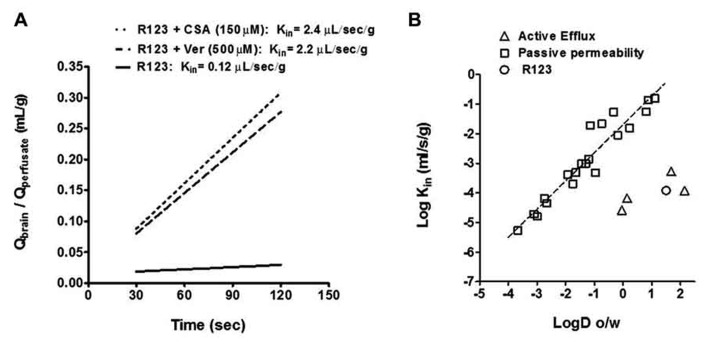
(A) The Kin of R123 in the presence of the known P-gp inhibitors, cyclosporin A and verapamil, increases brain distribution (as reported by the Kin) by >10-fold. All data represent mean ± S.E.M for total brain; n = 3–5 for all groups. Statistics: one-way ANOVA; Dunnett’s. (B) The relationship between LogD (octanol/water coefficient; pH = 7.4) and observed Kin is used to profile a molecule or drug’s mechanism of distribution into brain. Compounds that are known to cross the BBB via passive diffusion are plotted using gray squares and those subject to efflux are plotted with gray triangles. R123 (open circle) falls below ~3 log units the line of identity for passive permeability indicating it may be subject to efflux.
FIGURE 3
FIGURE 3
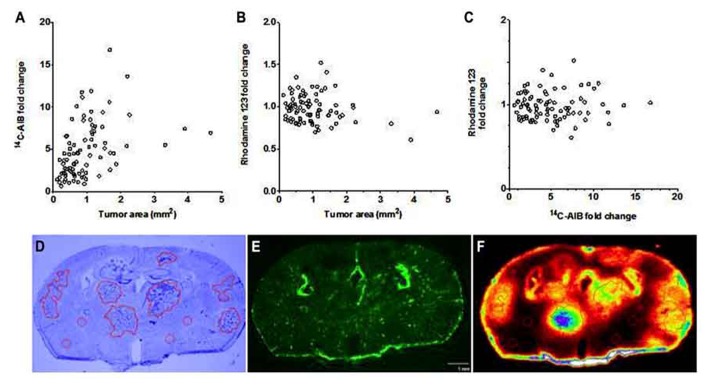
The BTB is variably compromised for compounds entering via passive diffusion but retains P-gp mediated efflux. The passive permeability marker 14C-AIB fold change in brain metastases did not correlate (r2 = 0.167) with metastasis size (mm2) (A). R123 fold change in brain metastases did not correlate (r2 = 0.033) with metastasis size (B). There was no observed relationship (r2 = 0.0009) between the fold increase in brain metastases of 14C-AIB (passive permeability marker) and R123 (P-gp substrate) (C). One representative brain slice showing metastases location (D, cresyl violet), R123 fluorescence distribution (E, fluorescence microscopy), and 14C-AIB brain uptake (F, quantitative autoradiography).
FIGURE 4
FIGURE 4
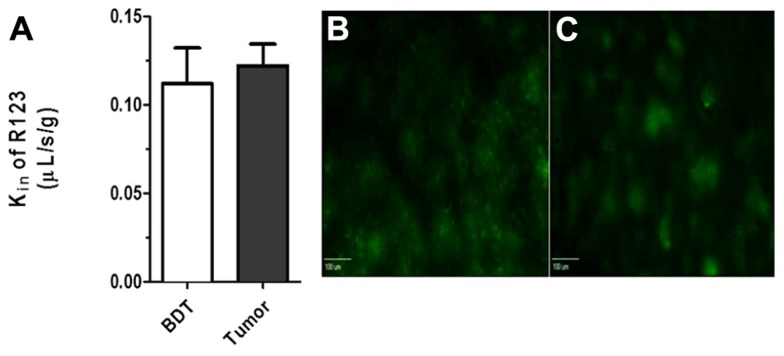
(A) No difference (p > 0. 05; student t-test, n = 3–5) was seen between R123 blood to brain transfer constant Kin between values measured in normal brain (Kin = 0.11 + 0.01 μL/s/g) and metastases (Kin = 0.12 ± 0.02 μL/s/g). Representative R123 fluorescence images in normal brain (B) and within a metastasis (C) (scale bar = 100 μm).

References

    1. Abbott N. J., Patabendige A. A., Dolman D. E., Yusof S. R., Begley D. J. (2010). Structure and function of the blood-brain barrier. Neurobiol. Dis. 37 13–25 10.1016/j.nbd.2009.07.030 - DOI - PubMed
    1. Agarwal S., Hartz A. M., Elmquist W. F., Bauer B. (2011). Breast cancer resistance protein and P-glycoprotein in brain cancer: two gatekeepers team up. Curr. Pharm. Des. 17 2793–2802 10.2174/138161211797440186 - DOI - PMC - PubMed
    1. Agarwal S., Manchanda P., Vogelbaum M. A., Ohlfest J. R., Elmquist W. F. (2013). Function of the blood-brain barrier and restriction of drug delivery to invasive glioma cells: findings in an orthotopic rat xenograft model of glioma. Drug Metab. Dispos. 41 33–39 10.1124/dmd.112.048322 - DOI - PMC - PubMed
    1. Baumert C., Hilgeroth A. (2009). Recent advances in the development of P-gp inhibitors. Anticancer Agents Med. Chem. 9 415–436 10.2174/1871520610909040415 - DOI - PubMed
    1. Begley D. J. (1996). The blood-brain barrier: principles for targeting peptides and drugs to the central nervous system. J. Pharm. Pharmacol. 48 136–146 10.1111/j.2042-7158.1996.tb07112.x - DOI - PubMed

LinkOut - more resources