


Knee adduction moment and medial contact force--facts about their correlation during gait
- PMID: 24312522
- PMCID: PMC3847086
- DOI: 10.1371/journal.pone.0081036
Knee adduction moment and medial contact force--facts about their correlation during gait
Abstract
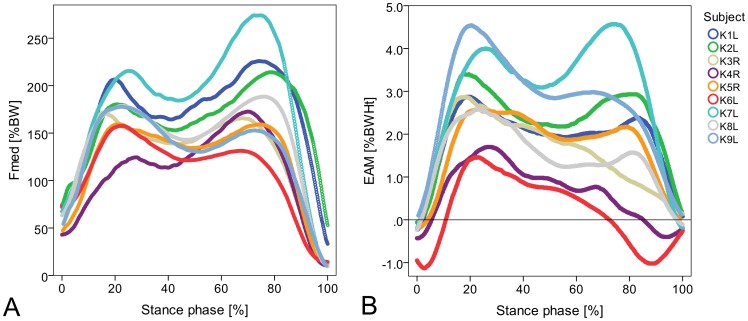
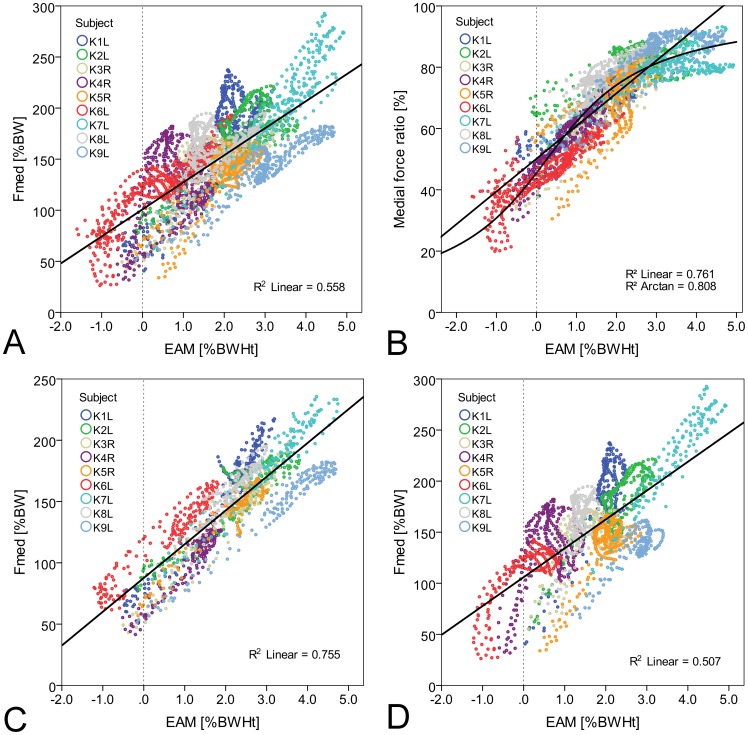
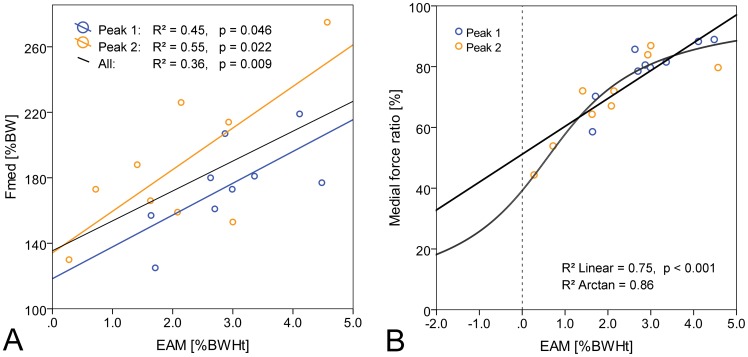
The external knee adduction moment is considered a surrogate measure for the medial tibiofemoral contact force and is commonly used to quantify the load reducing effect of orthopedic interventions. However, only limited and controversial data exist about the correlation between adduction moment and medial force. The objective of this study was to examine whether the adduction moment is indeed a strong predictor for the medial force by determining their correlation during gait. Instrumented knee implants with telemetric data transmission were used to measure tibiofemoral contact forces in nine subjects. Gait analyses were performed simultaneously to the joint load measurements. Skeletal kinematics, as well as the ground reaction forces and inertial parameters, were used as inputs in an inverse dynamics approach to calculate the external knee adduction moment. Linear regression analysis was used to analyze the correlation between adduction moment and medial force for the whole stance phase and separately for the early and late stance phase. Whereas only moderate correlations between adduction moment and medial force were observed throughout the whole stance phase (R(2) = 0.56) and during the late stance phase (R(2) = 0.51), a high correlation was observed at the early stance phase (R(2) = 0.76). Furthermore, the adduction moment was highly correlated to the medial force ratio throughout the whole stance phase (R(2) = 0.75). These results suggest that the adduction moment is a surrogate measure, well-suited to predicting the medial force ratio throughout the whole stance phase or medial force during the early stance phase. However, particularly during the late stance phase, moderate correlations and high inter-individual variations revealed that the predictive value of the adduction moment is limited. Further analyses are necessary to examine whether a combination of other kinematic, kinetic or neuromuscular factors may lead to a more reliable prediction of the force magnitude.
Conflict of interest statement
Figures
References
-
- Andriacchi TP, Mündermann A, Smith RL, Alexander EJ, Dyrby CO, et al. (2004) A Framework for the in Vivo Pathomechanics of Osteoarthritis at the Knee. Annals of Biomedical Engineering 32: 447–457. - PubMed
-
- Jackson B, Wluka A, Teichtahl A, Morris M, Cicuttini F (2004) Reviewing knee osteoarthritis - a biomechanical perspective. Journal of Science and Medicine in Sport 7: 347–357. - PubMed
-
- Schipplein OD, Andriacchi TP (1991) Interaction between active and passive knee stabilizers during level walking. Journal of Orthopaedic Research 9: 113–119. - PubMed
-
- Hurwitz DE, Ryals AB, Case JP, Block JA, Andriacchi TP (2002) The knee adduction moment during gait in subjects with knee osteoarthritis is more closely correlated with static alignment than radiographic disease severity, toe out angle and pain. Journal of Orthopaedic Research 20: 101–107. - PubMed
Publication types
MeSH terms
LinkOut - more resources
Full Text Sources
Other Literature Sources
