Review
doi: 10.35946/arcr.v35.1.10.
Circadian disruption: potential implications in inflammatory and metabolic diseases associated with alcohol
Affiliations
- PMID: 24313168
- PMCID: PMC3860420
- DOI: 10.35946/arcr.v35.1.10
Item in Clipboard
Review
Circadian disruption: potential implications in inflammatory and metabolic diseases associated with alcohol
Alcohol Res.
2013.
Abstract
Circadian rhythms are a prominent and critical feature of cells, tissues, organs, and behavior that help an organism function most efficiently and anticipate things such as food availability. Therefore, it is not surprising that disrupted circadian rhythmicity, a prominent feature of modern-day society, promotes the development and/or progression of a wide variety of diseases, including inflammatory, metabolic, and alcohol-associated disorders. This article will discuss the influence of interplay between alcohol consumption and circadian rhythmicity and how circadian rhythm disruption affects immune function and metabolism as well as potential epigenetic mechanisms that may be contributing to this phenomenon.
Figures
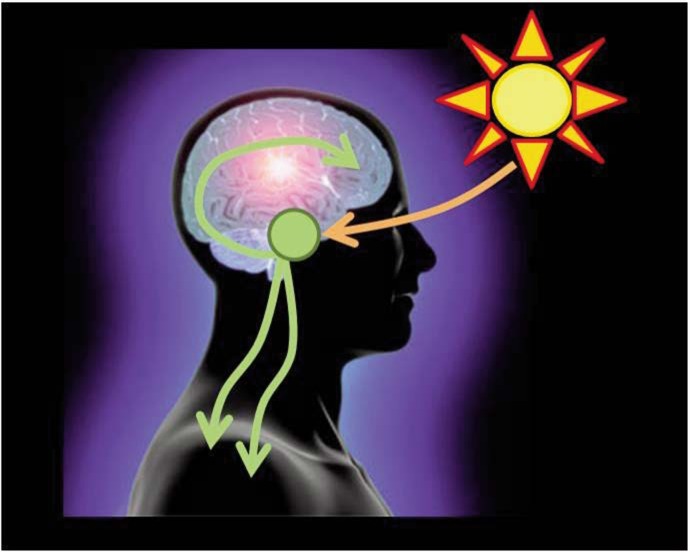
The suprachiasmatic nucleus (SCN) is the central circadian pacemaker. The SCN is located in the hypothalamus and is regulated by light signals from the eye. The SCN then affects a wide variety of physiological and behavioral outcomes.
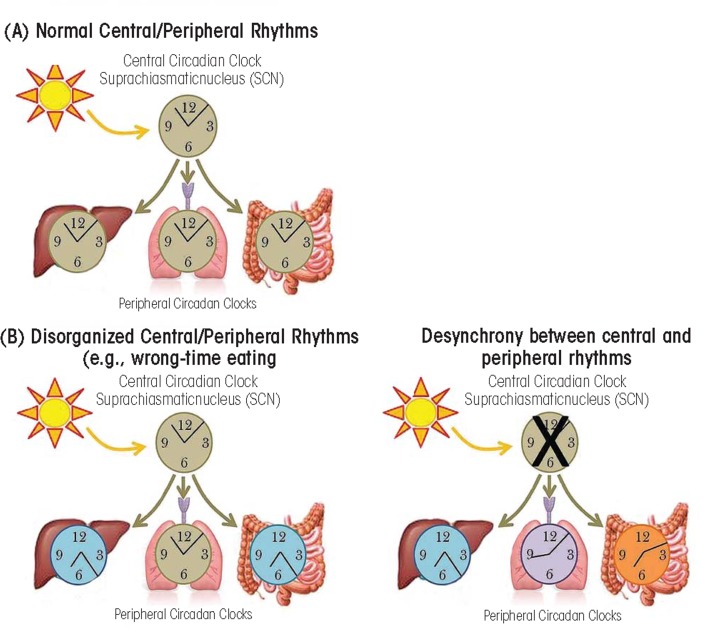
Central and peripheral circadian rhythms. (A) Under normal conditions, the central circadian clock in the suprachiasmatic nucleus which is entrained by light, then regulates peripheral circadian clocks. (B) Wrong-time eating can cause misalignment between the central circadian clock (entrained by light) and the peripheral circadian clocks entrained by food (illustrated here are intestine and liver). (C) When the central circadian clock is disrupted (e.g., due to lesion) peripheral circadian clocks will continue to cycle but will gradually become more misaligned with each other.
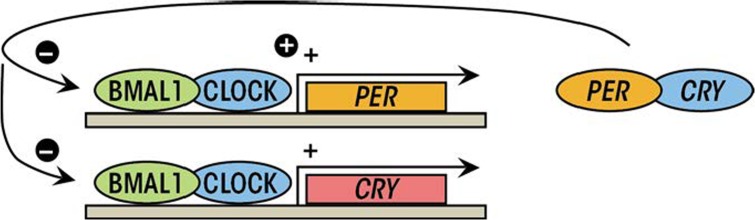
The molecular circadian clock. Transcription of the clock-controlled genes, including Per and Cry is initiated by the heterodimerization and binding of BMAL1 and CLOCK (the positive limb of the molecular circadian clock). Once sufficient amounts of PER and CRY have been produced, they dimerize and inhibit further BMAL1/CLOCK-mediated transcription (the negative limb of the molecular circadian clock).
References
-
- Allaman-Pillet N, Roduit R, Oberson A, et al. Circadian regulation of islet genes involved in insulin production and secretion. Molecular and Cellular Endocrinology. 2004;226:59–66. - PubMed
-
- Ando H, Ushijima K, Kumazaki M, et al. Associations of metabolic parameters and ethanol consumption with messenger RNA expression of clock genes in healthy men. Chronobiology International. 2010;27:194–203. - PubMed
-
- Andreasen AS, Krabbe KS, Krogh-Madsen R, et al. Human endotoxemia as a model of systemic inflammation. Current Medicinal Chemistry. 2008;15:1697–1705. - PubMed