. 2013 Dec 8:14:861.
doi: 10.1186/1471-2164-14-861.

The role of Dichaete in transcriptional regulation during Drosophila embryonic development

Affiliations

The role of Dichaete in transcriptional regulation during Drosophila embryonic development

Jelena Aleksic et al. BMC Genomics. .

Abstract

Background: Group B Sox domain transcription factors play conserved roles in the specification and development of the nervous system in higher metazoans. However, we know comparatively little about how these transcription factors regulate gene expression, and the analysis of Sox gene function in vertebrates is confounded by functional compensation between three closely related family members. In Drosophila, only two group B Sox genes, Dichaete and SoxN, have been shown to function during embryonic CNS development, providing a simpler system for understanding the functions of this important class of regulators.

Results: Using a combination of transcriptional profiling and genome-wide binding analysis we conservatively identify over 1000 high confidence direct Dichaete target genes in the Drosophila genome. We show that Dichaete plays key roles in CNS development, regulating aspects of the temporal transcription factor sequence that confer neuroblast identity. Dichaete also shows a complex interaction with Prospero in the pathway controlling the switch from stem cell self-renewal to neural differentiation. Dichaete potentially regulates many more genes in the Drosophila genome and was found to be associated with over 2000 mapped regulatory elements.

Conclusions: Our analysis suggests that Dichaete acts as a transcriptional hub, controlling multiple regulatory pathways during CNS development. These include a set of core CNS expressed genes that are also bound by the related Sox2 gene during mammalian CNS development. Furthermore, we identify Dichaete as one of the transcription factors involved in the neural stem cell transcriptional network, with evidence supporting the view that Dichaete is involved in controlling the temporal series of divisions regulating neuroblast identity.


Figures
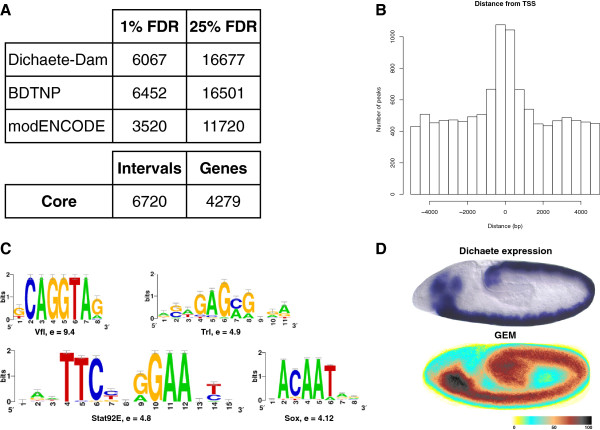
Figure 1
Figure 1
Dichaete binding overview. A) Number of binding intervals identified at different false discovery rates in the Dichaete DamID (stage 5–11), Berkeley (BDTNP; stage 4–5) and modENCODE (Stage 0–11; modENCODE_2571) datasets. The number of binding intervals and associated genes defined in the Dichaete core binding set. B) The distance of Dichaete peaks from transcription start sites, showing binding preference to the region within +/− 500 bp of a TSS. C) Top 4 enriched binding motifs in the Dichaete core intervals identified by i-CisTarget, including their e-scores. D) Top: lateral view of Dichaete in situ hybridisation in a stage 10 embryo. Bottom: Genome-wide Expression Map generated from the FlyExpress database from the Dichaete bound and regulated gene set.
Figure 2
Figure 2
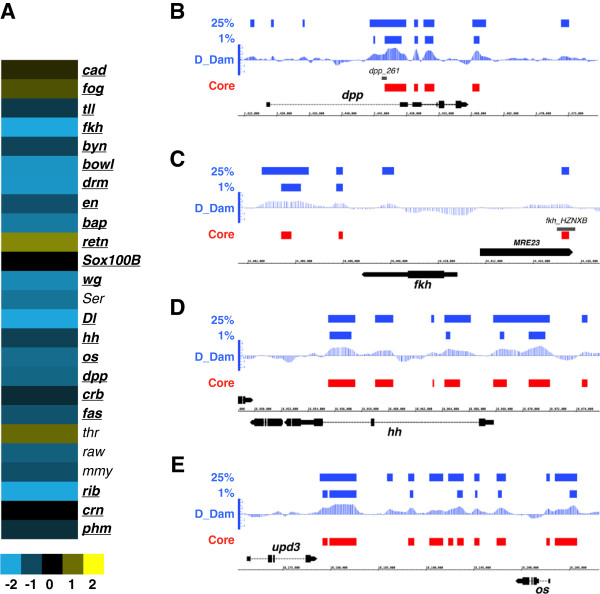
Dichaete in the hindgut. A) Expression levels of hindgut expressed genes in Dichaete mutants with genes ordered according to their position in the regulatory hierarchy. Scale bar represents log2 expression ratio. B – E) Dichaete binding profiles at indicated hindgut genes. Upper two blue plots represent 25% and 1% FDR DamID binding intervals; D_Dam represents the normalised window score of the triplicated DamID experiment; Core (red) represents the regions defined as core binding intervals overlapping DamID and ChIP data. The black regions represent gene models and the genome coordinates. The named grey bars in B and C represent mapped regulatory regions.
Figure 3
Figure 3
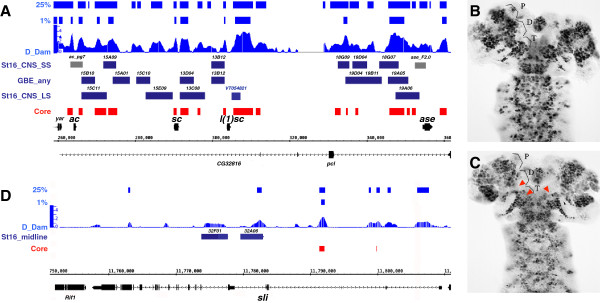
Dichaete at known target genes. A) Achaete-scute Complex: Dichaete Dam ID binding profiles with 1% and 25% FDR intervals. Dark blue tracks represent FlyLight Enhancers with expression categorised as; small subset of the CNS at stage 16 (st16_CNS_SS), any CNS in germ band extended embryos (GBE) and large subset of the CNS at stage 16 (St16_CNS_LS). Grey bars represent other mapped enhancer elements. Core (red) represents the regions defined as core binding intervals overlapping DamID and ChIP data. The black regions represent gene models and the genome coordinates. B and C) antibody staining revealing l(1)sc expression in wild type (B) and Dr8/Df(3 L)GS1-a(C) stage 16 embryos. P, D and T refer to the protocerebrum, deutocerebrum and tritocerebrum. Red arrowheads indicate loss of l(1)sc expression in the duetocerebrum and tritocerebrum. D)slit tracks as above with FlyLight enhancers identified as expressed in the midline at stage 16.
Figure 4
Figure 4
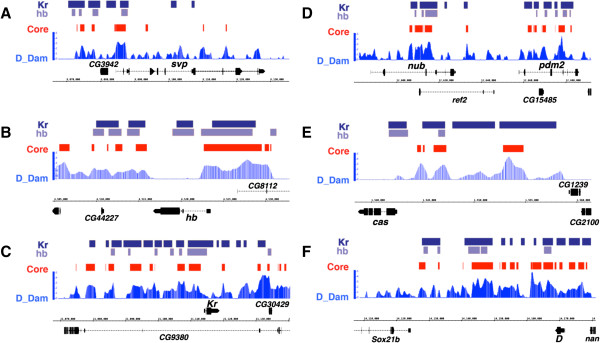
Temporal neuroblast cascade. A-F) Dichaete DamID profiles (blue) and core binding intervals (red) along with the 1% FDR binding intervals for Kr (dark blue) and Hb (light blue) from the BDTNP at the 5 genes of the temporal neuroblast cascade and the Dichaete region.
Figure 5
Figure 5
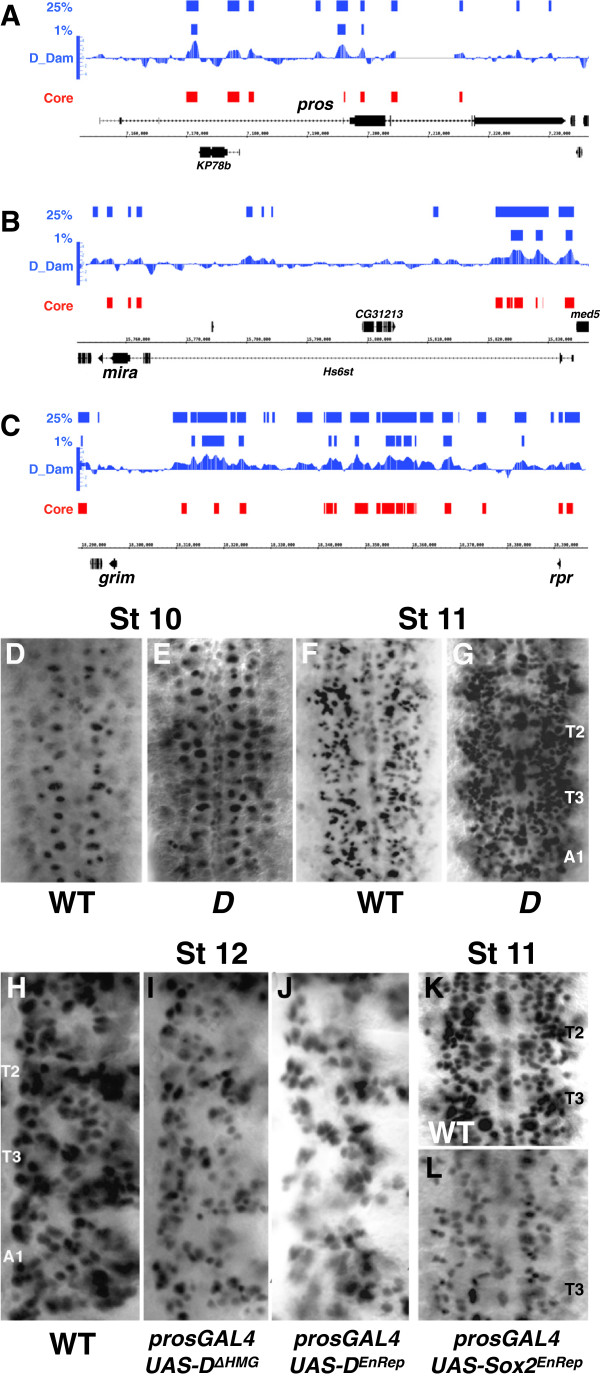
Dichaete and neuroblast segregation. A-C) Dichaete binding profiles at pros, mira and grim-rpr. Upper two blue plots represent 25% and 1% FDR DamID binding intervals; D_Dam represents the normalised window score of the triplicated DamID experiment; Core (red) represents the regions defined as core binding intervals overlapping DamID and ChIP data. The black regions represent gene models and the genome coordinates. D-G) anti-Prospero staining in Dichaete mutant embryos, all ventral view with anterior to the top. D) wild type stage 10. E)Dr72/Df(3 L)Gs1-a stage 10. F) wild type stage 11. G)Dr72/Df(3 L)Gs1-a stage 11. H-J) Anti-Prospero staining in embryos expressing dominant negative Dichaete constructs, images show the right half of two thoracic and 1 abdominal segment (T2, T3, A1). H) wild type, stage 12. I)prosGAL4, UAS-DΔHMG stage 12. J)prosGAL4, UAS-DEnRep stage 12. K and L) Anti-Pros staining in embryos expressing dominant negative mouse Sox2, ventral views of 2 abdominal segments from late stage 11 embryos. K) wild type. L)prosGAL4, UAS-mouseSox2EnRep.
Figure 6
Figure 6
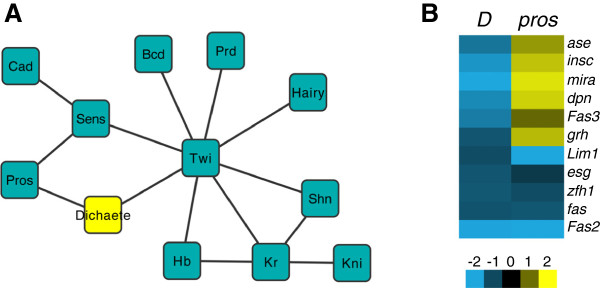
Dichaete Interactions. A) Significant binding interval overlaps between pairs of transcription factors generated with Coocur. B) Gene expression heatmaps for selected neural genes targets in Dichaete and pros mutants.
Figure 7
Figure 7
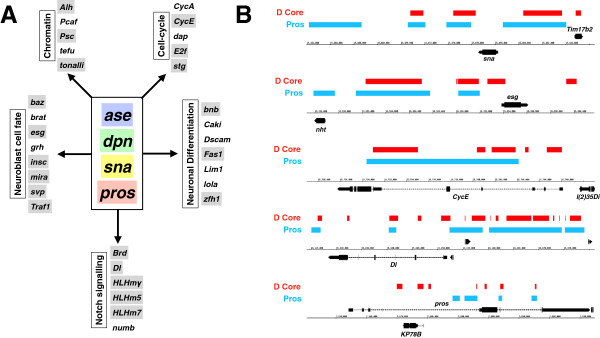
Dichaete in the neuroblast regulatory network. A) Representation of the transcriptional regulatory network from [60] is shown. Dichaete target genes (binding and expression change) overlapping with Prospero binding are shaded (coloured for the core genes and grey for downstream functions). B) Dichaete and Prospero binding at different genes in the transcriptional regulatory network. Dichaete core intervals are shown in red and pros-DamID intervals in blue.

References

    1. Wegner M, Stolt C. From stem cells to neurons and glia: a Soxist's view of neural development. Trends Neurosci. 2005;28:583–588. doi: 10.1016/j.tins.2005.08.008. - DOI - PubMed
    1. Avilion AA, Nicolis SK, Pevny LH, Perez L, Vivian N, Lovell-Badge R. Multipotent cell lineages in early mouse development depend on SOX2 function. Genes Dev. 2003;17:126–140. doi: 10.1101/gad.224503. - DOI - PMC - PubMed
    1. Bylund M, Andersson E, Novitch BG, Muhr J. Vertebrate neurogenesis is counteracted by Sox1–3 activity. Nat Neurosci. 2003;6:1162–1168. doi: 10.1038/nn1131. - DOI - PubMed
    1. Collignon J, Sockanathan S, Hacker A, Cohen-Tannoudji M, Norris D, Rastan S, Stevanovic M, Goodfellow P, Lovell-Badge R. A comparison of the properties of SOX3 with SRY and two related genes SOX1 and SOX2. Development. 1996;122:509–520. - PubMed
    1. Pevny LH, Nicolis SK. Sox2 roles in neural stem cells. Int J Biochem Cell Biol. 2010;42:421–424. doi: 10.1016/j.biocel.2009.08.018. - DOI - PubMed

Publication types

MeSH terms

LinkOut - more resources