


DSM-5 cannabis use disorder: a phenotypic and genomic perspective
- PMID: 24315570
- PMCID: PMC3943464
- DOI: 10.1016/j.drugalcdep.2013.11.008
DSM-5 cannabis use disorder: a phenotypic and genomic perspective
Abstract
Background: We explore the factor structure of DSM-5 cannabis use disorders, examine its prevalence across European- and African-American respondents as well as its genetic underpinnings, utilizing data from a genome-wide study of single nucleotide polymorphisms (SNPs). We also estimate the heritability of DSM-5 cannabis use disorders explained by these common SNPs.
Methods: Data on 3053 subjects reporting a lifetime history of cannabis use were utilized. Exploratory and confirmatory factor analyses were conducted to create a factor score, which was used in a genome-wide association analysis. p-values from the single SNP analysis were examined for evidence of gene-based association. The aggregate effect of all SNPs was also estimated using Genome-Wide Complex Traits Analysis.
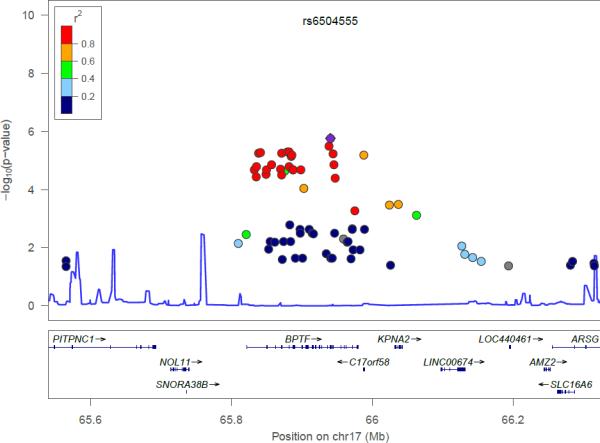
Results: The unidimensionality of DSM-5 cannabis use disorder criteria was demonstrated. Comparing DSM-IV to DSM-5, a decrease in prevalence of cannabis use disorders was only noted in European-American respondents and was exceedingly modest. For the DSM-5 cannabis use disorders factor score, no SNP surpassed the genome-wide significance testing threshold. However, in the European-American subsample, gene-based association testing resulted in significant associations in 3 genes (C17orf58, BPTF and PPM1D) on chromosome 17q24. In aggregate, 21% of the variance in DSM-5 cannabis use disorders was explained by the genome-wide SNPs; however, this estimate was not statistically significant.
Conclusions: DSM-5 cannabis use disorder represents a unidimensional construct, the prevalence of which is only modestly elevated above the DSM-IV version. Considerably larger sample sizes will be required to identify individual SNPs associated with cannabis use disorders and unequivocally establish its polygenic underpinnings.
Keywords: Association; Cannabis; DSM-5; GWAS; Genetics; Heritability.
Copyright © 2013 Elsevier Ireland Ltd. All rights reserved.
Figures
References
-
- Agrawal A, Lynskey MT, Hinrichs A, Grucza R, Saccone SF, Krueger R, Neuman R, Howells W, Fisher S, Fox L, Cloninger R, Dick DM, Doheny KF, Edenberg HJ, Goate AM, Hesselbrock V, Johnson E, Kramer J, Kuperman S, Nurnberger JI, Jr., Pugh E, Schuckit M, Tischfield J, Rice JP, Bucholz KK, Bierut LJ. A genome-wide association study of DSM-IV cannabis dependence. Addict. Biol. 2011b;16:514–518. - PMC - PubMed
-
- Agrawal A, Pergadia ML, Lynskey MT. Is there evidence for symptoms of cannabis withdrawal in the national epidemiologic survey of alcohol and related conditions? Am. J. Addict. 2008;17:199–208. - PubMed
Publication types
MeSH terms
Grants and funding
- U01HG004438/HG/NHGRI NIH HHS/United States
- U01 HG004446/HG/NHGRI NIH HHS/United States
- R01 DA023668/DA/NIDA NIH HHS/United States
- P01 CA089392/CA/NCI NIH HHS/United States
- UL1 TR001108/TR/NCATS NIH HHS/United States
- K08 DA032680/DA/NIDA NIH HHS/United States
- K02DA032573/DA/NIDA NIH HHS/United States
- HHSN268200782096C/HG/NHGRI NIH HHS/United States
- U01 HG004422/HG/NHGRI NIH HHS/United States
- K02 AA018755/AA/NIAAA NIH HHS/United States
- UL1 TR000448/TR/NCATS NIH HHS/United States
- U10 AA008401/AA/NIAAA NIH HHS/United States
- R01DA23668/DA/NIDA NIH HHS/United States
- K02 DA032573/DA/NIDA NIH HHS/United States
- U01 HG004438/HG/NHGRI NIH HHS/United States
- R01 DA019963/DA/NIDA NIH HHS/United States
- R01 DA013423/DA/NIDA NIH HHS/United States
LinkOut - more resources
Full Text Sources
Other Literature Sources
Medical
