


Pulmonary symptoms measured by the national institutes of health lung score predict overall survival, nonrelapse mortality, and patient-reported outcomes in chronic graft-versus-host disease
- PMID: 24315845
- PMCID: PMC3973401
- DOI: 10.1016/j.bbmt.2013.11.025
Pulmonary symptoms measured by the national institutes of health lung score predict overall survival, nonrelapse mortality, and patient-reported outcomes in chronic graft-versus-host disease
Abstract
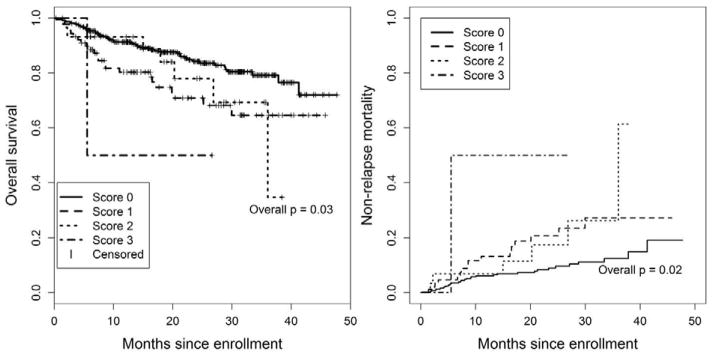
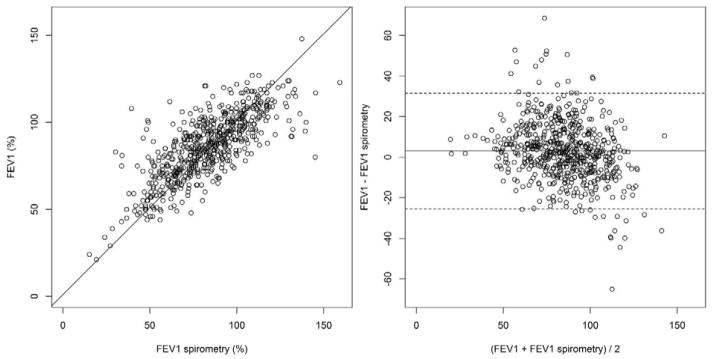
The 2005 National Institutes of Health (NIH) Consensus Conference recommended assessment of lung function in patients with chronic graft-versus-host disease (GVHD) by both pulmonary function tests (PFTs) and assessment of pulmonary symptoms. We tested whether pulmonary measures were associated with nonrelapse mortality (NRM), overall survival (OS), and patient-reported outcomes (PRO). Clinician and patient-reported data were collected serially in a prospective, multicenter, observational study. Available PFT data were abstracted. Cox regression models were fit for outcomes using a time-varying covariate model for lung function measures and adjusting for patient and transplantation characteristics and nonlung chronic GVHD severity. A total of 1591 visits (496 patients) were used in this analysis. The NIH symptom-based lung score was associated with NRM (P = .02), OS (P = .02), patient-reported symptoms (P < .001) and functional status (P < .001). Worsening of NIH symptom-based lung score over time was associated with higher NRM and lower survival. All other measures were not associated with OS or NRM; although, some were associated with patient-reported lung symptoms. In conclusion, the NIH symptom-based lung symptom score of 0 to 3 is associated with NRM, OS, and PRO measures in patients with chronic GVHD. Worsening of the NIH symptom-based lung score was associated with increased mortality.
Keywords: Bronchiolitis obliterans syndrome; Chronic graft-versus-host disease.
Copyright © 2014 American Society for Blood and Marrow Transplantation. All rights reserved.
Conflict of interest statement
The authors declare no competing financial interests related to this study.
Figures
Comment in
-
A "window of opportunity" for patients with late-onset pulmonary dysfunction after allogeneic hematopoietic cell transplantation.Biol Blood Marrow Transplant. 2014 Mar;20(3):291-2. doi: 10.1016/j.bbmt.2014.01.008. Epub 2014 Jan 25. Biol Blood Marrow Transplant. 2014. PMID: 24472717 Free PMC article. No abstract available.
References
-
- Chien JW, Martin PJ, Flowers ME, Nichols WG, Clark JG. Implications of early airflow decline after myeloablative allogeneic stem cell transplantation. Bone Marrow Transplantation. 2004;33:759–764. - PubMed
-
- Gore EM, Lawton CA, Ash RC, Lipchik RJ. Pulmonary function changes in long-term survivors of bone marrow transplantation. International Journal of Radiation Oncology*Biology*Physics. 1996;36:67–75. - PubMed
-
- Marras TK, Chan CK, Lipton JH, Messner HA, Szalai JP, Laupacis A. Long-term pulmonary function abnormalities and survival after allogeneic marrow transplantation. Bone Marrow Transplant. 2004;33:509–517. - PubMed
-
- Ralph DD, Springmeyer SC, Sullivan KM, Hackman RC, Storb R, Thomas ED. Rapidly progressive air-flow obstruction in marrow transplant recipients. Possible association between obliterative bronchiolitis and chronic graft-versus-host disease. Am Rev Respir Dis. 1984;129:641–644. - PubMed
-
- Sakaida E, Nakaseko C, Harima A, et al. Late-onset noninfectious pulmonary complications after allogeneic stem cell transplantation are significantly associated with chronic graft-versus-host disease and with the graft-versus-leukemia effect. Blood. 2003;102:4236–4242. - PubMed
Publication types
MeSH terms
Grants and funding
LinkOut - more resources
Full Text Sources
Other Literature Sources
