Corrosion of iron by sulfate-reducing bacteria: new views of an old problem
- PMID: 24317078
- PMCID: PMC3911074
- DOI: 10.1128/AEM.02848-13
Corrosion of iron by sulfate-reducing bacteria: new views of an old problem
Abstract
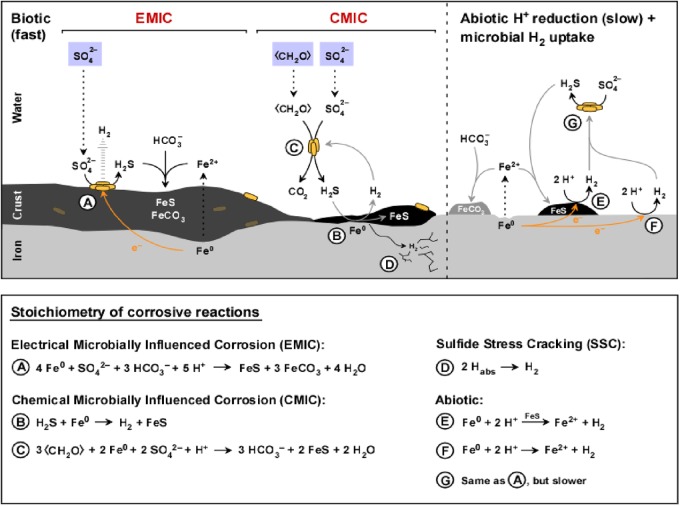
About a century ago, researchers first recognized a connection between the activity of environmental microorganisms and cases of anaerobic iron corrosion. Since then, such microbially influenced corrosion (MIC) has gained prominence and its technical and economic implications are now widely recognized. Under anoxic conditions (e.g., in oil and gas pipelines), sulfate-reducing bacteria (SRB) are commonly considered the main culprits of MIC. This perception largely stems from three recurrent observations. First, anoxic sulfate-rich environments (e.g., anoxic seawater) are particularly corrosive. Second, SRB and their characteristic corrosion product iron sulfide are ubiquitously associated with anaerobic corrosion damage, and third, no other physiological group produces comparably severe corrosion damage in laboratory-grown pure cultures. However, there remain many open questions as to the underlying mechanisms and their relative contributions to corrosion. On the one hand, SRB damage iron constructions indirectly through a corrosive chemical agent, hydrogen sulfide, formed by the organisms as a dissimilatory product from sulfate reduction with organic compounds or hydrogen ("chemical microbially influenced corrosion"; CMIC). On the other hand, certain SRB can also attack iron via withdrawal of electrons ("electrical microbially influenced corrosion"; EMIC), viz., directly by metabolic coupling. Corrosion of iron by SRB is typically associated with the formation of iron sulfides (FeS) which, paradoxically, may reduce corrosion in some cases while they increase it in others. This brief review traces the historical twists in the perception of SRB-induced corrosion, considering the presently most plausible explanations as well as possible early misconceptions in the understanding of severe corrosion in anoxic, sulfate-rich environments.
Figures
References
-
- U.S. Geological Survey 2011. Mineral commodity summaries 2011. U.S. Geological Survey, Washington, DC: http://minerals.usgs.gov/minerals/pubs/mcs/2011/mcs2011.pdf
-
- Koch GH, Brongers MPH, Thompson NG, Virmani YP, Payer JH. 2001. Corrosion cost and preventive strategies in the United States. FHWA-RD-01-156. CC Technologies Laboratories, NACE International, Dublin, OH
-
- Kruger J. 2011. Cost of metallic corrosion, p 15–20 In Revie RW. (ed), Uhlig's corrosion handbook, 3rd ed. Wiley, Hoboken, NJ
-
- Beaver JA, Thompson NG. 2006. External corrosion of oil and natural gas pipelines. In Cramer SD, Covino BSJ. (ed), ASM handbook, vol 13C Corrosion: environments and industries (#05145) ASM International, Materials Park, OH
-
- Beech IB, Sunner IA. 2007. Sulphate-reducing bacteria and their role in corrosion of ferrous materials, p 459–482 In Barton LL, Hamilton WA. (ed), Sulphate-reducing bacteria: environmental and engineered systems, 1st ed. Cambridge University Press, Cambridge, United Kingdom
Publication types
MeSH terms
Substances
LinkOut - more resources
Full Text Sources
Other Literature Sources
Medical
Miscellaneous