


The dual role of Smad7 in the control of cancer growth and metastasis
- PMID: 24317436
- PMCID: PMC3876077
- DOI: 10.3390/ijms141223774
The dual role of Smad7 in the control of cancer growth and metastasis
Abstract
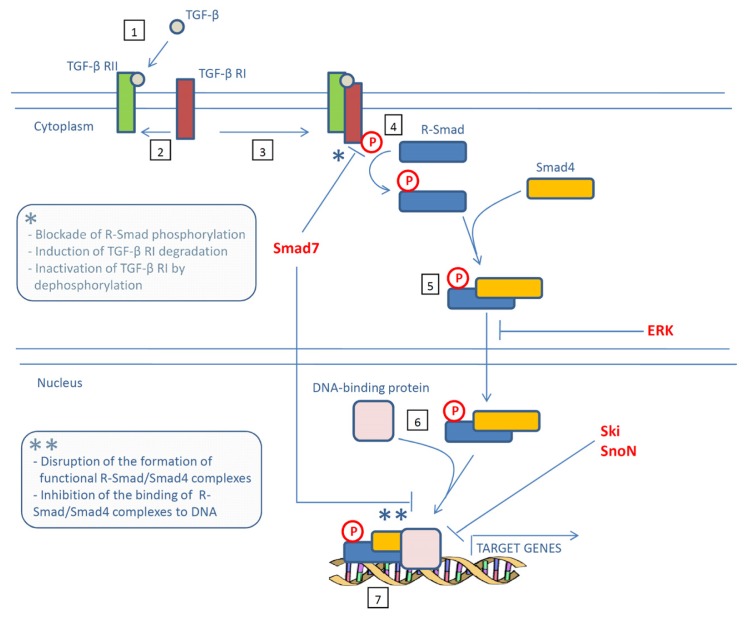
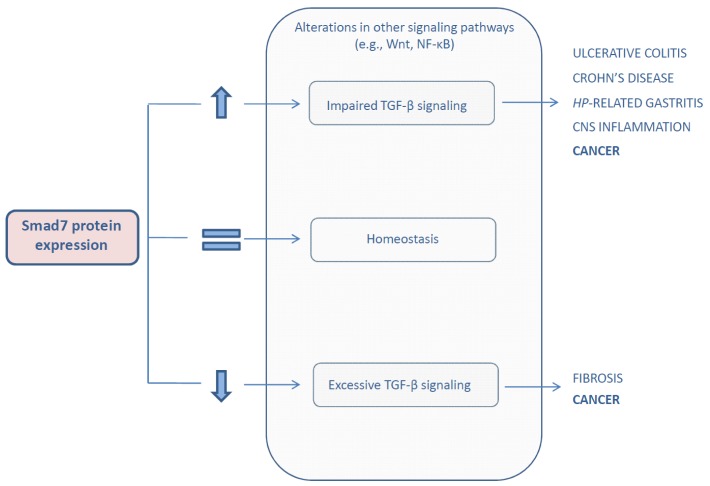
Smad7 was initially identified as an inhibitor of Transforming growth factor (TGF)-β due mainly to its ability to bind TGF-β receptor type I and prevent TGF-β-associated Smad signaling. More recently, it has been demonstrated that Smad7 can interact with other intracellular proteins and regulate also TGF-β-independent signaling pathways thus making a valid contribution to the neoplastic processes in various organs. In particular, data emerging from experimental studies indicate that Smad7 may differently modulate the course of various tumors depending on the context analyzed. These observations, together with the demonstration that Smad7 expression is deregulated in many cancers, suggest that therapeutic interventions around Smad7 can help interfere with the development/progression of human cancers. In this article we review and discuss the available data supporting the role of Smad7 in the modulation of cancer growth and progression.
Figures
References
-
- Fearon E.R., Vogelstein B. A genetic model for colorectal tumorigenesis. Cell. 1990;61:759–767. - PubMed
-
- Liotta L.A., Stetler-Stevenson W.G. Tumor invasion and metastasis: An imbalance of positive and negative regulation. Cancer Res. 1991;51:5054s–5059s. - PubMed
-
- Oft M., Akhurst R.J., Balmain A. Metastasis is driven by sequential elevation of H-ras and Smad2 levels. Nat. Cell Biol. 2002;4:487–494. - PubMed
-
- Katsuno Y., Lamouille S., Derynck R. Tgf-beta signaling and epithelial-mesenchymal transition in cancer progression. Curr. Opin. Oncol. 2013;25:76–84. - PubMed
-
- Piek E., Heldin C.H., Ten Dijke P. Specificity, diversity, and regulation in TGF-β superfamily signaling. FASEB J. 1999;13:2105–2124. - PubMed
Publication types
MeSH terms
Substances
LinkOut - more resources
Full Text Sources
Other Literature Sources
