Impact of postdiagnosis smoking on long-term survival of cancer patients: the Shanghai cohort study
- PMID: 24319070
- PMCID: PMC3919701
- DOI: 10.1158/1055-9965.EPI-13-0805-T
Impact of postdiagnosis smoking on long-term survival of cancer patients: the Shanghai cohort study
Abstract
Background: Cancer is the number one cause of death among men in China. Cigarette smoking is the most preventable cause of cancer. Data on the impact of continued smoking after cancer diagnosis on survival of patients with cancer are sparse.
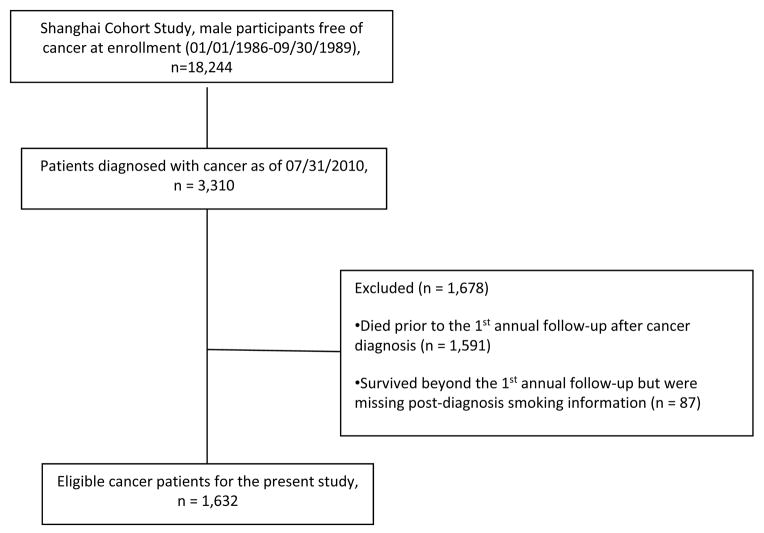
Methods: We studied the association between postdiagnosis smoking and risk of all-cause death among 1,632 incident cancer patients in the Shanghai Cohort Study, a population-based prospective cohort of 18,244 men in Shanghai. The change of smoking status after baseline interview was ascertained through annual in-person interviews. Cox proportional hazards regression models were used to estimate HR and 95% confidence interval (CI) for all-cause mortality associated with change in smoking status.
Results: Patients who continued smoking after cancer diagnosis experienced a statistically significant 59% (95% CI, 36-86) increase in risk of death compared with patients with cancer who did not smoke after cancer diagnosis. Among current smokers at cancer diagnosis, HRs (95% CIs) were 1.79 (1.49-2.16) in all patients with cancer, 2.36 (1.63-3.42) in patients with lung cancer, 1.63 (0.98-2.73) in patients with stomach cancer, 2.31 (1.40-3.81) in patients with colorectal cancer, and 2.95 (1.09-7.95) in patients with bladder cancer who continued smoking compared with their counterparts who stopped smoking after cancer diagnosis.
Conclusion: Postdiagnosis cigarettes smoking significantly increased the risk of death for male patients with cancer.
Impact: These data provide new information about smoking and cancer survival, which should inform future research into the contextual and individual-level barriers that may result in inadequate attention of smoking among patients with cancer in the postdiagnosis setting.
©2013 AACR.
Conflict of interest statement
Disclosure of potential conflicts of interest:
No potential conflicts of interest were disclosed by the authors.
Figures

References
-
- He J, Gu D, Wu X, Reynolds K, Duan X, Yao C, et al. Major causes of death among men and women in China. The New England journal of medicine. 2005;353:1124–34. - PubMed
-
- Stewart BW, Kleihues P. World Cancer Report 2003. IARC Press; 2003.
-
- CDC. Smoking-Attributable Mortality, Years of Potential Life Lost, and Productivity Losses --- United States, 2000–2004. MMWR. 2008;57:1226–8. - PubMed
-
- Gu D, Kelly TN, Wu X, Chen J, Samet JM, Huang JF, et al. Mortality attributable to smoking in China. The New England journal of medicine. 2009;360:150–9. - PubMed
Publication types
MeSH terms
Grants and funding
LinkOut - more resources
Full Text Sources
Other Literature Sources