


Conditional Cash Transfers and HIV/AIDS Prevention: Unconditionally Promising?
- PMID: 24319306
- PMCID: PMC3849819
- DOI: 10.1093/wber/lhr041
Conditional Cash Transfers and HIV/AIDS Prevention: Unconditionally Promising?
Abstract
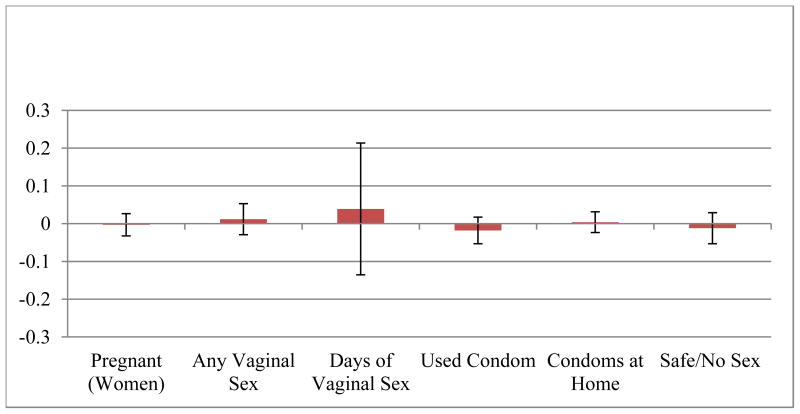
Conditional cash transfers (CCT) have recently received considerable attention as a potentially innovative and effective approach to the prevention of HIV/AIDS. We evaluate a conditional cash transfer program in rural Malawi which offered financial incentives to men and women to maintain their HIV status for approximately one year. The amounts of the reward ranged from zero to approximately 3-4 months wage. We find no effect of the offered incentives on HIV status or on reported sexual behavior. However, shortly after receiving the reward, men who received the cash transfer were 9 percentage points more likely and women were 6.7 percentage points less likely to engage in risky sex. Our analyses therefore question the "unconditional effectiveness" of CCT program for HIV prevention: CCT Programs that aim to motivate safe sexual behavior in Africa should take into account that money given in the present may have much stronger effects than rewards offered in the future, and any effect of these programs may be fairly sensitive to the specific design of the program, the local and/or cultural context, and the degree of agency an individual has with respect to sexual behaviors.
Figures
References
-
- Bernheim BD, Rangel B. Addiction and cue-triggered decision processes. American Economic Review. 2004;94(5):1558–1590. - PubMed
-
- Bertozzi S, Padian NS, Wegbreit J, DeMaria LM, Feldman B, Gayle H, Gold J, Grant R, Isbell MT. HIV/AIDS prevention and treatment. In: Jamison DT, Breman JG, Measham AR, Alleyne G, Claeson M, Evans DB, Jha P, Mills A, Musgrove P, editors. Disease Control Priorities in Developing Countries. 2. Oxford: Oxford University Press; 2006. pp. 331–370. http://files.dcp2.org/pdf/DCP/DCP18.pdf.
Grants and funding
LinkOut - more resources
Full Text Sources