Review
. 2013:2013:836790.
doi: 10.1155/2013/836790. Epub 2013 Nov 12.

The roles of genetic polymorphisms and human immunodeficiency virus infection in lipid metabolism

Affiliations
Review

The roles of genetic polymorphisms and human immunodeficiency virus infection in lipid metabolism

Elaine Regina Delicato de Almeida et al. Biomed Res Int. 2013.

Abstract

Dyslipidemia has been frequently observed among individuals infected with human immunodeficiency virus type 1 (HIV-1), and factors related to HIV-1, the host, and antiretroviral therapy (ART) are involved in this phenomenon. This study reviews the roles of genetic polymorphisms, HIV-1 infection, and highly active antiretroviral therapy (HAART) in lipid metabolism. Lipid abnormalities can vary according to the HAART regimen, such as those with protease inhibitors (PIs). However, genetic factors may also be involved in dyslipidemia because not all patients receiving the same HAART regimen and with comparable demographic, virological, and immunological characteristics develop variations in the lipid profile. Polymorphisms in a large number of genes are involved in the synthesis of structural proteins, and enzymes related to lipid metabolism account for variations in the lipid profile of each individual. As some genetic polymorphisms may cause dyslipidemia, these allele variants should be investigated in HIV-1-infected patients to identify individuals with an increased risk of developing dyslipidemia during treatment with HAART, particularly during therapy with PIs. This knowledge may guide individualized treatment decisions and lead to the development of new therapeutic targets for the treatment of dyslipidemia in these patients.


Figures
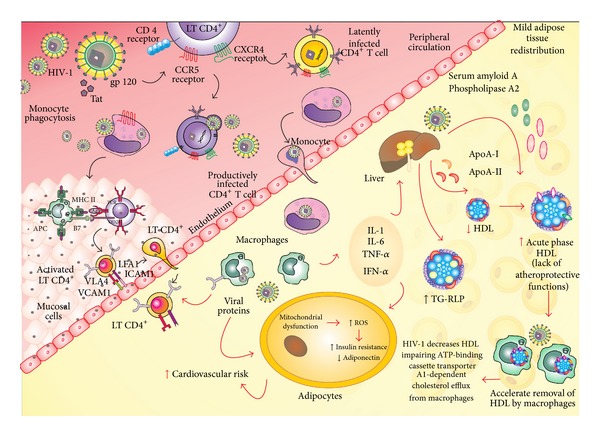
Figure 1
Figure 1
At tissues, human immunodeficiency virus type 1 (HIV-1) infects macrophages using the CD4 as receptor and the CCR5 as coreceptor and induces the local immune response. At peripheral circulation, HIV-1 infects Th1 CD4+ cells, particularly by the coreceptor CXCR4 that persists latently infected or becomes a productively infected cell. The viral proteins induce an proinflammatory response in peripheral circulation and in the tissues and decrease plasma high-density lipoprotein cholesterol (HDL-C) by impairing the cholesterol-dependent efflux transporter ATP-binding cassette protein A1 (ABCA1) in human macrophages, a condition that is highly atherogenic. Additionally, the viral proteins and the proinflammatory cytokines interleukin 1 (IL-1), interleukin 6 (IL-6), tumor necrosis factor α (TN-Fα), and interferon α (IFN-α) stimulate endothelial lipase and certain acute phase proteins, such as serum amyloid A. The viral proteins also exert effects on the adipocytes resulting mitochondrial dysfunction, reactive oxygen species (ROS) production, and insulin resistance and decrease adiponectin. The chronic inflammatory processes increase the production of these proinflammatory cytokines, resulting in the impaired clearance of triglyceride-rich lipoproteins (TG-RLP) and insulin resistance. All these mechanisms increase the risk of cardiovascular diseases in the HIV-1-infected individuals.
Figure 2
Figure 2
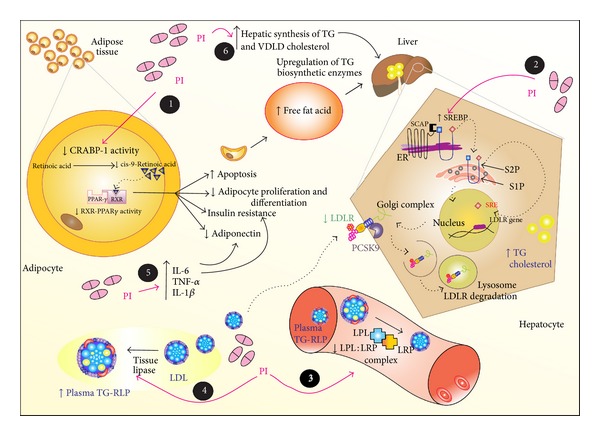
The dyslipidemia associated with protease inhibitor (PI) is characterized by decreased plasma high-density lipoprotein cholesterol (HDL-C) and increased total cholesterol, triglyceride (TG), and low-density lipoprotein cholesterol (LDL-C), which together constitute a highly atherogenic lipid profile. Several mechanisms are proposed such that: (1) the PI-induced dyslipidemia is based upon the structural similarity with the amino acid sequence of the C-terminal region of cytoplasmic retinoic acid-binding protein type 1 (CRABP-1). The PI likely binds to CRABP-1, increasing apoptosis and diminishing the proliferation of peripheral adipocytes; (2) PI suppresses the proteasome-mediated degradation of sterol regulatory element binding proteins (nSREBP) in the liver and adipocytes. These transcription factors stimulate fatty acid and TG synthesis in the liver and adipose tissue and control several steps of cholesterol synthesis. The hepatic accumulation of nSREBP increases TG and cholesterol biosynthesis, whereas accumulation in adipose tissue causes insulin resistance reduced leptin expression and lipodystrophy; (3 and 4) PI-induced dyslipidemia is also based on the structural similarity between the catalytic region of HIV-1 protease and the LDL-receptor-related protein (LRP) and interferes with LRP-LPL complex formation, as a result it reduces the adipose storage capacity and increases plasma TG-rich lipoproteins; (5) PI also increases the expression and secretion of proinflammatory cytokines, such as tumor necrosis factor alpha (TNF-α), interleukin 6 (IL-6), and interleukin 1β (IL-1β), which are involved in altered adipocyte functions and decreased adiponectin; and (6) PI increases the hepatic synthesis of TG, very-low density lipoprotein cholesterol (VLDL-C), and to a lesser extent, cholesterol.
Figure 3
Figure 3
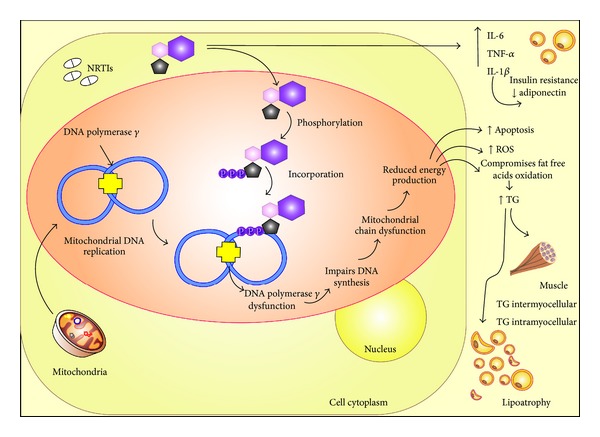
Some mechanisms are proposed to explain the effects of nucleoside reverse transcriptase inhibitors (NRTIs) in the lipid profile of human immunodeficiency virus type 1- (HIV-1-) infected individuals treated with this class of antiretroviral. (1) NRTIs increase the expression and secretion of proinflammatory cytokines, such as tumor necrosis factor alpha (TNF-α), interleukin 6 (IL-6), and interleukin 1β (IL-1β), that are involved in altered adipocyte function, insulin resistance, and adiponectin expression; (2) Upon entry into the cell, NRTIs are metabolized to the active triphosphorylated form and can be used as substrates by the mitochondrial DNA polymerase γ. Subsequently, they may inhibit mitochondrial DNA (mtDNA) replication and/or increase the number of mutations in mtDNA. This effect can lead to mtDNA depletion, the disruption of oxidative phosphorylation, decrease in ATP production, increase in reactive oxygen species (ROS), and, ultimately, inappropriate mitochondrial and cellular toxicity.

References

    1. Andrade FM, Hutz MH. O componente genético da determinação dos lipídeos séricos. Ciência & Saúde Coletiva. 2002;7(1):175–182.
    1. Valente AM, Reis AF, Machado DM, Succi RC, Chacra AR. Alterações metabólicas da síndrome lipodistrofia do HIV. Arquivos Brasileiros de Endocrinologia & Metabologia. 2005;49(6):10–17. - PubMed
    1. Estrada V, Portilla J. Dyslipidemia related to antiretroviral therapy. AIDS Reviews. 2011;13(1):49–56. - PubMed
    1. Wlodawer A, Vondrasek J. Terapia anti-aids. Annual Review of Biophysics and Biomolecular Structure. 1998;27(249):10–16. - PubMed
    1. Menéndez-Arias L. Molecular basis of human immunodeficiency virus type 1 drug resistance: overview and recent developments. Antiviral Research. 2013;98(1):93–120. - PubMed