


HIV prevalence and factors associated with HIV infection among men who have sex with men in Cameroon
- PMID: 24321114
- PMCID: PMC3852127
- DOI: 10.7448/IAS.16.4.18752
HIV prevalence and factors associated with HIV infection among men who have sex with men in Cameroon
Abstract
Introduction: Despite men who have sex with men (MSM) being a key population for HIV programming globally, HIV epidemiologic data on MSM in Central Africa are sparse. We measured HIV and syphilis prevalence and the factors associated with HIV infection among MSM in Cameroon.
Methods: Two hundred and seventy-two and 239 MSM aged ≥ 18 from Douala and Yaoundé, respectively, were recruited using respondent-driven sampling (RDS) for this cross-sectional surveillance study in 2011. Participants completed a structured questionnaire and HIV and syphilis testing. Statistical analyses, including RDS-weighted proportions, bootstrapped confidence intervals and logistic regressions, were used.
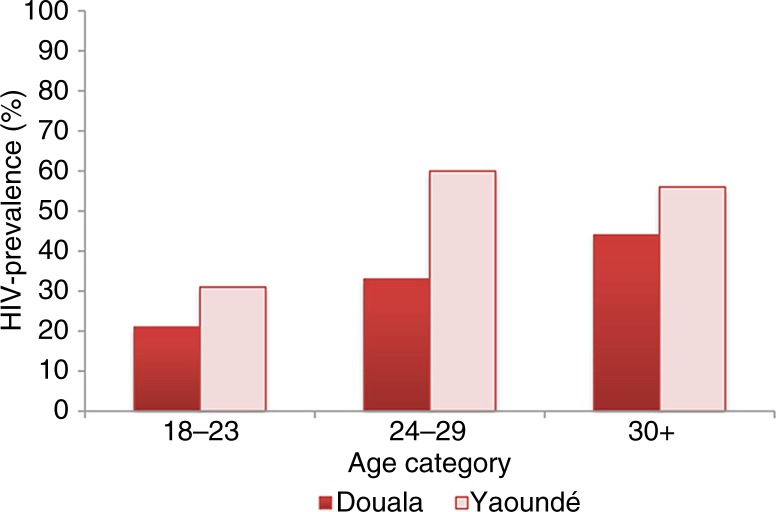
Results: Crude and RDS-weighted HIV prevalence were 28.6% (73/255) and 25.5% (95% CI 19.1-31.9) in Douala, and 47.3% (98/207) and 44.4% (95% CI 35.7-53.2) in Yaoundé. Active syphilis prevalence in total was 0.4% (2/511). Overall, median age was 24 years, 62% (317/511) of MSM identified as bisexual and 28.6% (144/511) identified as gay. Inconsistent condom use with regular male partners (64.1%; 273/426) and casual male and female partners (48.5%; 195/402) was common, as was the inconsistent use of condom-compatible lubricants (CCLs) (26.3%; 124/472). In Douala, preferring a receptive sexual role was associated with prevalent HIV infection [adjusted odds ratio (aOR) 2.33, 95% CI 1.02-5.32]. Compared to MSM without HIV infection, MSM living with HIV were more likely to have ever accessed a health service targeting MSM in Douala (aOR 4.88, 95% CI 1.63-14.63). In Yaoundé, MSM living with HIV were more likely to use CCLs (aOR 2.44, 95% CI 1.19-4.97).
Conclusions: High HIV prevalence were observed and condoms and CCLs were used inconsistently indicating that MSM are a priority population for HIV prevention, treatment and care services in Douala and Yaoundé. Building the capacity of MSM community organizations and improving the delivery and scale-up of multimodal interventions for MSM that are sensitive to concerns about confidentiality and the complex individual, social, community-level and policy challenges are needed to successfully engage young MSM in the continuum of HIV care. In addition to scaling up condom and CCL access, evaluating the feasibility of novel biomedical interventions, including antiretroviral pre-exposure prophylaxis and early antiretroviral therapy for MSM living with HIV in Cameroon, is also warranted.
Keywords: Africa; HIV/AIDS; Men who have sex with men (MSM); epidemiology; homosexuality; prevalence; prevention; respondent-driven sampling (RDS); risk factors; sexual behaviour.
Figures
References
-
- van Griensven F, de Lind van Wijngaarden JW, Baral S, Grulich A. The global epidemic of HIV infection among men who have sex with men. Curr Opin HIV AIDS. 2009;4(4):300–7. - PubMed
-
- Wade AS, Larmarange J, Diop AK, Diop O, Gueye K, Marra A, et al. Reduction in risk-taking behaviors among MSM in Senegal between 2004 and 2007 and prevalence of HIV and other STIs. ELIHoS Project, ANRS 12139. AIDS Care. 2010;22(4):409–14. - PubMed
-
- Merrigan M, Azeez A, Afolabi B, Chabikuli ON, Onyekwena O, Eluwa G, et al. HIV prevalence and risk behaviours among men having sex with men in Nigeria. Sex Transm Infect. 2011;87(1):65–70. - PubMed
Publication types
MeSH terms
LinkOut - more resources
Full Text Sources
Other Literature Sources
Medical
