


How effective and cost-effective was the national mass media smoking cessation campaign 'Stoptober'?
- PMID: 24322004
- PMCID: PMC3929003
- DOI: 10.1016/j.drugalcdep.2013.11.003
How effective and cost-effective was the national mass media smoking cessation campaign 'Stoptober'?
Abstract
Background: A national smoking cessation campaign based on behaviour change theory and operating through both traditional and new media was launched across England during late 2012 ('Stoptober'). In addition to attempting to start a movement in which smokers would quit at the same time in response to a positive mass quitting trigger, the campaign set smokers the goal of being smoke-free for October and embodied other psychological principles in a range of tools and communications.
Methods: Data on quit attempts were obtained from 31,566 past-year smokers during nationally representative household surveys conducted monthly between 2007 and 2012. The effectiveness of the campaign was assessed by the increase in national quit attempt rate in October relative to other months in 2012 vs. 2007-2011.
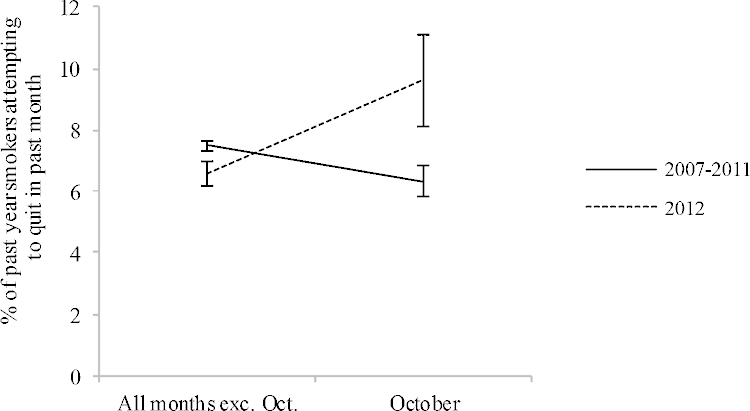
Results: Relative to other months in the year, more people tried to quit in October in 2012 compared with 2007-2011 (OR=1.79, 95%CI=1.20-2.68). In 2012 there was an approximately 50% increase in quitting during October compared with other months of the same year (9.6% vs. 6.6%; OR=1.50, 95%CI=1.05-2.15), whereas in 2007-2011 the rate in October was non-significantly less than in other months of the same period (6.4% vs. 7.5%; OR=0.84, 95%CI=0.70-1.00). Stoptober is estimated to have generated an additional 350,000 quit attempts and saved 10,400 discounted life years (DLY) at less than £415 per DLY in the modal age group.
Conclusions: Designing a national public health campaign with a clear behavioural target (making a serious quit attempt) using key psychological principles can yield substantial behaviour change and public health impact.
Keywords: Cessation; Cost-effectiveness; Mass media; Quitting; Smoking; Stoptober.
Copyright © 2013 The Authors. Published by Elsevier Ireland Ltd.. All rights reserved.
Figures
References
-
- Bala M., Strzeszynski L., Cahill K. Can tobacco control programmes that include a mass media campaign help to reduce levels of smoking among adults. Cochrane Database Syst. Rev. 2012;(6) doi: 10.1002/14651858.CD004704.pub3. Art. No.: CD004704. - DOI
-
- Centers for Disease Control and Prevention Cigarette smoking among adults and trends in smoking cessation—United States, 2008. MMWR Morb. Mortal. Wkly. Rep. 2009;58:1227–1232. - PubMed
Publication types
MeSH terms
Grants and funding
LinkOut - more resources
Full Text Sources
Other Literature Sources
Medical
Miscellaneous
