


Recombinant human erythropoietin for treating treatment-resistant depression: a double-blind, randomized, placebo-controlled phase 2 trial
- PMID: 24322509
- PMCID: PMC3988543
- DOI: 10.1038/npp.2013.335
Recombinant human erythropoietin for treating treatment-resistant depression: a double-blind, randomized, placebo-controlled phase 2 trial
Abstract
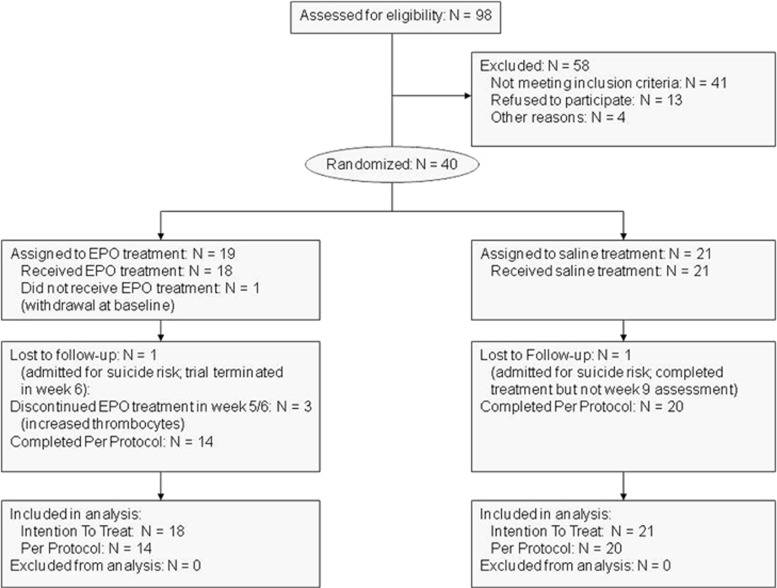
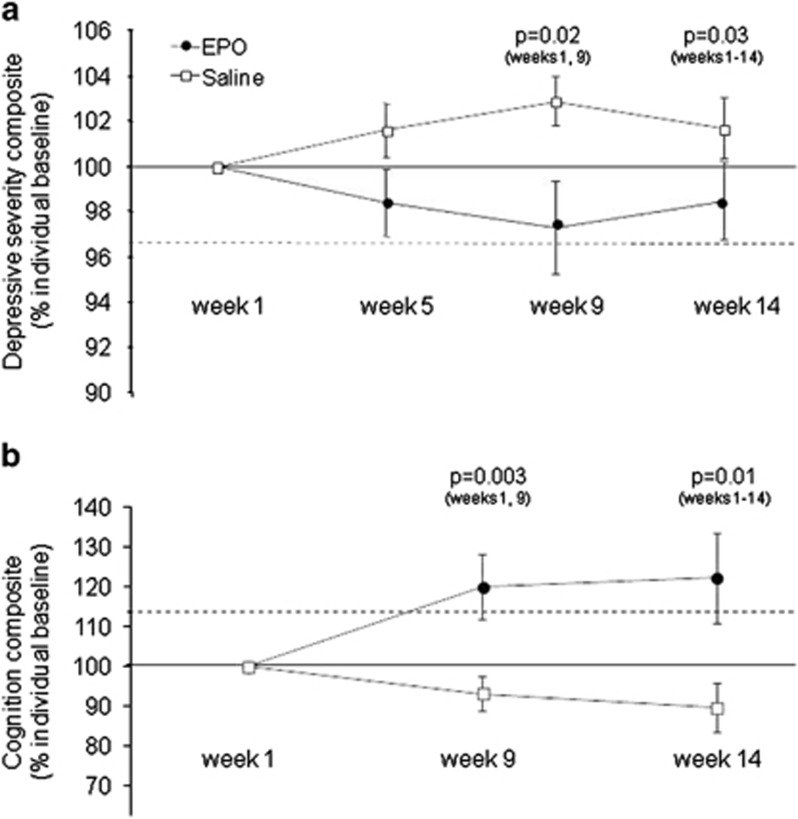
Pharmacological treatments for depression have insufficient efficacy in 30-40% of patients and fail to reverse cognitive deficits. Erythropoietin (EPO) has neurotrophic actions and aids neurocognitive function. The aim of this exploratory study was to determine whether recombinant human EPO improves mood and memory in treatment-resistant depression. Forty treatment-resistant depressed unipolar patients with Hamilton Depression Rating Scale-17 (HDRS-17) score ≥ 17 were randomized to eight weekly EPO (Eprex; 40,000 IU) or saline infusions in a double-blind, placebo-controlled, parallel-group design. Patients were assessed at baseline and at weeks 5, 9, and 14. Primary outcome was reduction in HDRS-17 score. Global assessment of function (GAF) was reported in addition. Secondary outcome was remission rate, and tertiary outcomes were changes in Rey Auditory Verbal Learning Test (RAVLT), Beck Depression Inventory-21 (BDI-21), and World Health Organization Quality of life-BREF (WHOQOL-BREF). Exploratory outcomes were depression and cognition composite scores. HDRS-17, GAF, and remission rates showed no effects of EPO over saline at week 9 (P-value ≥ 0.09). However, EPO improved BDI (P=0.02) and WHOQOL-BREF (P=0.01), and this was maintained at follow-up week 14 (P-values ≤ 0.04). EPO enhanced verbal recall (P=0.02) and recognition (P=0.03), which was sustained at follow-up (P-values ≤ 0.04). Exploratory analysis in patients fulfilling depression severity criteria at trial start revealed ameliorated HDRS-17 in EPO (N=14) vs saline groups (N=17), which was sustained at week 14 (P-values ≤ 0.05). Exploratory analysis in the complete cohort showed that EPO reduced depression composite at weeks 9 and 14 (P-values=0.02). The findings of this exploratory study highlight EPO as an interesting compound for treatment-resistant depression, which deserves further investigation.
Figures
References
-
- Curran HV, Morgan C. Cognitive, dissociative and psychotogenic effects of ketamine in recreational users on the night of drug use and 3 days later. Addiction. 2000;95:575–590. - PubMed
-
- Danysz W, Wroblewski JT, Costa E. Learning impairment in rats by N-methyl-D-aspartate receptor antagonists. Neuropharmacology. 1988;27:653–656. - PubMed
-
- Ehrenreich H, Fischer B, Norra C, Schellenberger F, Stender N, Stiefel M, et al. Exploring recombinant human erythropoietin in chronic progressive multiple sclerosis. Brain. 2007;130:2577–2588. - PubMed
Publication types
MeSH terms
Substances
LinkOut - more resources
Full Text Sources
Other Literature Sources
Medical
Research Materials
