. 2014 Feb 15;20(4):837-46.
doi: 10.1158/1078-0432.CCR-13-1854. Epub 2013 Dec 9.

Colon cancer cells escape 5FU chemotherapy-induced cell death by entering stemness and quiescence associated with the c-Yes/YAP axis

Affiliations

Colon cancer cells escape 5FU chemotherapy-induced cell death by entering stemness and quiescence associated with the c-Yes/YAP axis

Yasmine Touil et al. Clin Cancer Res. .

Abstract

Purpose: Metastasis and drug resistance are the major limitations in the survival and management of patients with cancer. This study aimed to identify the mechanisms underlying HT29 colon cancer cell chemoresistance acquired after sequential exposure to 5-fluorouracil (5FU), a classical anticancer drug for treatment of epithelial solid tumors. We examined its clinical relevance in a cohort of patients with colon cancer with liver metastases after 5FU-based neoadjuvant chemotherapy and surgery.

Results: We show that a clonal 5F31 cell population, resistant to 1 μmol/L 5FU, express a typical cancer stem cell-like phenotype and enter into a reversible quiescent G0 state upon reexposure to higher 5FU concentrations. These quiescent cells overexpressed the tyrosine kinase c-Yes that became activated and membrane-associated upon 5FU exposure. This enhanced signaling pathway induced the dissociation of the Yes/YAP (Yes-associated protein) molecular complex and depleted nuclear YAP levels. Consistently, YES1 silencing decreased nuclear YAP accumulation and induced cellular quiescence in 5F31 cells cultured in 5FU-free medium. Importantly, YES1 and YAP transcript levels were higher in liver metastases of patients with colon cancer after 5FU-based neoadjuvant chemotherapy. Moreover, the YES1 and YAP transcript levels positively correlated with colon cancer relapse and shorter patient survival (P < 0.05 and P < 0.025, respectively).

Conclusions: We identified c-Yes and YAP as potential molecular targets to eradicate quiescent cancer cells and dormant micrometastases during 5FU chemotherapy and resistance and as predictive survival markers for colon cancer.


Conflict of interest statement

Disclosures:

No potential conflicts of interest were disclosed.

Figures
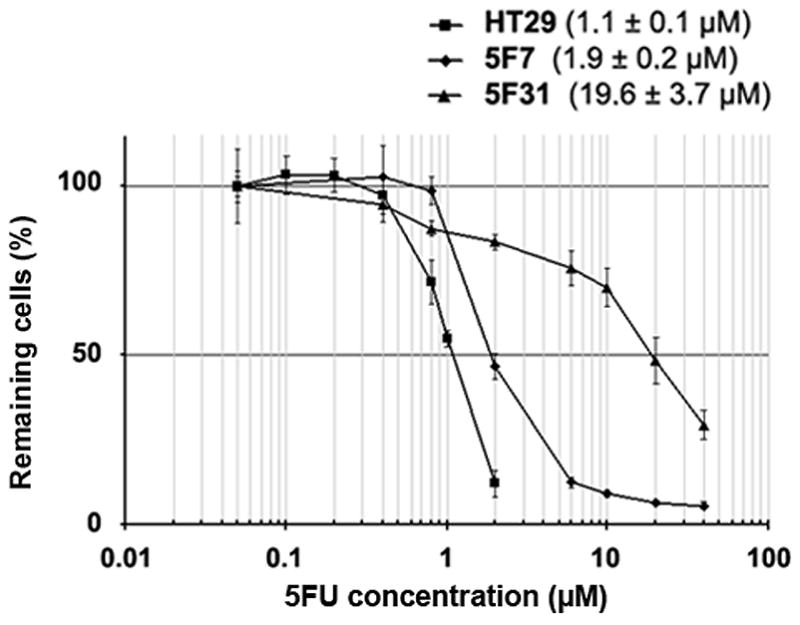
Figure 1
Figure 1
5FU-resistance of 5F7 and 5F31 cells. Survival curves of 5FU-resistant 5F7 and 5F31 clones after subsequent exposure to 5FU concentrations for 5 days. The IC50 was defined as the concentration of 5FU producing a 50% decrease in the number of cells compared with untreated controls. Error bars represent the mean±SD for six replicates.
Figure 2
Figure 2
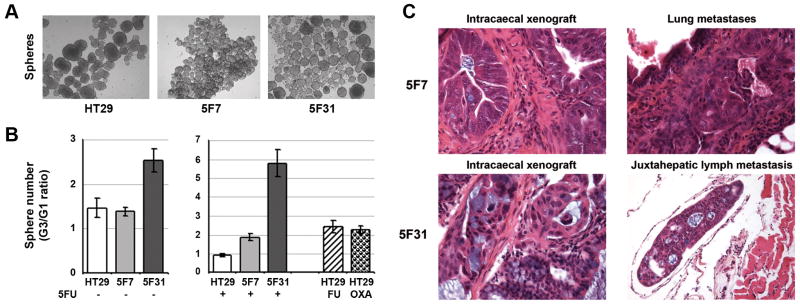
5FU-resistant 5F7 and 5F31 clones differ in their self-renewal and metastatatic potentials. A- Sphere formation in anchorage-independent culture conditions, using parental HT29 cells and the drug-resistant clones. B- Self-renewal capacity in spheres arising from untreated or treated cells. The spheres obtained from cells cultured in the absence of 5FU (left panel) or presence of 5FU (4 days, ½IC50, right panel) were dissociated and subsequently reseeded over three passages. The HT29FU and HT29OXA subpopulations were analyzed in comparison (right panel). Results are the ratio of the number of counted spheres between the third and first generations of spheres. Histograms are the means from at least two independent experiments. HT29 parental population (white), 5F7 (bright grey), 5F31 (dark grey), HT29FU (hatched), HT29OXA (grid). C- Tumorigenic and metastatic potential of 5F7 and 5F31 clones in immunodeficient mice using orthotopic intracaecal xenografts. Intracaecal tumors and metastases were analysed by conventional histology (hematoxylin, eosin, saffron and Astra blue, HESAB), magnification, ×200. Intracaecal xenografts appear as adenocarcinoma with cell rows and mucus-secreting glands. Both 5F7 and 5F31 tumors produce lung metastases but only 5F31 tumors generate extrahepatic lymph metastases.
Figure 3
Figure 3
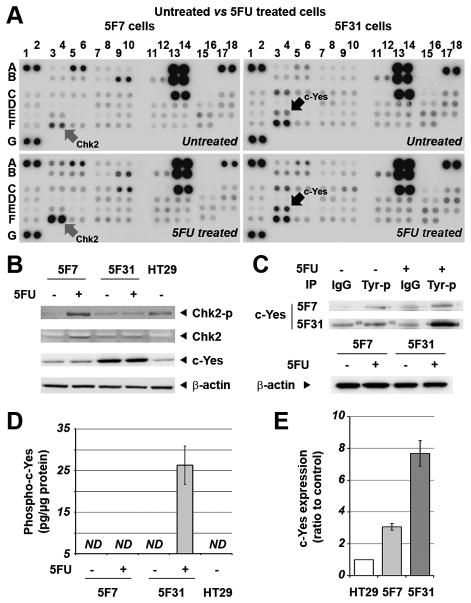
5FU-resistant 5F7 and 5F31 clones selectively activate different signaling pathways following subsequent exposure to 5FU. A- Total cell lysates from control and 5FU-treated 5F7 and 5F31 cells (4 days) were analyzed using phospho-kinase arrays. Chk-2 serine/threonine kinase, c-Yes tyrosine kinase (arrows). Other kinases explored in these phospho-antibody arrays are involved in cancer cell proliferation and cell cycle controls, survival, adhesion and transcription (see the phospho-array coordinates in the methods section). F17, F18, G5, G6: negative controls; A1, A2, A17, A18, G1, G2, positive controls. B- Western blots of the total cell lysates using specific antibodies against P-Chk-2 (T68), Chk-2 and c-Yes. Actin was used as loading control. The data are representative of two independent experiments. C- Analysis of c-Yes phosphorylation by immunoprecipitation using the anti-phosphotyrosine antibody followed by western blotting with the anti-c-Yes antibody. D- Analysis of c-Yes phosphorylation using the phospho-c-Yes (Y426) ELISA assay. The error bars represent the mean ± SD for three replicates. E- Analysis of c-Yes mRNA levels in 5F7 and 5F31 cells in comparison to HT29 cells.
Figure 4
Figure 4
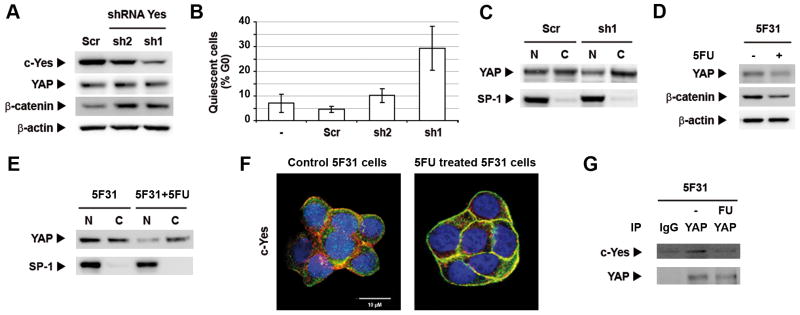
c-Yes-silencing and 5FU inhibits YAP nuclear translocation. A- Western blot analysis of c-Yes, YAP and β-catenin in c-Yes silenced Sh1 and Sh2 cells as compared to control Scr cells. B- Percentage of cells arrested at the quiescent G0 state in c-Yes silenced Sh1 and Sh2 cells. Results are expressed in percentage of quiescent cells in G0 state. C- Immunoblot of YAP and transcription factor Sp1 (nuclear marker) in nuclear and cytoplasmic fractions from c-Yes silenced Sh1 cells and control Scr cells. D- Immunoblots of YAP and β-catenin in control and 5FU-treated (2×IC50, 4 days) 5F31 cells. E- Impact of subsequent 5FU treatement (2×IC50, 4 days) on the nuclear distribution of YAP in 5F31 cells. Western blots are representative of at least two independent experiments. F- Subcellular localization of c-Yes by confocal microscopy analysis in control and 5FU-treated 5F31 cells. G- Coimmunoprecipitation (IP) of c-Yes with the anti-YAP antibody followed by immunoblotting using the c-Yes antibody and the YAP antibody in control and 5FU-treated 5F31 cells. Non-specific c-Yes immunoprecipitation was monitored using a non-relevant IgG.
Figure 5
Figure 5
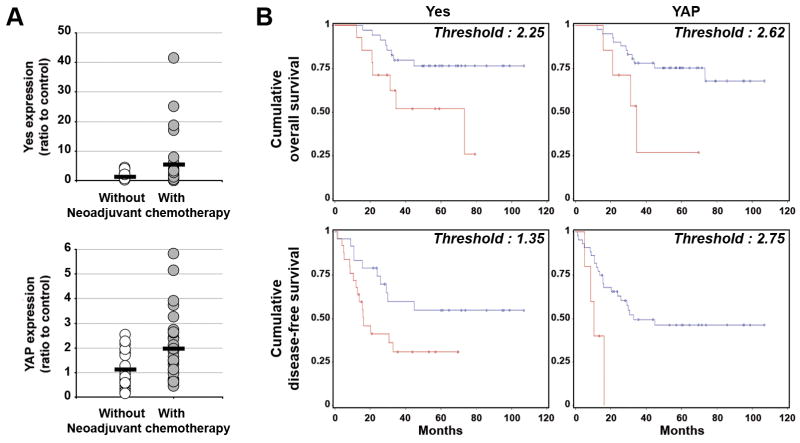
Correlations between c-Yes and YAP expression and colon cancer patient survival. A- Comparison of c-Yes and YAP transcript levels in colon liver metastases resected from patients who have received or not neoadjuvant chemotherapy. B- Kaplan-Meier survival analysis of colon cancer patients according to the expression of c-Yes and YAP transcripts.

References

    1. Douillard JY, Cunningham D, Roth AD, Navarro M, James RD, Karasek P, et al. Irinotecan combined with fluorouracil compared with fluorouracil alone as first-line treatment for metastatic colorectal cancer: a multicentre randomised trial. Lancet. 2000;355:1041–7. - PubMed
    1. Saltz LB, Cox JV, Blanke C, Rosen LS, Fehrenbacher L, Moore MJ, et al. Irinotecan plus fluorouracil and leucovorin for metastatic colorectal cancer. Irinotecan Study Group. N Engl J Med. 2000;343:905–14. - PubMed
    1. de Gramont A, Figer A, Seymour M, Homerin M, Hmissi A, Cassidy J, et al. Leucovorin and fluorouracil with or without oxaliplatin as first-line treatment in advanced colorectal cancer. J Clin Oncol. 2000;18:2938–47. - PubMed
    1. Saltz LB, Meropol NJ, Loehrer PJ, Sr, Needle MN, Kopit J, Mayer RJ. Phase II trial of cetuximab in patients with refractory colorectal cancer that expresses the epidermal growth factor receptor. J Clin Oncol. 2004;22:1201–8. - PubMed
    1. Chung KY, Shia J, Kemeny NE, Shah M, Schwartz GK, Tse A, et al. Cetuximab shows activity in colorectal cancer patients with tumors that do not express the epidermal growth factor receptor by immunohistochemistry. J Clin Oncol. 2005;23:1803–10. - PubMed

Publication types

MeSH terms