. 2013 Dec 24;110(52):21071-6.
doi: 10.1073/pnas.1314781111. Epub 2013 Dec 9.

Mutational effects on stability are largely conserved during protein evolution

Affiliations

Mutational effects on stability are largely conserved during protein evolution

Orr Ashenberg et al. Proc Natl Acad Sci U S A. .

Abstract

Protein stability and folding are the result of cooperative interactions among many residues, yet phylogenetic approaches assume that sites are independent. This discrepancy has engendered concerns about large evolutionary shifts in mutational effects that might confound phylogenetic approaches. Here we experimentally investigate this issue by introducing the same mutations into a set of diverged homologs of the influenza nucleoprotein and measuring the effects on stability. We find that mutational effects on stability are largely conserved across the homologs. We reach qualitatively similar conclusions when we simulate protein evolution with molecular-mechanics force fields. Our results do not mean that proteins evolve without epistasis, which can still arise even when mutational stability effects are conserved. However, our findings indicate that large evolutionary shifts in mutational effects on stability are rare, at least among homologs with similar structures and functions. We suggest that properly describing the clearly observable and highly conserved amino acid preferences at individual sites is likely to be far more important for phylogenetic analyses than accounting for rare shifts in amino acid propensities due to site covariation.

Keywords: consensus design; heterotachy; substitution models.


Conflict of interest statement

The authors declare no conflict of interest.

Figures
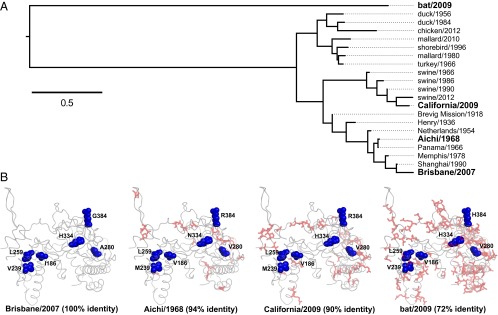
Fig. 1.
Fig. 1.
The homologs and mutations examined in this study. (A) Phylogenetic tree of the four NP homologs, constructed using the Goldman–Yang codon model. (B) The blue spheres show the sites of the six experimentally studied mutations and their identities in each homolog. The red sticks show all other sites that differ between each homolog and Brisbane/2007. The crystal structure is PDB 2IQH.
Fig. 2.
Fig. 2.
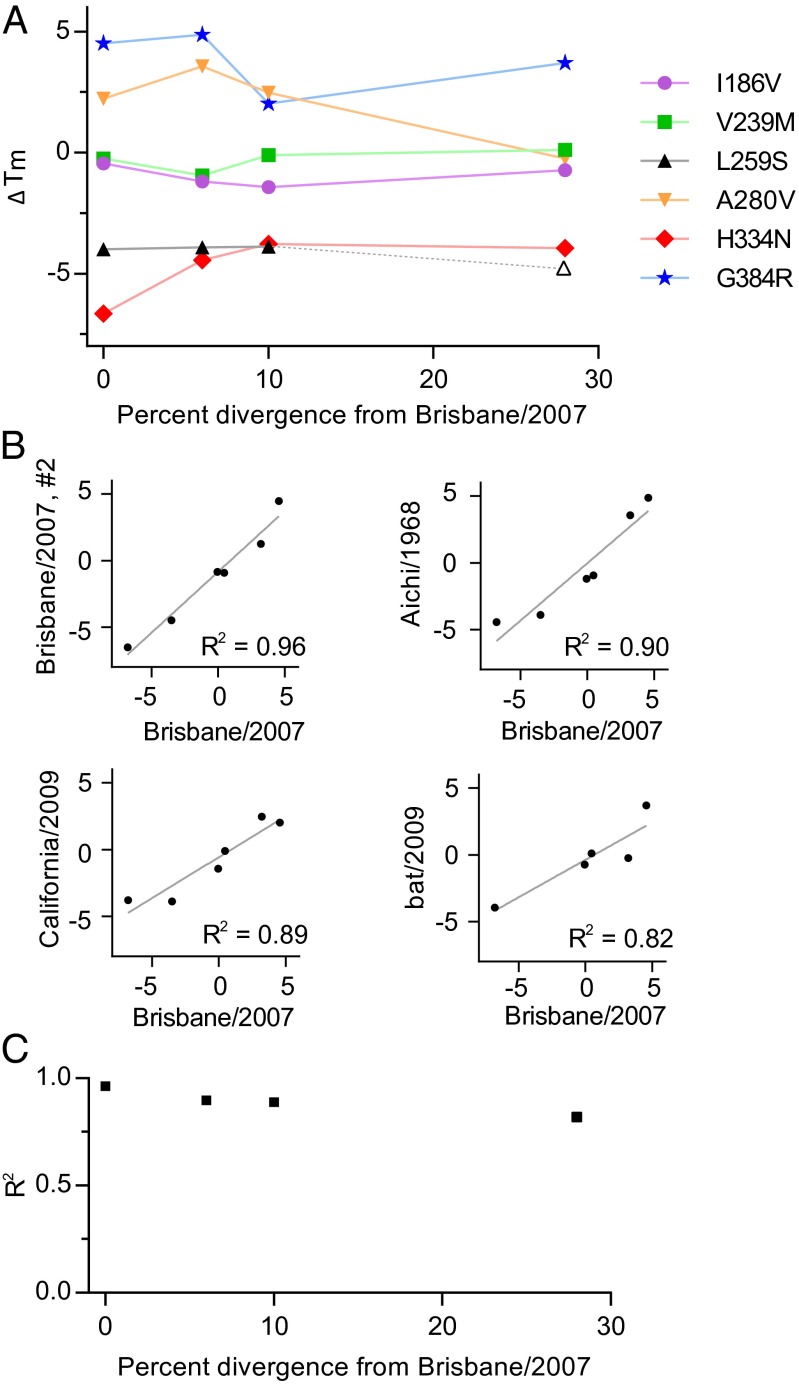
Experimentally measured mutational effects on stability are similar in all homologs. (A) The difference in melting temperature (ΔTm in °C) caused by the indicated single-site change in each homolog versus the protein-sequence divergence of that homolog from Brisbane/2007. We were unable to purify bat/2009 with L259S, so an open symbol shows the hypothetical ΔTm if this variant had a Tm equal to the least stable NP that we successfully purified (typically highly destabilized proteins are hard to purify). (B) The correlation between ΔTm values for the single-site changes for two replicates of Brisbane/2007 and then between the first Brisbane/2007 replicate and the other homologs. (C) The squared Pearson correlation (R2) between the stability effects as a function of sequence divergence. The R2 for bat/2009 does not include L259S. For bat/2009, ΔTmG384R = ΔTmH384R − ΔTmH384G.
Fig. 3.
Fig. 3.
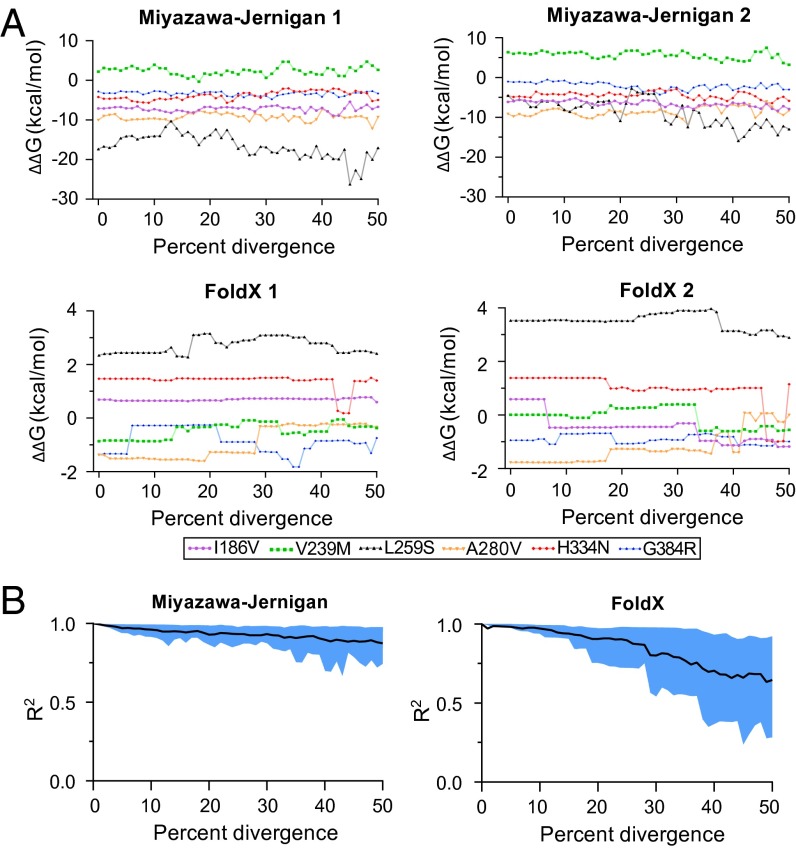
Predicted mutational effects after simulating NP evolution using the FoldX or Miyazawa–Jernigan force field. (A) Mutational effects as a function of protein-sequence divergence for two replicates of simulated evolution with the Miyazawa–Jernigan or FoldX force field. (B) Correlation between the effects in the original parent and the simulated homologs at different levels of sequence divergence. Plots show the mean (black line) and 10–90% interval of the correlation between the effects in the original parent and homologs for many replicates of simulated evolution with the Miyazawa–Jernigan (50 replicates) or FoldX (20 replicates) force field. Additional replicates and plots where the x axis is the number of substitutions are in Figs. S3S5.
Fig. 4.
Fig. 4.
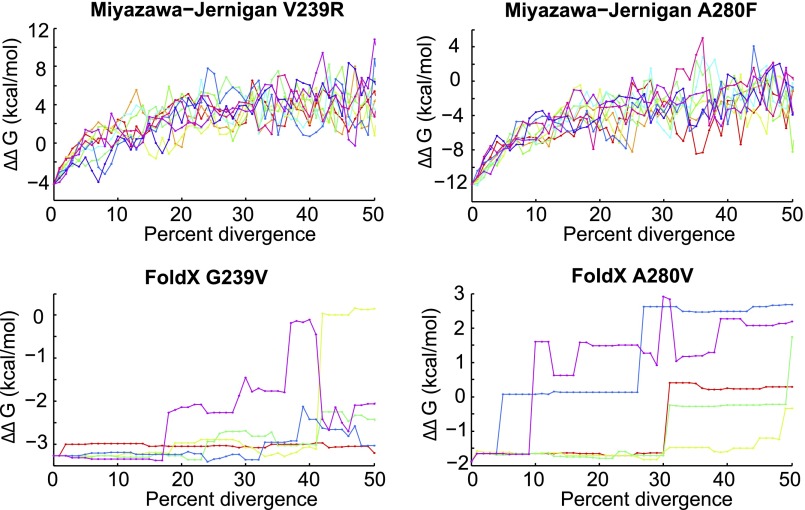
In simulations, making a destabilizing substitution and constraining it to remain fixed during subsequent evolution leads to a shift in the substitution’s effect on stability. Each plot shows the stability effect of reverting the initially destabilizing substitution listed in the plot title as a function of the amount of subsequent evolution. Reversion of the destabilizing mutation is initially stabilizing (ΔΔG << 0) but becomes less so, especially when evolution is simulated with the Miyazawa–Jernigan force field. Each line in a plot shows a different independent replicate: 10 per plot for Miyazawa–Jernigan and 5 for FoldX. These simulations parallel those used by Pollock et al. (2) to argue for an evolutionary shift in mutational effects on stability. However, real evolution does not include artificial constraints forcing destabilizing substitutions to remain fixed, and in practice we observe that destabilizing substitutions often revert (Figs. 1 and 5). Additional plots and plots where the x axis is number of substitutions are in Figs. S6 and S7.
Fig. 5.
Fig. 5.
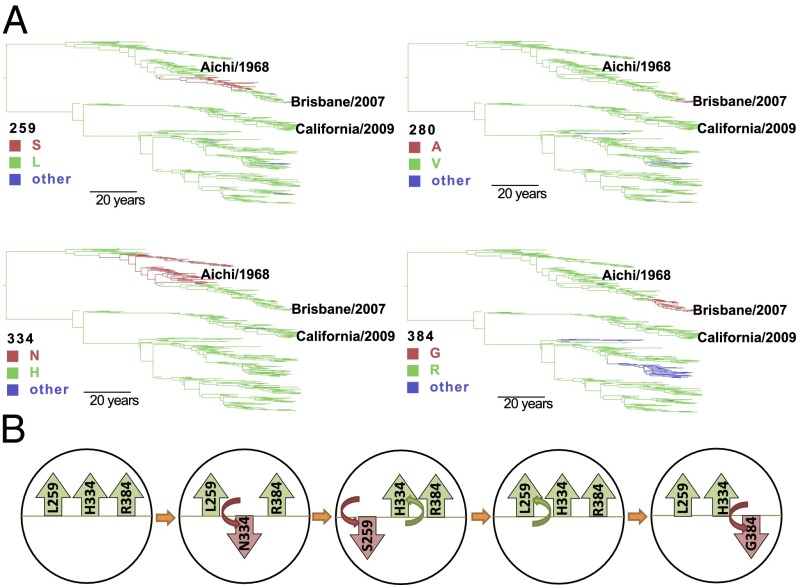
Destabilizing mutations only fix occasionally during actual evolution and then tend to revert. (A) At the four sites where mutations are experimentally characterized to have large effects on stability, most influenza variants have the more stable amino acid (green) rather than the less stable one (red). Shown are NP phylogenetic trees colored according to the amino acid with the highest posterior probability. (B) Schematic of the mode of evolution suggested by our results. When destabilizing mutations fix, they tend to revert; we see little evidence of evolutionary shifts that alter the fact that the initial mutation is destabilizing.

Comment in

References

    1. Anfinsen CB. Principles that govern the folding of protein chains. Science. 1973;181(4096):223–230. - PubMed
    1. Pollock DD, Thiltgen G, Goldstein RA. Amino acid coevolution induces an evolutionary Stokes shift. Proc Natl Acad Sci USA. 2012;109(21):E1352–E1359. - PMC - PubMed
    1. Rodrigue N, Philippe H, Lartillot N. Assessing site-interdependent phylogenetic models of sequence evolution. Mol Biol Evol. 2006;23(9):1762–1775. - PubMed
    1. Choi SC, Hobolth A, Robinson DM, Kishino H, Thorne JL. Quantifying the impact of protein tertiary structure on molecular evolution. Mol Biol Evol. 2007;24(8):1769–1782. - PubMed
    1. Nasrallah CA, Mathews DH, Huelsenbeck JP. Quantifying the impact of dependent evolution among sites in phylogenetic inference. Syst Biol. 2011;60(1):60–73. - PMC - PubMed

Publication types

LinkOut - more resources