


To evaluate and compare the effect of different Post Surface treatments on the Tensile Bond Strength between Fiber Posts and Composite Resin
- PMID: 24324301
- PMCID: PMC3845281
To evaluate and compare the effect of different Post Surface treatments on the Tensile Bond Strength between Fiber Posts and Composite Resin
Abstract
Background: Fiber posts are widely used for restoration of mutilated teeth that lack adequate coronal tooth structure to retain a core for definitive restoration, bond between the fiber post and composite material depends upon the chemical reaction between the post surface and the resin material used for building up the core. In attempt to maximize the resin bonding with fiber post, different post surface conditioning is advocated. Therefore the purpose of the study is to examine the interfacial strength between fiber post and composite, as core build-up material after different surface treatments of fiber posts.
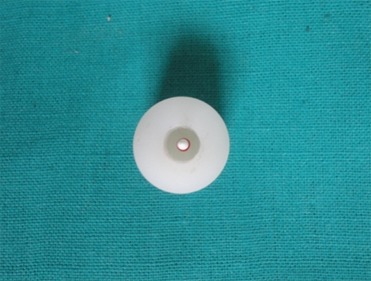
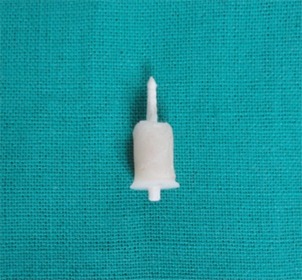
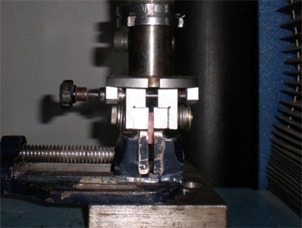
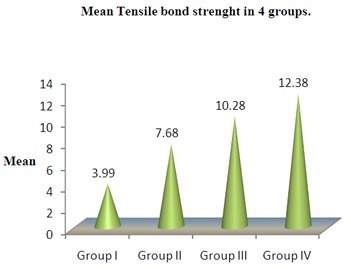
Materials & methods: Twenty fiber posts were split into four groups off five each according to different surface treatments viz. Group I-(Negative Control), Group II-Silanization (Positive control), Group III-(37% Phosphoric Acid & Silanization) ,Group IV- (10% Hydrogen Peroxide and Silanization). With the preformed plastic mould, a core of dual cure composite resin around the fiber post having the uniform thickness was created. Tensile bond strength of each specimen was measured under Universal Testing Machine (UTM) at the cross head speed of 3mm/min.
Results: The results achieved with 10% Hydrogen peroxide had a marked effect on micro tensile bond strength values between the tested materials.
Conclusion: Immense enhancement in the silanization efficiency of quartz fiber phase was observed with different surface chemical treatment of the resin phase of fiber posts with the marked increase in the micro-tensile bond strength between fiber post and composite core.
How to cite this article: Shori D, Pandey S, Kubde R, Rathod Y, Atara R, Rathi S. To evaluate and compare the effect of different Post Surface treatments on the Tensile Bond Strength between Fiber Posts and Composite Resin. J Int Oral Health 2013; 5(5):27-32.
Keywords: Fiber post; Micro-tensile bond strength; Silanization; Surface treatment.
Conflict of interest statement
Conflict of Interest: None Declared
Figures
References
-
- A Balbosh, M Kern. Effect of surface treatment on retention of glass-fiber endodontic posts. J Prosthet Dent. 2006;95:218–223. - PubMed
-
- I Nergiz, P Schmage, M Ozcan, U Platzer. Effect of length and diameter of tapered posts on the retention. J Oral Rehabil. 2002;29(1):28–34. - PubMed
-
- F Monticelli, R Osorio, FT Sadek, I Radovic, M Toledano, M Ferrari. Surface treatments for improving bond strength to prefabricated fiber posts: A literature review. Oper Dent. 2008;33:346–355. - PubMed
-
- S Bouillaguet, S Troesch, JC Wataha, I Krejci, JM Meyer, DH Pashley. Microtensile bond strength between adhesive cements and root canal dentin. Dent Mater. 2003;19:199–205. - PubMed
-
- G Bateman, DN Ricketts, WP Saunders. Fibre-based post systems: a review. Br Dent J. 2003;195(1):43–48. - PubMed
LinkOut - more resources
Full Text Sources