


Response of bean (Vicia faba L.) plants to low sink demand by measuring the gas exchange rates and chlorophyll a fluorescence kinetics
- PMID: 24324626
- PMCID: PMC3851463
- DOI: 10.1371/journal.pone.0080770
Response of bean (Vicia faba L.) plants to low sink demand by measuring the gas exchange rates and chlorophyll a fluorescence kinetics
Abstract
Background: The decline of photosynthesis in plants under low sink demand is well known. Previous studies focused on the relationship between stomatal conductance (gs) and net photosynthetic rate (Pn). These studies investigated the effect of changes in Photosystem II (PSII) function on the Pn decline under low sink demand. However, little is known about its effects on different limiting steps of electron transport chain in PSII under this condition.
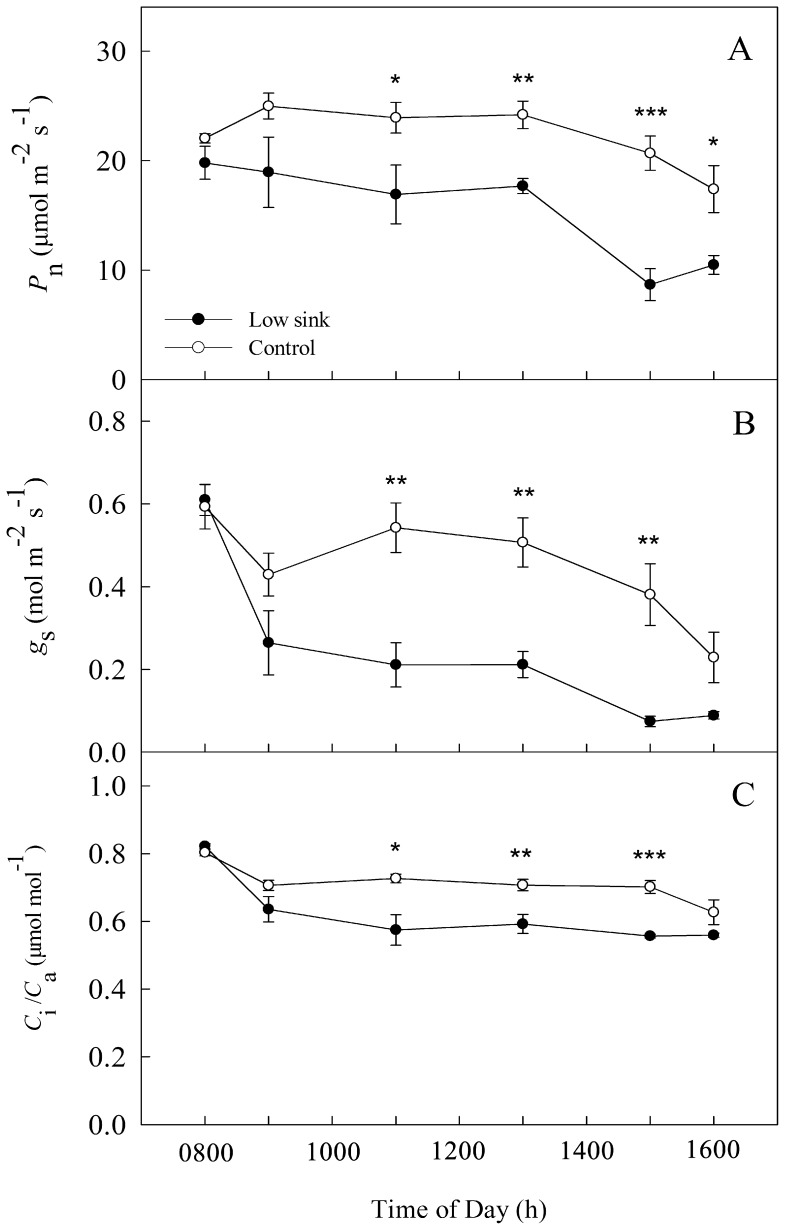
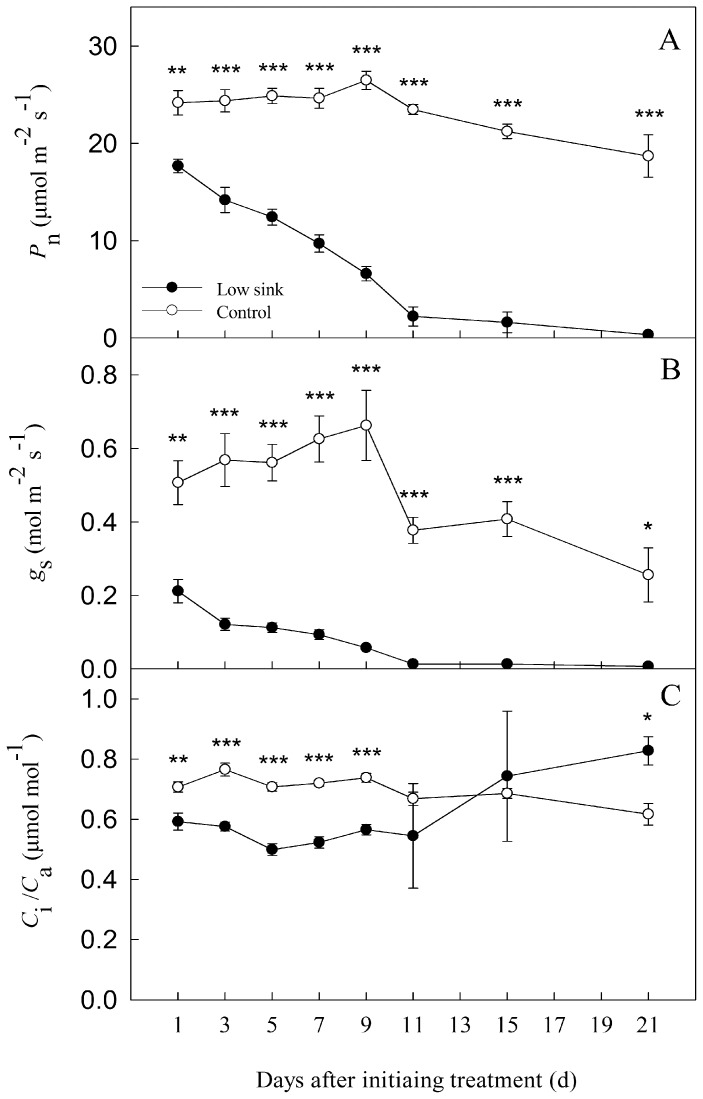
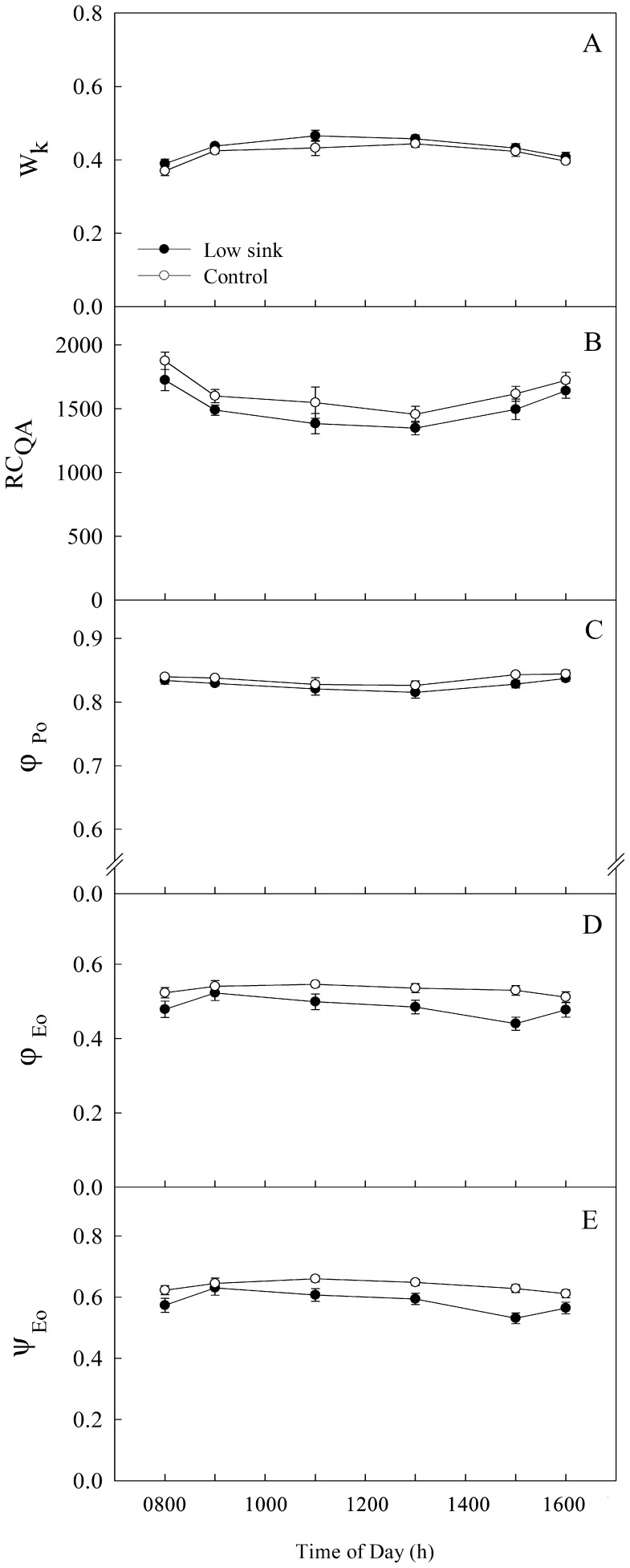
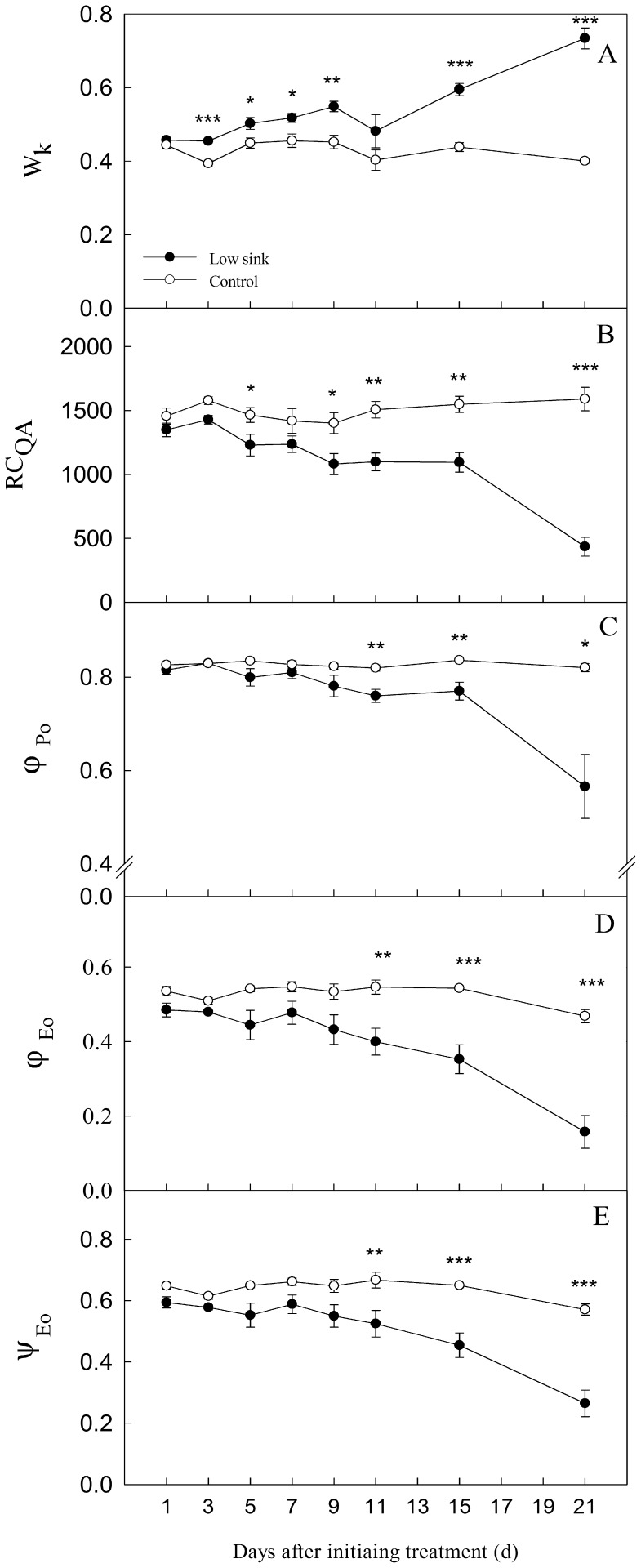
Methodology/principal finding: Two-month-old bean plants were processed by removing pods and flowers (low sink demand). On the 1(st) day after low sink demand treatment, a decline of Pn was accompanied by a decrease in gs and internal-to-ambient CO2 concentration ratio (Ci/Ca). From the 3(rd) to 9(th) day, Pn and gs declined continuously while Ci/Ca ratio remained stable in the treatment. Moreover, these values were lower than that of control. Wk (a parameter reflecting the damage to oxygen evolving complex of the donor side of PSII) values in the treatment were significantly higher than their corresponding control values. However, RCQA (a parameter reflecting the number of active RCs per excited cross-section of PSII) values in the treatment were significantly lower than control from the 5(th) day. From the 11(th) to 21(st) day, Pn and gs of the treatment continued to decline and were lower than control. This was accompanied by a decrease of RCQA, and an increase of Wk. Furthermore, the quantum yield parameters φPo, φEo and ψEo in the treatment were lower than in control; however, Ci/Ca values in the treatment gradually increased and were significantly higher than control on the 21(st) day.
Conclusions: Stomatal limitation during the early stage, whereas a combination of stomatal and non-stomatal limitation during the middle stage might be responsible for the reduction of Pn under low sink demand. Non-stomatal limitation during the late stages after the removal of the sink of roots and pods may also cause Pn reduction. The non-stomatal limitation was associated with the inhibition of PSII electron transport chain. Our data suggests that the donor side of PSII was the most sensitive to low sink demand followed by the reaction center of PSII. The acceptor side of PSII may be the least sensitive.
Conflict of interest statement
Figures
References
-
- Boussingault JB (1868) Agronomie, chimie agricole et physiologie. 2nd ed. Paris: Mallet Bachelier. pp. 236–312.
-
- Mason TG, Maskell EJ (1928) Studies on the transport of carbohydrates in the cotton plant. I. A study of diurnal variation in the carbohydrates of leaf, bark, and wood, and of the effects of ringing. Annals of Botany 42: 189–253.
-
- Neales TF, Incoll LD (1968) Control of leaf photosynthesis rate by level of assimilate concentration in leaf–a review of hypothesis. Botanical Review 34: 107–125.
-
- Cheng JS, Fan PG, Liang ZC, Wang YQ, Niu N, et al. (2009) Accumulation of end products in source leaves affects photosynthetic rate in peach via alteration of stomatal conductance and photosynthetic efficiency. Journal of the American Society for Horticultural Science 134: 667–676.
-
- DaMatta FM, Cunha RL, Antunes WC, Martins SCV, Araujo WL, et al. (2008) In field-grown coffee trees source-sink manipulation alters photosynthetic rates, independently of carbon metabolism, via alterations in stomatal function. New Phytologist 178: 348–357. - PubMed
Publication types
MeSH terms
Substances
LinkOut - more resources
Full Text Sources
Other Literature Sources
Miscellaneous
