. 2013 Dec 6;8(12):e82551.
doi: 10.1371/journal.pone.0082551. eCollection 2013.

Whole genome sequencing reveals complex evolution patterns of multidrug-resistant Mycobacterium tuberculosis Beijing strains in patients

Affiliations

Whole genome sequencing reveals complex evolution patterns of multidrug-resistant Mycobacterium tuberculosis Beijing strains in patients

Matthias Merker et al. PLoS One. .

Abstract

Multidrug-resistant (MDR) Mycobacterium tuberculosis complex (MTBC) strains represent a major threat for tuberculosis (TB) control. Treatment of MDR-TB patients is long and less effective, resulting in a significant number of treatment failures. The development of further resistances leads to extensively drug-resistant (XDR) variants. However, data on the individual reasons for treatment failure, e.g. an induced mutational burst, and on the evolution of bacteria in the patient are only sparsely available. To address this question, we investigated the intra-patient evolution of serial MTBC isolates obtained from three MDR-TB patients undergoing longitudinal treatment, finally leading to XDR-TB. Sequential isolates displayed identical IS6110 fingerprint patterns, suggesting the absence of exogenous re-infection. We utilized whole genome sequencing (WGS) to screen for variations in three isolates from Patient A and four isolates from Patient B and C, respectively. Acquired polymorphisms were subsequently validated in up to 15 serial isolates by Sanger sequencing. We determined eight (Patient A) and nine (Patient B) polymorphisms, which occurred in a stepwise manner during the course of the therapy and were linked to resistance or a potential compensatory mechanism. For both patients, our analysis revealed the long-term co-existence of clonal subpopulations that displayed different drug resistance allele combinations. Out of these, the most resistant clone was fixed in the population. In contrast, baseline and follow-up isolates of Patient C were distinguished each by eleven unique polymorphisms, indicating an exogenous re-infection with an XDR strain not detected by IS6110 RFLP typing. Our study demonstrates that intra-patient microevolution of MDR-MTBC strains under longitudinal treatment is more complex than previously anticipated. However, a mutator phenotype was not detected. The presence of different subpopulations might confound phenotypic and molecular drug resistance tests. Furthermore, high resolution WGS analysis is necessary to accurately detect exogenous re-infection as classical genotyping lacks discriminatory power in high incidence settings.


Conflict of interest statement

Competing Interests: The co-author AR was employed at the Research Center Borstel in the process of data analysis and changed later to the company Biomedizinische ForschungsgmbH, Vienna, Austria, where he assisted in drafting the manuscript. This does not alter the authors' adherence to all the PLOS ONE policies on sharing data and materials.

Figures

Figure 1
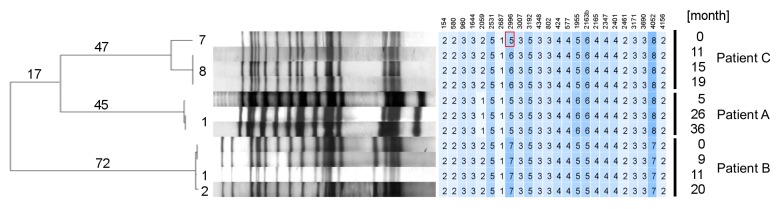
Figure 1. Genotyping data of all analyzed patient derived isolates.
Unrooted UPGMA tree based on 289 concatenated single nucleotide polymorphisms (SNPs) differentiating all analyzed W-Beijing isolates illustrated with corresponding IS6110 RFLP and 24-loci MIRU-VNTR patterns. Vertical lines indicate patient derived isolates. Known resistance conferring SNPs were excluded.
Figure 2
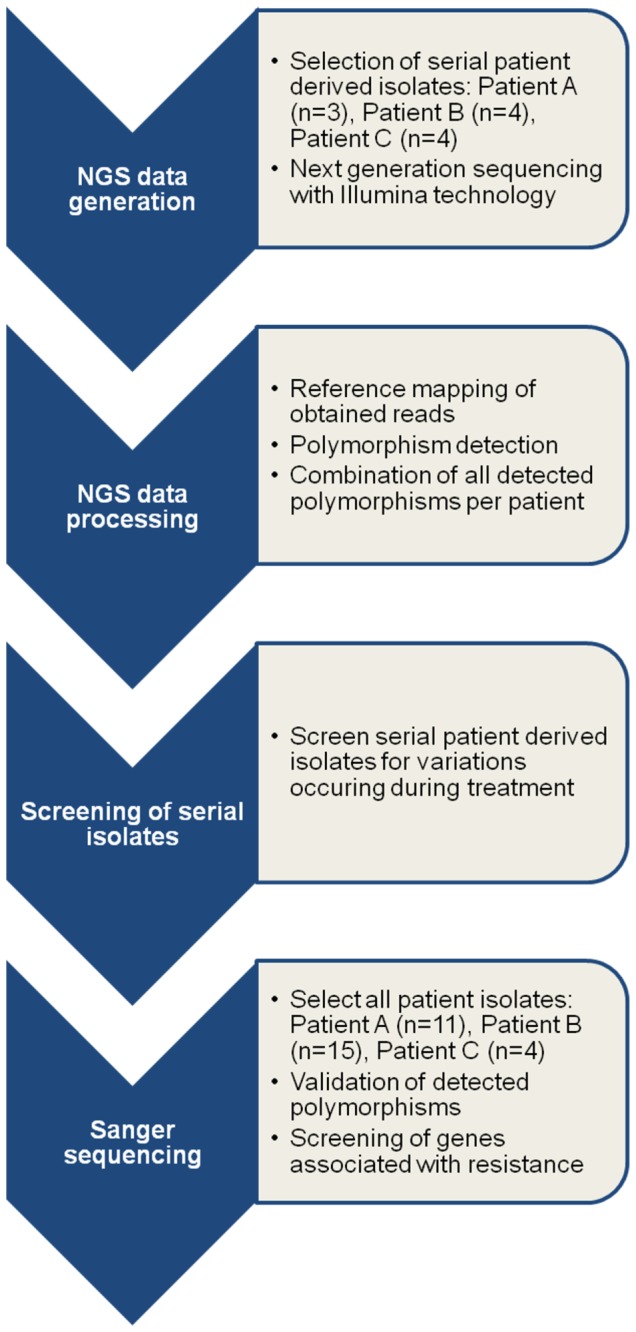
Figure 2. Workflow.
Next generation sequencing (NGS) data can be found under the accession number SRA060746. NGS reads were mapped with SARUMAN (Blom et al. 2011) to the H37Rv reference strain (GenBank ID: NC_000962.2). Variant detection was carried out with in house Perl scripts, followed by screening for high frequency polymorphisms that occurred during treatment. Finally, we validated all detected polymorphisms and genes associated with acquired resistances in each patient with Sanger sequencing in all available serial isolates.
Figure 3
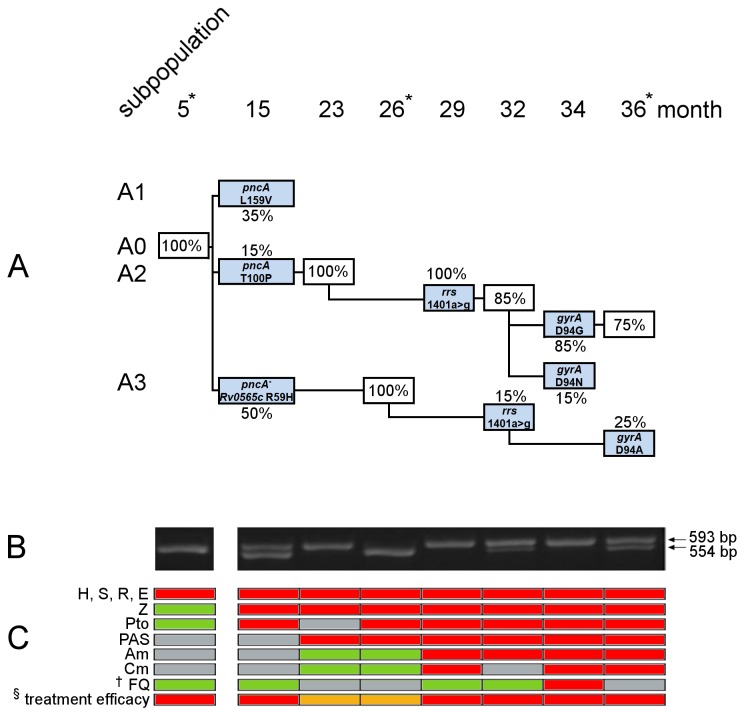
Figure 3. Evolution and competition of Patient A derived clones during MDR-TB therapy.
* Isolates selected for whole genome sequencing (WGS). † Isolate on month 15 was tested susceptible to ofloxacin, isolates on month 29 was tested susceptible to ciprofloxacin, isolate on month 34 was tested resistant to levofloxacin. § Treatment efficacy is annotated as green=more than two effective drugs applied at the given time point, orange=two drugs being active, red=only one drug active or treatment failure. A) Model of intra-patient evolution and competition during 32 months of MDR-TB therapy of different W-Beijing subpopulations (A1, A2, A3) in Patient A originating from the initial clone A0. Newly detected clones are colored in light blue. Peak height ratios calculated by VarDetect [22] of corresponding chromatograms were used to estimate the frequency of predominating subpopulation in all serial patient derived isolates. B) Multiplex-PCR analysis of Patient A derived isolates targeting a 3.1 kb deletion affecting Rv2042 to Rv2045 (including pncA) showing a mixture of clones after 15 month of MDR-TB therapy. The larger fragment (593 bp) represents the presence of that region; the 554 bp fragment is the product of primers flanking the large deletion. C) Resistogram of phenotypic DST results. Red=resistant, green=susceptible, grey=no data. (A detailed description of genotypic and phenotypic drug resistance acquisition of Patient A derived serial isolates, as well as applied regimens are presented in Table S2 in File S1).
Figure 4
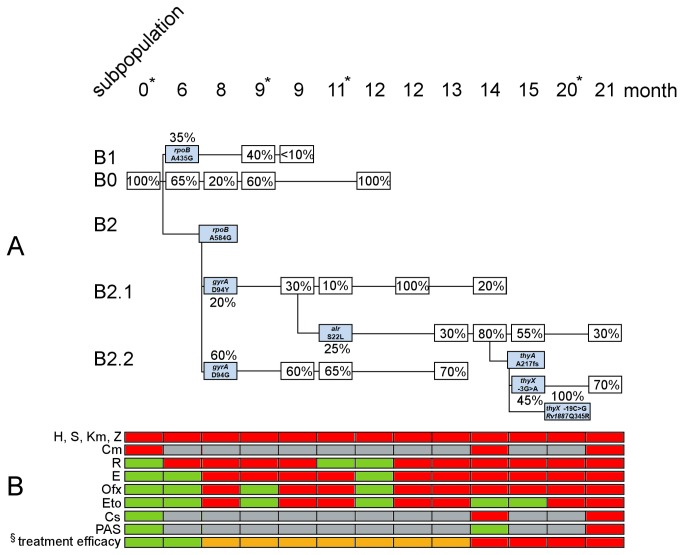
Figure 4. Evolution and competition of Patient B derived clones during MDR-TB therapy.
* Isolates selected for whole genome sequencing (WGS). § Treatment efficacy is annotated as green=more than two effective drugs applied at the given time point, orange=two drugs being active, red=only one drug active or treatment failure. A) Model of intra-patient evolution and competition during 21 months of MDR-TB therapy of different W-Beijing subpopulations (B1, B2, B2.1, B2.2) in Patient B originating from the initial clone B0. Newly detected clones are colored in light blue. Peak height ratios calculated by VarDetect [22] of corresponding chromatograms were used to estimate the frequency of predominating subpopulation in all serial patient derived isolates. B) Resistogram of phenotypic DST results. Red=resistant, green=susceptible, grey=no data. (A detailed description of genotypic and phenotypic drug resistance acquisition of Patient B derived serial isolates, as well as applied regimens are presented in Table S4 in File S1).
Figure 5
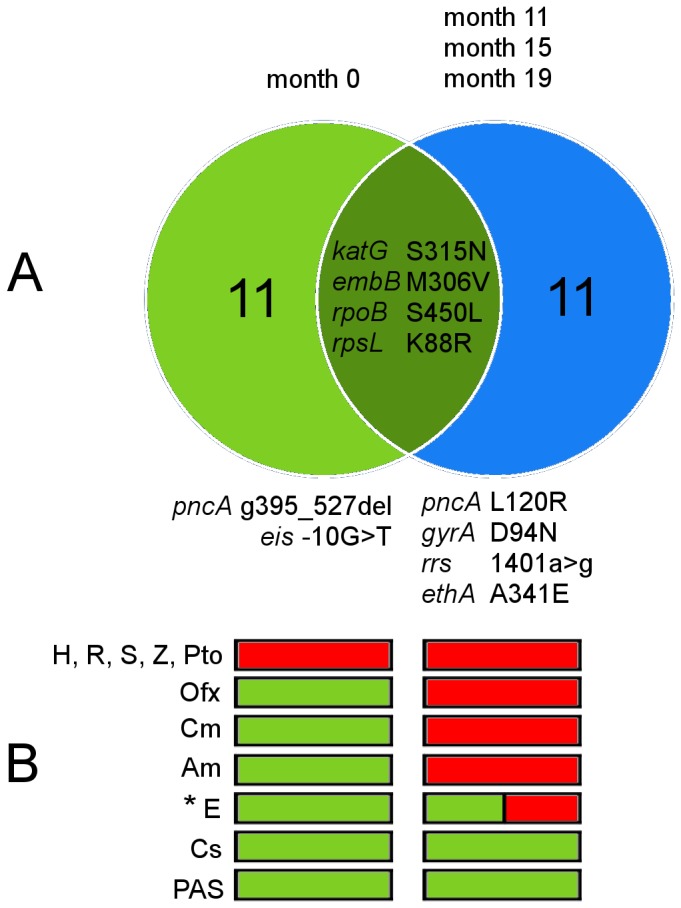
Figure 5. Exogenous re-infection with an XDR strain observed in Patient C.
* Isolate on month 11 was testest susceptible to ethambutol (E), the following isolates on month 15 and 19 were tested phenotypically resistant; all isolates exhibit the mutation embB M306V. A) Venn diagram showing that while the baseline isolate (month 0) and follow up isolates (month 11-19) share common drug resistance mutations and identical IS6110 RFLP fingerprints (Figure 1) both are clearly differentiated by eleven unique polymorphisms including additional drug resistance conferring genes. B) Resistogram of phenotypic DST results. Red=resistant, green=susceptible.

References

    1. WHO (2012) WHO | Tuberculosis Fact sheet. WHO. Available: http://www.who.int/mediacentre/factsheets/fs104/en/. Accessed 5 April 2012
    1. Cox HS, Sibilia C, Feuerriegel S, Kalon S, Polonsky J et al. (2008) Emergence of Extensive Drug Resistance during Treatment for Multidrug-Resistant. Tuberculosis - N Engl J Med 359: 2398–2400. doi: 10.1056/NEJMc0805644. - DOI - PubMed
    1. Ahuja SD, Ashkin D, Avendano M, Banerjee R, Bauer M et al. (2012) Multidrug resistant pulmonary tuberculosis treatment regimens and patient outcomes: an individual patient data meta-analysis of 9,153 patients. PLoS Med 9: e1001300. doi: 10.1371/journal.pmed.1001300. PubMed: 22952439. - DOI - PMC - PubMed
    1. Borrell S, Gagneux S (2009) Infectiousness, reproductive fitness and evolution of drug-resistant Mycobacterium tuberculosis. Int J Tuberc Lung Dis 13: 1456–1466. PubMed: 19919762. - PubMed
    1. De Steenwinkel JEM, ten Kate MT, de Knegt GJ, Kremer K, Aarnoutse RE et al. (2012) Drug susceptibility of Mycobacterium tuberculosis Beijing genotype and association with MDR TB. Emerg Infect Dis 18: 660–663. doi: 10.3201/eid1804.110912. PubMed: 22469099. - DOI - PMC - PubMed

Publication types

MeSH terms

Substances

LinkOut - more resources