


Can RNA-Seq resolve the rapid radiation of advanced moths and butterflies (Hexapoda: Lepidoptera: Apoditrysia)? An exploratory study
- PMID: 24324810
- PMCID: PMC3853519
- DOI: 10.1371/journal.pone.0082615
Can RNA-Seq resolve the rapid radiation of advanced moths and butterflies (Hexapoda: Lepidoptera: Apoditrysia)? An exploratory study
Abstract
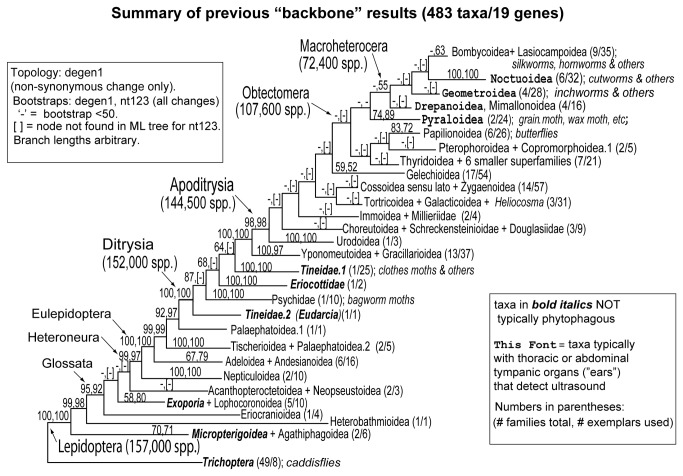
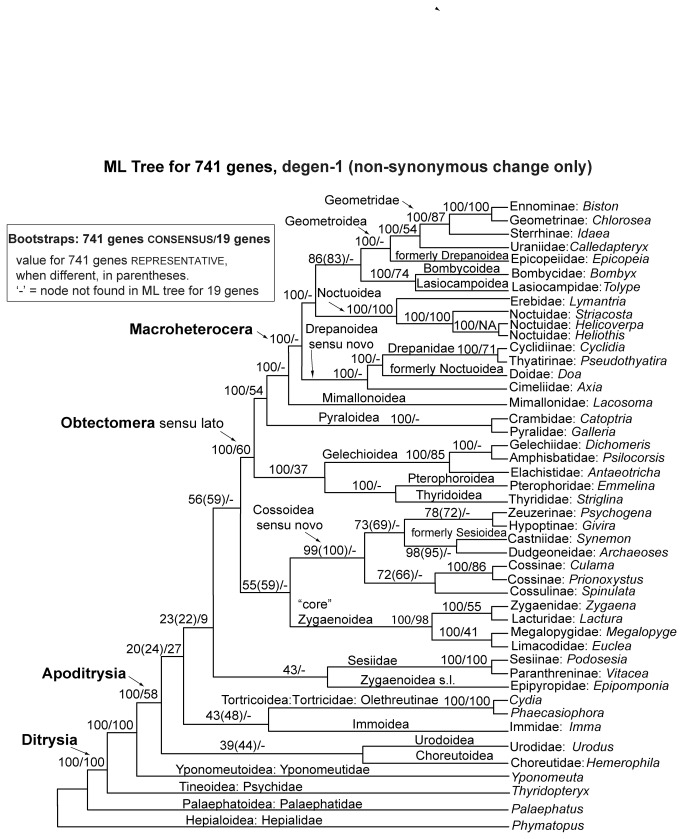
Recent molecular phylogenetic studies of the insect order Lepidoptera have robustly resolved family-level divergences within most superfamilies, and most divergences among the relatively species-poor early-arising superfamilies. In sharp contrast, relationships among the superfamilies of more advanced moths and butterflies that comprise the mega-diverse clade Apoditrysia (ca. 145,000 spp.) remain mostly poorly supported. This uncertainty, in turn, limits our ability to discern the origins, ages and evolutionary consequences of traits hypothesized to promote the spectacular diversification of Apoditrysia. Low support along the apoditrysian "backbone" probably reflects rapid diversification. If so, it may be feasible to strengthen resolution by radically increasing the gene sample, but case studies have been few. We explored the potential of next-generation sequencing to conclusively resolve apoditrysian relationships. We used transcriptome RNA-Seq to generate 1579 putatively orthologous gene sequences across a broad sample of 40 apoditrysians plus four outgroups, to which we added two taxa from previously published data. Phylogenetic analysis of a 46-taxon, 741-gene matrix, resulting from a strict filter that eliminated ortholog groups containing any apparent paralogs, yielded dramatic overall increase in bootstrap support for deeper nodes within Apoditrysia as compared to results from previous and concurrent 19-gene analyses. High support was restricted mainly to the huge subclade Obtectomera broadly defined, in which 11 of 12 nodes subtending multiple superfamilies had bootstrap support of 100%. The strongly supported nodes showed little conflict with groupings from previous studies, and were little affected by changes in taxon sampling, suggesting that they reflect true signal rather than artifacts of massive gene sampling. In contrast, strong support was seen at only 2 of 11 deeper nodes among the "lower", non-obtectomeran apoditrysians. These represent a much harder phylogenetic problem, for which one path to resolution might include further increase in gene sampling, together with improved orthology assignments.
Conflict of interest statement
Figures
References
-
- van Nieukerken EJ, Kaila L, Kitching IJ, Kristensen NP, Lees DC, et al. (2011) Order Lepidoptera Linnaeus, 1758. In Zhang Z.-Q. Animal Biodiversity: An outline of higher level classification and survey of taxonomic richness. Order Lepidoptera Linnaeus, 1758. Zootaxa 3148: 212-221
-
- Wagner DL (2001) Moths. In Levin SA. Encyclopedia of Biodiversity. Academic Press, San Diego, CA. pp. 249-270.
-
- Roe AD, Weller SJ, Baixeras J, Brown J, Cummings MP, et al. (2009) Evolutionary framework for lepidoptera model systems. In Goldsmith M.R., Marec F. Molecular Biology and Genetics of the Lepidoptera. CRC Press / Taylor & Francis; (Contemporary topics in entomology series). Boca Raton, Florida. pp. 1-24
-
- Ehrlich PR, Raven PH (1964) Butterflies and plants: A study in coevolution. Evolution 18: 586–608. doi: 10.2307/2406212. - DOI
-
- Mitter C, Farrell B, Wiegmann BM (1988) The phylogenetic study of adaptive radiation: Has phytophagy promoted insect diversification? Am Nat 132: 107-128. doi: 10.1086/284840. - DOI
Publication types
MeSH terms
Substances
LinkOut - more resources
Full Text Sources
Other Literature Sources
Miscellaneous
