Impact of post-stroke cognitive impairment with no dementia on health-related quality of life
- PMID: 24324939
- PMCID: PMC3779672
- DOI: 10.5853/jos.2013.15.1.49
Impact of post-stroke cognitive impairment with no dementia on health-related quality of life
Abstract
Background and purpose: Health-related quality of life (HRQoL) is a multidimensional concept that signifies a subjective evaluation of perceived health; hence, it has gained wide acceptance in geriatrics. However, its application has not been tested in patients with post-stroke cognitive impairment with no dementia (PSCIND). We investigated whether PSCIND interferes with HRQoL measured by EQ-5D, compared the findings to those of healthy people with normal cognition, and evaluated the influence of each cognitive domain on this score.
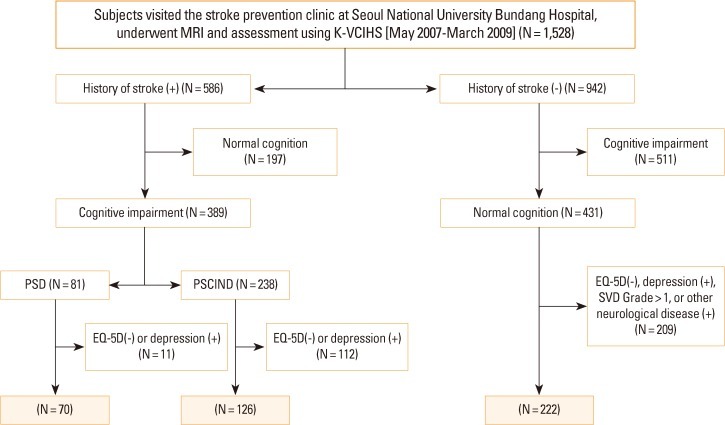
Methods: In total, 1,528 subjects were identified who had undergone neuropsychological assessment using the 60-min protocol of the Korean version of Vascular Cognitive Impairment Harmonization Standards, EQ-5D, and magnetic resonance imaging at the stroke prevention clinic. Fifty PSCIND patients were matched to 50 post-stroke dementia (PSD) patients and 50 normal age- (±3 years) and sex-matched controls. The effects of PSCIND, PSD, and control groups upon the EQ-5Dindex score were tested by generalized estimating equation modeling.
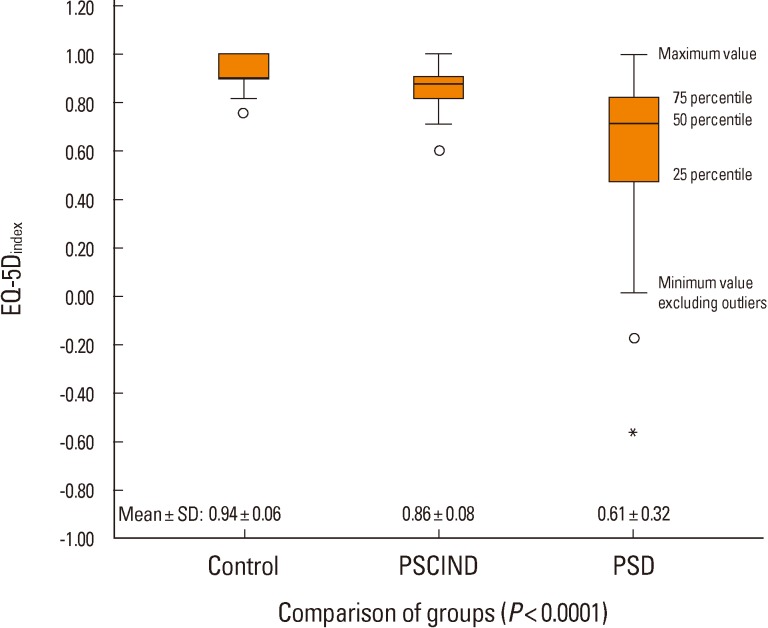
Results: Estimated means±standard errors of EQ-5Dindex scores were as follows: 0.94±0.06 (control group), 0.86±0.08 (PSCIND group), and 0.61±0.32 (PSD group); and the difference among the three groups was statistically significant (P<0.0001). Pairwise comparisons showed that EQ-5Dindex scores in the PSCIND group differed from those in the PSD and control groups (both P<0.01). No cognitive domain was specifically associated with EQ-5Dindex scores after adjusting for functional status.
Conclusions: This study shows that PSCIND may interfere with the quality of life in stroke victims.
Keywords: Dementia; Quality of life; Stroke.
Conflict of interest statement
The authors have no financial conflicts of interest.
Figures
References
-
- Carod-Artal FJ, Egido JA. Quality of life after stroke: the importance of a good recovery. Cerebrovasc Dis. 2009;27(Suppl 1):204–214. - PubMed
-
- The WHOQOL Group. Development of the World Health Organization WHOQOL-BREF quality of life assessment. Psychol Med. 1998;28:551–558. - PubMed
-
- Lees KR, Zivin JA, Ashwood T, Davalos A, Davis SM, Diener HC, et al. NXY-059 for acute ischemic stroke. N Engl J Med. 2006;354:588–600. - PubMed
-
- Woods B, Thorgrimsen L, Spector A, Royan L, Orrell M. Improved quality of life and cognitive stimulation therapy in dementia. Aging Ment Health. 2006;10:219–226. - PubMed
LinkOut - more resources
Full Text Sources
Other Literature Sources