Review
. 2014 Feb;8(1):25-42.
doi: 10.1586/17476348.2014.854167. Epub 2013 Dec 10.

A tale of two cytokines: IL-17 and IL-22 in asthma and infection

Affiliations
Review

A tale of two cytokines: IL-17 and IL-22 in asthma and infection

Michelle L Manni et al. Expert Rev Respir Med. 2014 Feb.

Abstract

The Th17 pathway has recently been shown to play a critical role in host defense, allergic responses and autoimmune inflammation. Th17 cells predominantly produce IL-17 and IL-22, which are two cytokines with broad effects in the lung and other tissues. This review summarizes not only what is currently known about the molecular regulation of this pathway and Th17-related cytokine signaling, but also the roles of these cytokines in pathogen immunity and asthma. In the last 5 years, the Th17 field has rapidly grown and research has revealed that the Th17 pathway is essential in lung pathogenesis in response to exogenous stimuli. As work in the field continues, it is expected that many exciting therapeutic advances will be made for a broad range of diseases.


Figures
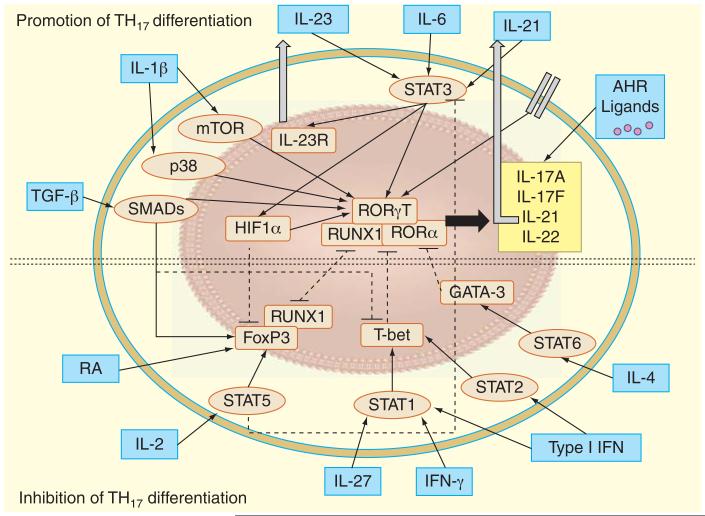
Figure 1
Figure 1. Regulation of Th17 differentiation
Th17 cells are induced upon TCR ligation with presented antigen from dendritic cells in the presence of the cytokines, IL-6, IL-23 and IL-21, which activate signal STAT3. The transcription factors RORγT and RORα activate expression of gene encoding Th17-related cytokine, IL-17A, IL-17F, IL-21 and IL-22. Once secreted, IL-21 acts in an autocrine fashion to further promote Th17 differentiation and proliferation. Further, STAT3 activation via IL-6 increases the expression of IL-23R, thus causing the Th cell to be more sensitive to the polarizing effects of IL-23. Activation of STAT3 also increases expression of HIF1α, which inhibits FoxP3 expression and promotes Th17 polarization. IL-1β promotes Th17 differentiation by activating the AKT/ mTOR and p38 MAPK. TGF-β signals through SMADs to promote Th17 differentiation by activating RORγT and RORα and limiting T-box transcription factor TBX21 (T-bet) expression. Further, TGF-β in conjunction with RA and STAT5 activation via IL-2 can increase FoxP3 expression to promote Treg formation. When stimulated with exogenous ligand, aryl hydrocarbon receptors in the cytosol cause Th17 cells to produce IL-17 and also may negatively regulate STAT1 and STAT5 to enhance Th17 differentiation (not shown). Several cytokines that promote Th1 and Th2 cell polarization oppose Th17 polarization by inhibiting RORγT and RORα expression. For instance, Type 1 interferon signals through STAT1 and 2 signaling and IFN-γ and IL-27 via STAT1 to promote T-bet expression, which inhibits Th17 differentiation. Similarly, IL-4 activates STAT6 to promote the transcription factor GATA-3 expression that inhibits Th17 polarization. Both FoxP3 and RORγT form complexes with Runx1 and therefore regulate each other. RA is known to limit Th17 polarization. Arrowed lines (solid) indicate activation or production, while square lines (dotted) illustrate inhibition. IL-23R: IL-23 receptor; RA: Retinoic acid; RORα: RA-related orphan receptor α; RORγT: RA-related orphan receptor γ thymus; TCR: T-cell receptor; Th: T helper.
Figure 2
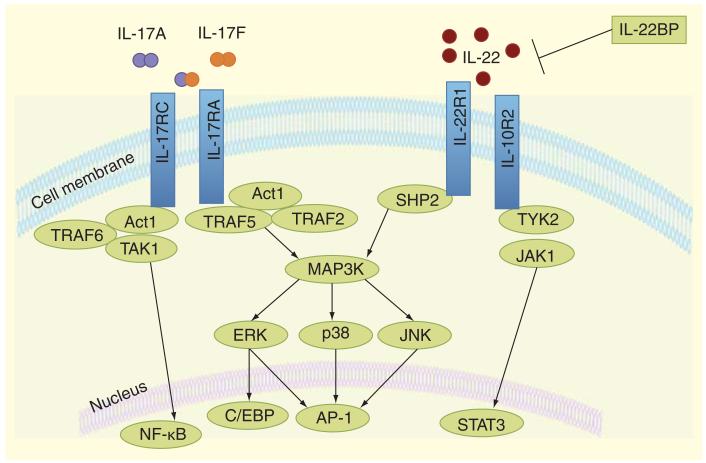
Figure 2. IL-17 and IL-22 signaling pathways
IL-17 and IL-22 bind to transmembrane heterodimeric cell surface receptors to induce cellular signaling pathways. Specifically, IL-17A or IL-17F binds to the IL-17RA and IL-17RC, respectively as homodimers or heterodimers. The binding of IL-17 to its receptor leads to the recruitment of adaptor protein and E3 ligase, Act1. Scaffold proteins TRAF6 and TAK1 interact with Act1 to activate NF-κB expression, which leads to subsequent induction of proinflammatory genes. IL-17 signaling through its receptor also induces ERK, p38, and JNK activation via Act1 binding with TRAF2 and TRAF5. Further, this MAP kinase activation can induce downstream signaling to activate AP-1 and CCAAT/enhancer binding protein (C/EBP). Receptor signaling of IL-22 through its heterodimer receptor of IL-10R2 and IL-22R1 induces phosphorylation of tyrosine kinases Jak1 and Tyk2, which activate the transcription factor STATs. In some cases, MAP kinases (ERK, p38, and JNK) are also activated through a distinct pathway following IL-22R activation. IL-22 binding protein (IL-22BP) acts as a soluble antagonist.
Figure 3
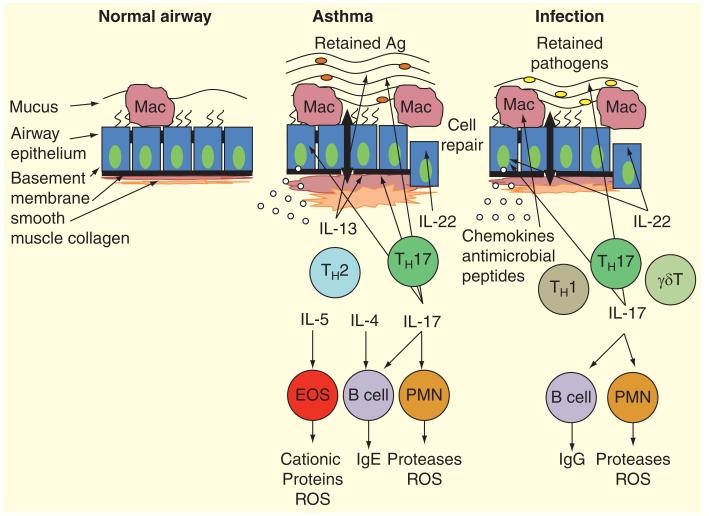
Figure 3. The role of Th17 cytokines in asthma and infection
The normal airway (left panel) is characterized by low or undetectable levels of Th17 cytokines. In the context of allergy (center panel), Th17 and Th2 cells likely interact to drive the airway changes characteristic of disease; mucus metaplasia, smooth muscle hypertrophy, airway wall thickening, and inflammation. IL-17 orchestrates neutrophilic inflammation via the airway epithelium production of chemokines and growth factors. IL-22 functions to regulate epithelial injury. The precise mechanisms by which Th17 cytokines interact with Th2 pathways remain unclear. During infection (right panel) Th17 cells and other sources of IL-17 and IL-22 drive inflammation and pathogen clearance. Many of these functions involve activation of the airway epithelium to produce chemokines and AMPs. It is likely that there is additional crosstalk with Th1 and IFN-γ regulated pathways in many contexts. Ag: Antigen; AMPs: Antimicrobial peptides; EOS: Eosinophils; Ig: Immunoglobulin; Mac: Alveolar macrophage; PMN: Polymorphonuclear cells; ROS: Reactive oxygen species.

References

    1. Zhu J, Paul WE. CD4 T cells: fates, functions, and faults. Blood. 2008;112(5):1557–1569. - PMC - PubMed
    1. Bevan MJ. Helping the CD8(+) T-cell response. Nat. Rev. Immunol. 2004;4(8):595–602. - PubMed
    1. Swain SL, Mckinstry KK, Strutt TM. Expanding roles for CD4(+) T cells in immunity to viruses. Nat. Rev. Immunol. 2012;12(2):136–148. - PMC - PubMed
    1. Muranski P, Restifo NP. Adoptive immunotherapy of cancer using CD4(+) T cells. Curr. Opin. Immunol. 2009;21(2):200–208. - PMC - PubMed
    1. Mosmann TR, Cherwinski H, Bond MW, Giedlin MA, Coffman RL. Two types of murine helper T cell clone. I. Definition according to profiles of lymphokine activities and secreted proteins. J. Immunol. 1986;136(7):2348–2357. - PubMed

Publication types

MeSH terms