


Genetic dissection of drought tolerance in chickpea (Cicer arietinum L.)
- PMID: 24326458
- PMCID: PMC3910274
- DOI: 10.1007/s00122-013-2230-6
Genetic dissection of drought tolerance in chickpea (Cicer arietinum L.)
Abstract
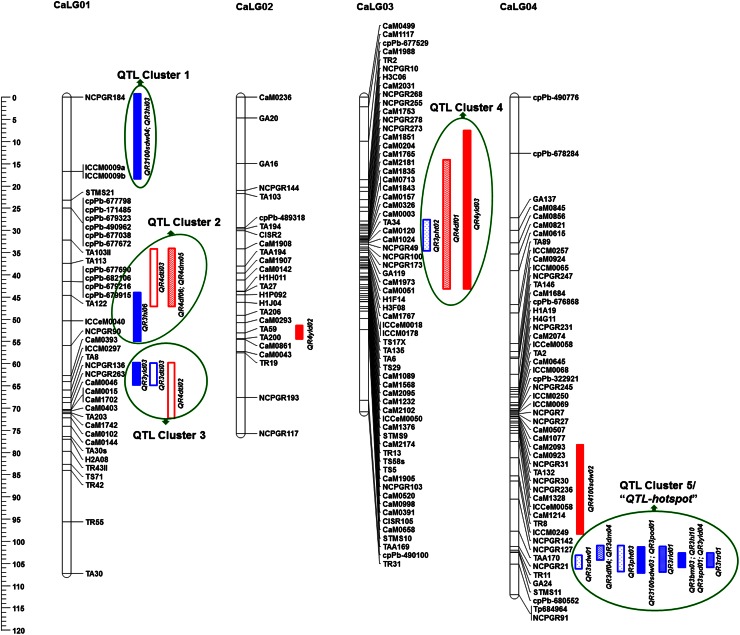
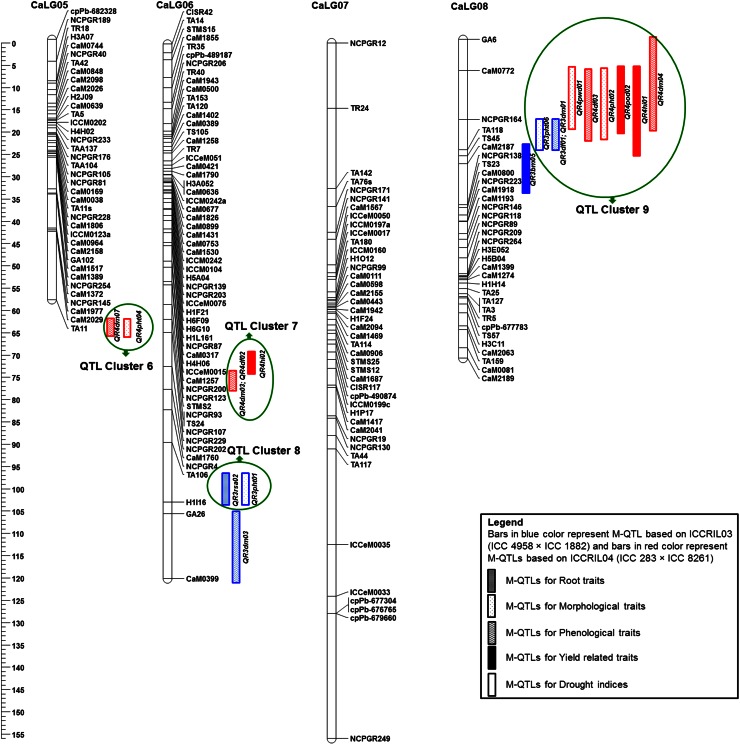
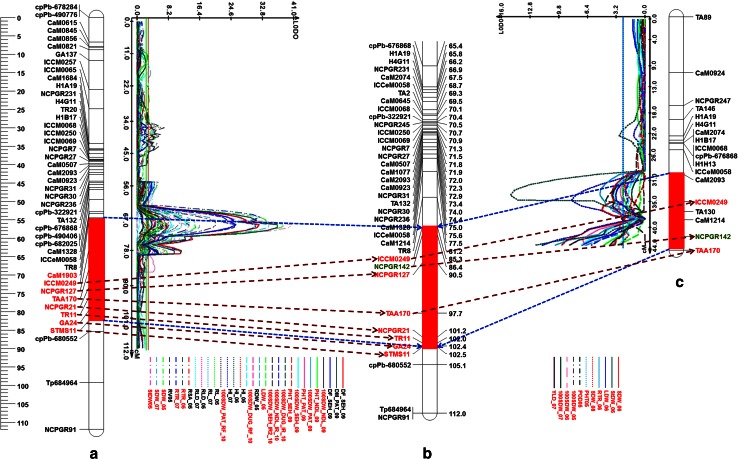
Analysis of phenotypic data for 20 drought tolerance traits in 1-7 seasons at 1-5 locations together with genetic mapping data for two mapping populations provided 9 QTL clusters of which one present on CaLG04 has a high potential to enhance drought tolerance in chickpea improvement. Chickpea (Cicer arietinum L.) is the second most important grain legume cultivated by resource poor farmers in the arid and semi-arid regions of the world. Drought is one of the major constraints leading up to 50% production losses in chickpea. In order to dissect the complex nature of drought tolerance and to use genomics tools for enhancing yield of chickpea under drought conditions, two mapping populations-ICCRIL03 (ICC 4958 × ICC 1882) and ICCRIL04 (ICC 283 × ICC 8261) segregating for drought tolerance-related root traits were phenotyped for a total of 20 drought component traits in 1-7 seasons at 1-5 locations in India. Individual genetic maps comprising 241 loci and 168 loci for ICCRIL03 and ICCRIL04, respectively, and a consensus genetic map comprising 352 loci were constructed ( http://cmap.icrisat.ac.in/cmap/sm/cp/varshney/). Analysis of extensive genotypic and precise phenotypic data revealed 45 robust main-effect QTLs (M-QTLs) explaining up to 58.20% phenotypic variation and 973 epistatic QTLs (E-QTLs) explaining up to 92.19% phenotypic variation for several target traits. Nine QTL clusters containing QTLs for several drought tolerance traits have been identified that can be targeted for molecular breeding. Among these clusters, one cluster harboring 48% robust M-QTLs for 12 traits and explaining about 58.20% phenotypic variation present on CaLG04 has been referred as "QTL-hotspot". This genomic region contains seven SSR markers (ICCM0249, NCPGR127, TAA170, NCPGR21, TR11, GA24 and STMS11). Introgression of this region into elite cultivars is expected to enhance drought tolerance in chickpea.
Figures
References
-
- Abate T, Alene AD, Bergvinson D, Shiferaw B, Silim S, Orr A, Asfaw S (2012) Tropical grain legumes in Africa and south Asia: knowledge and opportunities. SAT eJournal 10:1–12. http://ejournal.icrisat.org/Volume10/IMPI/Research_development.pdf
-
- Ahmad F, Gaur PM, Croser J. Chickpea (Cicer arietinum L.) In: Singh RJ, Jauhar PP, editors. Genetic resources, chromosome engineering, and crop improvement—Grain Legumes. Boca Raton: CRC Press; 2005. pp. 187–217.
-
- Blum A (2011) Plant breeding for water–limited environments, vol 14. Springer, New York, p 258
-
- Bohra A, Saxena RK, Gnanesh BN, Saxena KB, Byregowda M, Rathore A, KaviKishor PB, Cook D, Varshney RK. An intra-specific consensus genetic map of pigeonpea [Cajanus cajan (L) Millspaugh] derived from six mapping populations. Theor Appl Genet. 2012;125:1325–1338. doi: 10.1007/s00122-012-1916-5. - DOI - PMC - PubMed
Publication types
MeSH terms
LinkOut - more resources
Full Text Sources
Other Literature Sources
Miscellaneous
