. 2013:4:2854.
doi: 10.1038/ncomms3854.

Influenza A(H7N9) virus gains neuraminidase inhibitor resistance without loss of in vivo virulence or transmissibility

Affiliations
Free PMC article

Influenza A(H7N9) virus gains neuraminidase inhibitor resistance without loss of in vivo virulence or transmissibility

Rong Hai et al. Nat Commun. 2013.
Free PMC article

Abstract

Without baseline human immunity to the emergent avian influenza A(H7N9) virus, neuraminidase inhibitors are vital for controlling viral replication in severe infections. An amino acid change in the viral neuraminidase associated with drug resistance, NA-R292K (N2 numbering), has been found in some H7N9 clinical isolates. Here we assess the impact of the NA-R292K substitution on antiviral sensitivity and viral replication, pathogenicity and transmissibility of H7N9 viruses. Our data indicate that an H7N9 isolate encoding the NA-R292K substitution is highly resistant to oseltamivir and peramivir and partially resistant to zanamivir. Furthermore, H7N9 reassortants with and without the resistance mutation demonstrate comparable viral replication in primary human respiratory cells, virulence in mice and transmissibility in guinea pigs. Thus, in stark contrast to oseltamivir-resistant seasonal influenza A(H3N2) viruses, H7N9 virus replication and pathogenicity in these models are not substantially altered by the acquisition of high-level oseltamivir resistance due to the NA-R292K mutation.


Figures
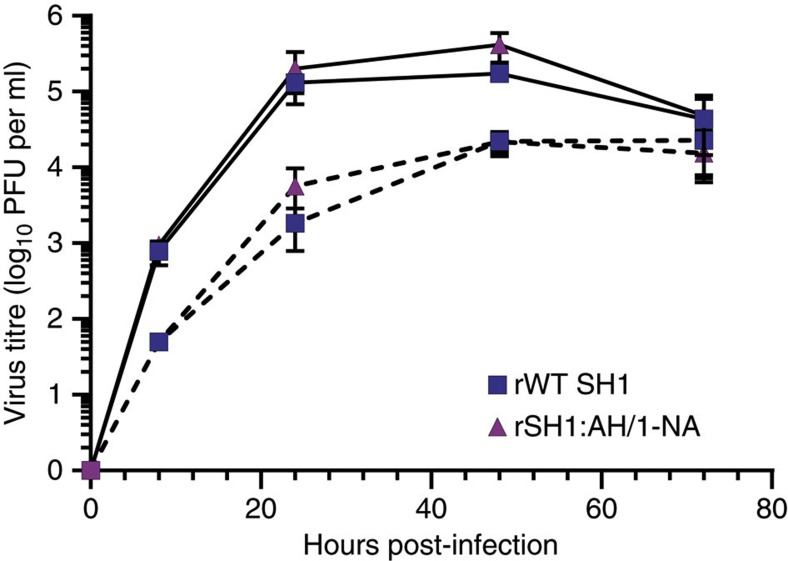
Figure 1
Figure 1. Oseltamivir resistance does not affect viral replication in human tracheobronchial epithelial cells.
Differentiated human tracheobronchial epithelial cells were infected with rSH/1 (squares) or rSH/1:AH/1-NA (triangles) viruses, at an MOI of 0.01, at either 33 °C (dashed line) or 37 °C (solid line). At 8, 24, 48 and 72 h post infection, cells were washed with PBS/BSA and the concentration of virus in each wash sample was determined by standard plaque assay on MDCK cells. The hTBE growth curves were performed in triplicate. Error bars represent s.d.
Figure 2
Figure 2. Oseltamivir resistance in a recombinantly derived H7N9 virus does not modulate viral pathogenicity in mice.
Female BALB/c mice (6–8-week-old) were infected intranasally with various amounts of rSH/1 (squares) or rSH/1:AH/1-NA (triangles) viruses. (a) Viral replication in lung, spleen and intestine. Mice (n=9) were infected intranasally with 100 PFU of rSH/1 (squares) or rSH/1:AH/1-NA (triangles) viruses. On days 2, 4 and 6 post infection, three mice per group were euthanized. The presence of virus in lung, spleen and intestinal tissues was determined by standard plaque assay on MDCK cells. Dashed line indicates the limit of detection (100 PFU ml−1). ND=not detected. (be) Weight loss of mice after infection with rSH/1 (squares) or rSH/1:AH/1-NA (triangles) viruses. Mice (n=5) were infected intranasally with serial 10-fold dilutions of each virus, from 104 to 101 PFU per mouse. The mock animals (circles) were inoculated with PBS/BSA. Following infection, mice were weighed daily, and the average body weights±s.d. of surviving animals in each group up to day 14 post infection are indicated as percentages of the original body weights. Dashed line indicates 75% of initial body weight. (fi) Survival of mice after infection with rSH/1 (squares) or rSH/1:AH/1-NA (triangles) viruses or mock treated (circles). Kaplan–Meier curves represent survival after infection with each virus at 10-fold dilutions from 104 to 101 PFU or mock infection with PBS/BSA (n=5 per group). Please note that experiments be and fi share the same control mock-infected animals. Error bars represent s.d. in all panels.
Figure 3
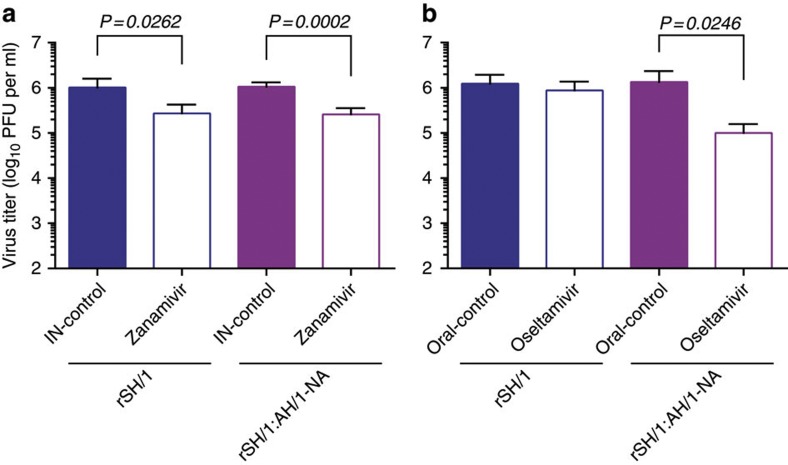
Figure 3. Oseltamivir does not suppress H7N9 virus replication in mice infected with rSH/1.
Female BALB/c mice (6–8-week-old; n=5) were infected intranasally with 100 PFU of rSH/1 (blue) or rSH/1:AH/1-NA (purple) viruses. Mice were treated with intranasal zanamivir (a), oral oseltamivir (b), intranasal PBS vehicle (a) or oral distilled water vehicle (b) twice daily for 5 days. Five mice were euthanized at day 5 post infection and viral lung titres were determined by plaque assays in MDCK cells. Student’s t-test was applied to evaluate the statistical significance between viral titres of control animals and antiviral-treated animals. Error bars indicate s.d. value.

References

    1. De Jong M. D. et al. Oseltamivir resistance during treatment of influenza A (H5N1) infection. N. Engl. J. Med. 353, 2667–2672 (2005). - PubMed
    1. European Centre for Disease Prevention and Control (ECDC). ECDC/WHO frequently asked questions for Oseltamivir Resistance http://ecdc.europa.eu/en/healthtopics/seasonal_influenza/antivirals/page... (2008).
    1. Le Q. M. et al. Avian flu: isolation of drug-resistant H5N1 virus. Nature 437, 1108 (2005). - PubMed
    1. World Health Organization (WHO). Overview of the emergence and characteristics of the avian influenza A(H7N9) virus http://www.who.int/influenza/human_animal_interface/influenza_h7n9/WHO_H... (2013).
    1. World Health Organization (WHO). Influenza at the human-animal interface: Summary and assessment as of 4 June 2013 http://www.who.int/influenza/human_animal_interface/Influenza_Summary_IR... (2013).

Publication types

MeSH terms