


Frequency and outcomes of aortocoronary dissection during percutaneous coronary intervention of chronic total occlusions: a case series and systematic review of the literature
- PMID: 24327476
- PMCID: PMC4053511
- DOI: 10.1002/ccd.25338
Frequency and outcomes of aortocoronary dissection during percutaneous coronary intervention of chronic total occlusions: a case series and systematic review of the literature
Abstract
Background: Aortocoronary dissection can complicate percutaneous coronary intervention (PCI) of chronic total occlusions (CTOs).
Methods: We retrospectively examined the frequency and outcomes of aortocoronary dissection among 336 consecutive CTO PCIs performed at our institution between 2005 and 2012 and performed a systematic review of the published literature.
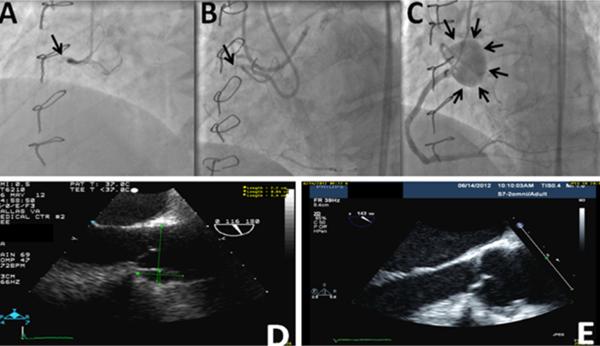
Results: Aortocoronary dissection occurred in six patients (1.8%, 95% confidence intervals 0.7%, 3.8%). All aortocoronary dissections occurred in the right coronary artery (CTO target vessel in five patients and donor vessel in one patient). The baseline clinical characteristics of patients with and without aortocoronary dissection were similar. Compared to patients without, those with aortocoronary dissection were more likely to undergo crossing attempts using the retrograde approach (25% vs. 67%, P = 0.036) and experience a major complication (2.4% vs. 33.3%, P = 0.008). Technical and procedural success rates were similar in both groups. Of the six patients with aortocoronary dissection one underwent emergency coronary bypass graft surgery (CABG), four were treated with ostial stenting, and one was treated conservatively without subsequent adverse clinical outcomes. Systematic literature review provided 107 published cases of aortocoronary dissection during PCI, that occurred mainly in the right coronary artery (74.8%) and were treated with stenting (49.5%), emergency CABG (29%), or conservatively (21.5%).
Conclusions: Aortocoronary dissection is an infrequent complication of CTO PCI and although it can be treated with stents in most patients, it may infrequently require emergency CABG.
Keywords: aortocoronary dissection; chronic total occlusion; complications; percutaneous coronary intervention.
Published 2013. This article is a U.S. Government work and is in the public domain in the USA.
Figures
Comment in
-
The best treatment is prevention: tales of aortocoronary dissection during CTO intervention.Catheter Cardiovasc Interv. 2014 Oct 1;84(4):676. doi: 10.1002/ccd.25633. Catheter Cardiovasc Interv. 2014. PMID: 25251712 No abstract available.
References
-
- Christofferson RD, Lehmann KG, Martin GV, Every N, Caldwell JH, Kapadia SR. Effect of chronic total coronary occlusion on treatment strategy. Am J Cardiol. 2005;95:1088–91. - PubMed
-
- Fefer P, Knudtson ML, Cheema AN, Galbraith PD, Osherov AB, Yalonetsky S, Gannot S, Samuel M, Weisbrod M, Bierstone D. Current perspectives on coronary chronic total occlusions: the Canadian Multicenter Chronic Total Occlusions Registry. J Am Coll Cardiol. 2012;59:991–7. others. - PubMed
-
- Joyal D, Afilalo J, Rinfret S. Effectiveness of recanalization of chronic total occlusions: a systematic review and meta-analysis. Am Heart J. 2010;160:179–87. - PubMed
-
- Grantham JA, Jones PG, Cannon L, Spertus JA. Quantifying the early health status benefits of successful chronic total occlusion recanalization: Results from the FlowCardia's Approach to Chronic Total Occlusion Recanalization (FACTOR) Trial. Circ Cardiovasc Qual Outcomes. 2010;3:284–90. - PubMed
-
- Grantham JA, Marso SP, Spertus J, House J, Holmes DR, Jr., Rutherford BD. Chronic total occlusion angioplasty in the United States. JACC Cardiovasc Interv. 2009;2:479–86. - PubMed
Publication types
MeSH terms
Grants and funding
LinkOut - more resources
Full Text Sources
Other Literature Sources
Medical
Miscellaneous
