. 2013:2013:857986.
doi: 10.1155/2013/857986. Epub 2013 Nov 14.

Identification of Cassava MicroRNAs under Abiotic Stress

Affiliations

Identification of Cassava MicroRNAs under Abiotic Stress

Carolina Ballén-Taborda et al. Int J Genomics. 2013.

Abstract

The study of microRNAs (miRNAs) in plants has gained significant attention in recent years due to their regulatory role during development and in response to biotic and abiotic stresses. Although cassava (Manihot esculenta Crantz) is tolerant to drought and other adverse conditions, most cassava miRNAs have been predicted using bioinformatics alone or through sequencing of plants challenged by biotic stress. Here, we use high-throughput sequencing and different bioinformatics methods to identify potential cassava miRNAs expressed in different tissues subject to heat and drought conditions. We identified 60 miRNAs conserved in other plant species and 821 potential cassava-specific miRNAs. We also predicted 134 and 1002 potential target genes for these two sets of sequences. Using real time PCR, we verified the condition-specific expression of 5 cassava small RNAs relative to a non-stress control. We also found, using publicly available expression data, a significantly lower expression of the predicted target genes of conserved and nonconserved miRNAs under drought stress compared to other cassava genes. Gene Ontology enrichment analysis along with condition specific expression of predicted miRNA targets, allowed us to identify several interesting miRNAs which may play a role in stress-induced posttranscriptional regulation in cassava and other plants.


Figures
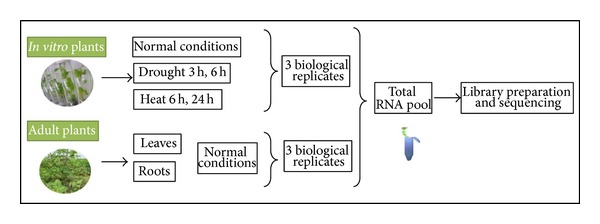
Figure 1
Figure 1
Source materials for RNA extraction, library preparation, and sequencing.
Figure 2
Figure 2
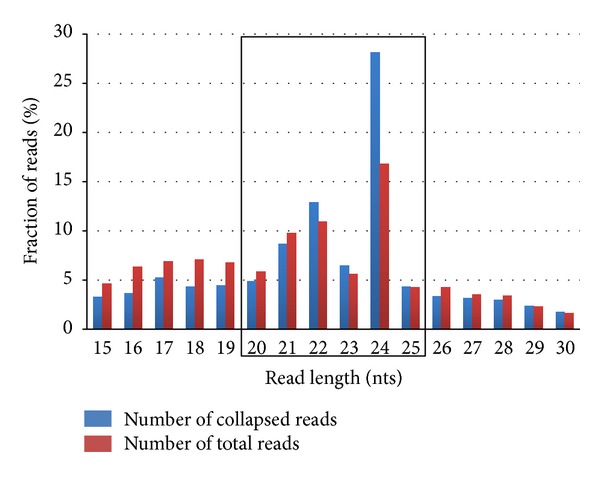
Frequency distribution of cassava small RNAs between 15 to 30 nt. Reads with 20 to 25 nts (black box) in length were selected for further analysis.
Figure 3
Figure 3
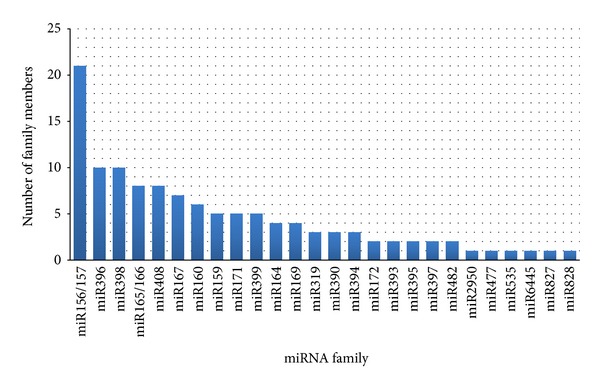
Distribution of 60 conserved cassava miRNAs grouped in 26 different families. Names correspond to homologous small RNAs in other plant species.
Figure 4
Figure 4
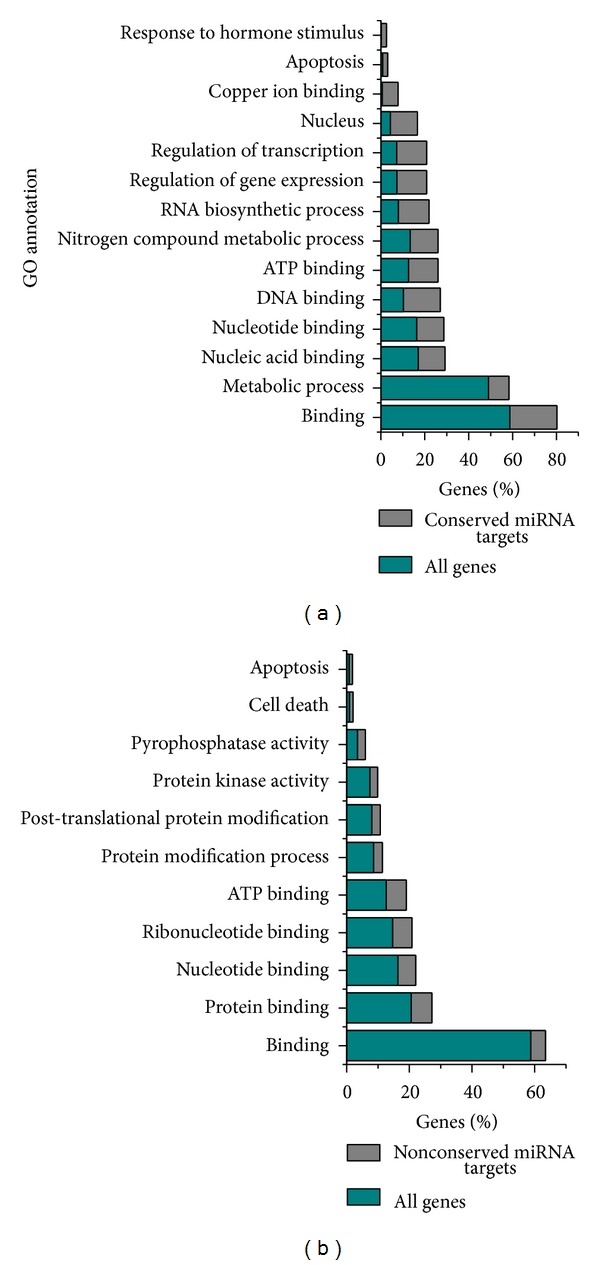
GO enrichment analysis of predicted miRNA targets. (a) Significantly overrepresented GO terms for conserved miRNAs identified in this study. (b) Significantly overrepresented GO terms for possible cassava-specific miRNAs. Cyan and gray bars indicate the fraction of miRNA targets and cassava genes annotated with a corresponding GO term, respectively. See Supplementary Tables 3 and 4 for the full list of significant terms.
Figure 5
Figure 5
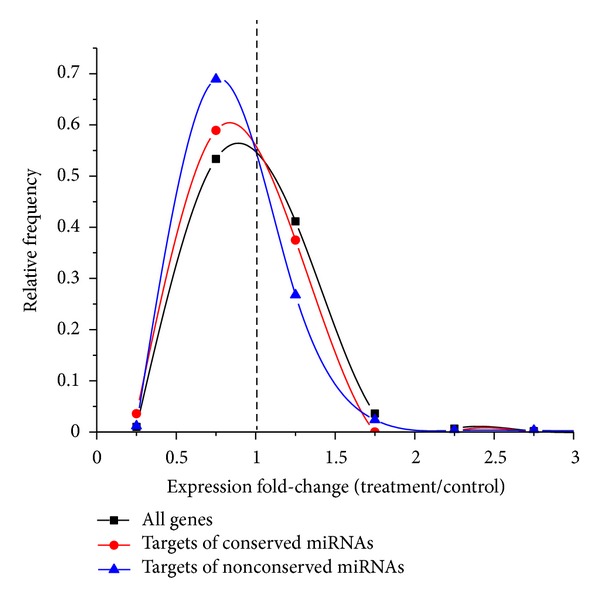
Relative expression levels of cassava genes after exposure to drought-like conditions. Data is from the study by Utsumi et al. [54]. Targets of conserved and nonconserved miRNA candidates display lower expression, on average, compared to all measured cassava genes upon stress treatment.
Figure 6
Figure 6
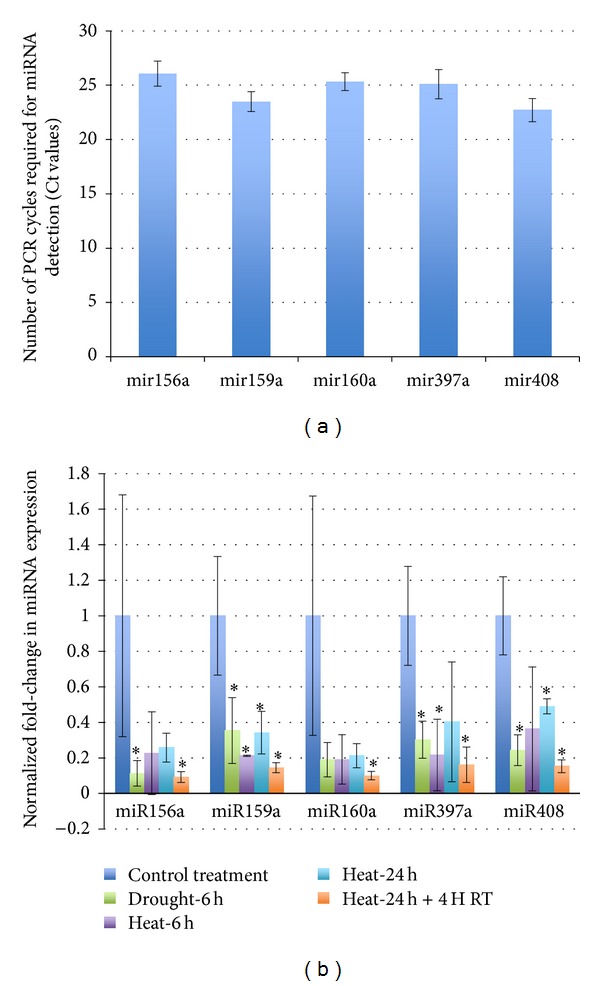
Validation of 5 predicted cassava miRNAs. (a) Mean cycle threshold (Ct) values showing the expression levels of the selected miRNAs under normal conditions; Ct values indicate the number of PCR cycles at which the amplification signal crosses a fixed threshold; lower Ct values correspond to higher expression levels. Error bars correspond to the standard deviation (SD) of Ct values (n = 3). (b) Comparison of the relative expression levels of the selected miRNAs under heat and drought treatments normalized to values in (a) using the 2−ΔΔCt method. 18s rRNA was chosen as an endogenous control; error bars correspond to the normalized SD of 2−ΔΔCt values (n = 3). *: Mann-Whitney P value <0.1; RT: Room temperature.

References

    1. Bartel DP. MicroRNAs: genomics, biogenesis, mechanism, and function. Cell. 2004;116(2):281–297. - PubMed
    1. Song L, Han M, Lesicka J, Fedoroff N. Arabidopsis primary microRNA processing proteins HYL1 and DCL1 define a nuclear body distinct from the Cajal body. Proceedings of the National Academy of Sciences of the United States of America. 2007;104(13):5437–5442. - PMC - PubMed
    1. Jones-Rhoades MW, Bartel DP, Bartel B. MicroRNAs and their regulatory roles in plants. Annual Review of Plant Biology. 2006;57:19–53. - PubMed
    1. Voinnet O. Origin, biogenesis, and activity of plant MicroRNAs. Cell. 2009;136(4):669–687. - PubMed
    1. Brodersen P, Sakvarelidze-Achard L, Bruun-Rasmussen M, et al. Widespread translational inhibition by plant miRNAs and siRNAs. Science. 2008;320(5880):1185–1190. - PubMed

LinkOut - more resources