. 2014 May 1;23(9):990-1000.
doi: 10.1089/scd.2013.0486. Epub 2014 Jan 24.

Dimethyloxaloylglycine increases the bone healing capacity of adipose-derived stem cells by promoting osteogenic differentiation and angiogenic potential

Affiliations

Dimethyloxaloylglycine increases the bone healing capacity of adipose-derived stem cells by promoting osteogenic differentiation and angiogenic potential

Hao Ding et al. Stem Cells Dev. .

Abstract

Hypoxia inducible factor-1α (HIF-1α) plays an important role in angiogenesis-osteogenesis coupling during bone regeneration, which can enhance the bone healing capacity of mesenchymal stem cells (MSCs) by improving their osteogenic and angiogenic activities. Previous studies transduced the HIF-1α gene into MSCs with lentivirus vectors to improve their bone healing capacity. However, the risks due to lentivirus vectors, such as tumorigenesis, should be considered before clinical application. Dimethyloxaloylglycine (DMOG) is a cell-permeable prolyl-4-hydroxylase inhibitor, which can activate the expression of HIF-1α in cells at normal oxygen tension. Therefore, DMOG is expected to be an alternative strategy for enhancing HIF-1α expression in cells. In this study, we explored the osteogenic and angiogenic activities of adipose-derived stem cells (ASCs) treated with different concentrations of DMOG in vitro, and the bone healing capacity of DMOG-treated ASCs combined with hydrogels for treating critical-sized calvarial defects in rats. The results showed that DMOG had no obvious cytotoxic effects on ASCs and could inhibit the death of ASCs induced by serum deprivation. DMOG markedly increased vascular endothelial growth factor production in ASCs in a dose-dependent manner and improved the osteogenic differentiation potential of ASCs by activating the expression of HIF-1α. Rats with critical-sized calvarial defects treated with hydrogels containing DMOG-treated ASCs had more bone regeneration and new vessel formation than the other groups. Therefore, we believe that DMOG enhanced the angiogenic and osteogenic activity of ASCs by activating the expression of HIF-1α, thereby improving the bone healing capacity of ASCs in rat critical-sized calvarial defects.


Figures
<b>FIG. 1.</b>
FIG. 1.
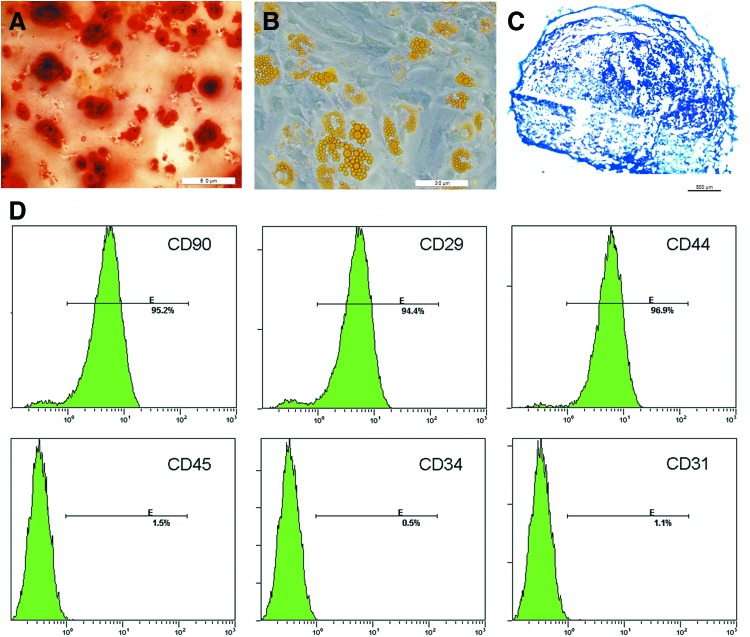
The adipose-derived stem cell (ASC) potential of osteogenic, adipogenic, and chondrogenic differentiation was separately confirmed by alizarin red-S (ARS) staining (A), Oil Red O staining (B), and Alcian blue staining (C). Flow cytometry showed that ASCs had high expression of mesenchymal stem cell markers CD29, CD44, and CD90, whereas low expression of the hematopoietic lineage markers CD31, CD34, and CD45 (D). Color images available online at www.liebertpub.com/scd
<b>FIG. 2.</b>
FIG. 2.
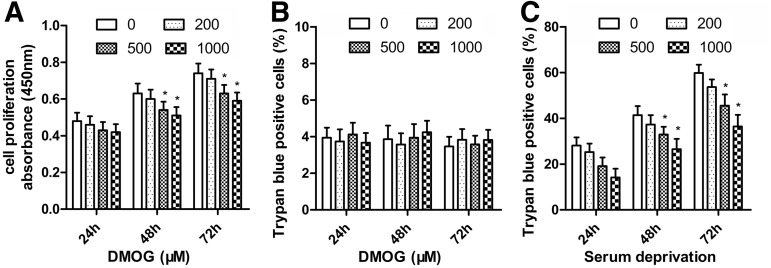
Effect of dimethyloxalylglycine (DMOG) on the proliferation and survival of ASCs. (A) After treatment with different concentrations of DMOG, ASC proliferation was measured with the Cell Counting Kit-8 (CCK-8) and the results are expressed as the mean of absorbance±SEM. (B) ASC death ratio was determined using trypan blue staining after exposure to different concentrations of DMOG. (C) DMOG dose-dependently reduced cell death ratio in serum deprivation conditions (*, significant difference compared with cells treated with culture medium alone, P<0.05).
<b>FIG. 3.</b>
FIG. 3.
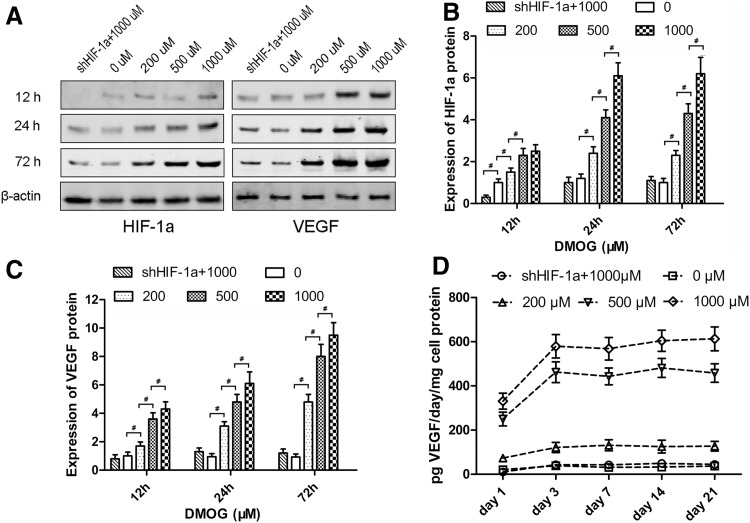
Effect of DMOG on the expression of hypoxia inducible factor-1α (HIF-1α) and vascular endothelial growth factor (VEGF) in ASCs. (A) Western blotting showed that DMOG significantly affected the protein levels of HIF-1α and VEGF in ASCs. (B, C) The analysis suggested that the expression of HIF-1α and VEGF in ASCs was increased by DMOG in a dose-dependent manner, and there was no notable increase in shHIF-1α ASCs treated with 1,000 μM DMOG. (D) Enzyme-linked immunosorbent assay (ELISA) showed the production of VEGF secreted from ASCs treated with different concentrations of DMOG (#, significant difference between the two groups, P<0.05).
<b>FIG. 4.</b>
FIG. 4.
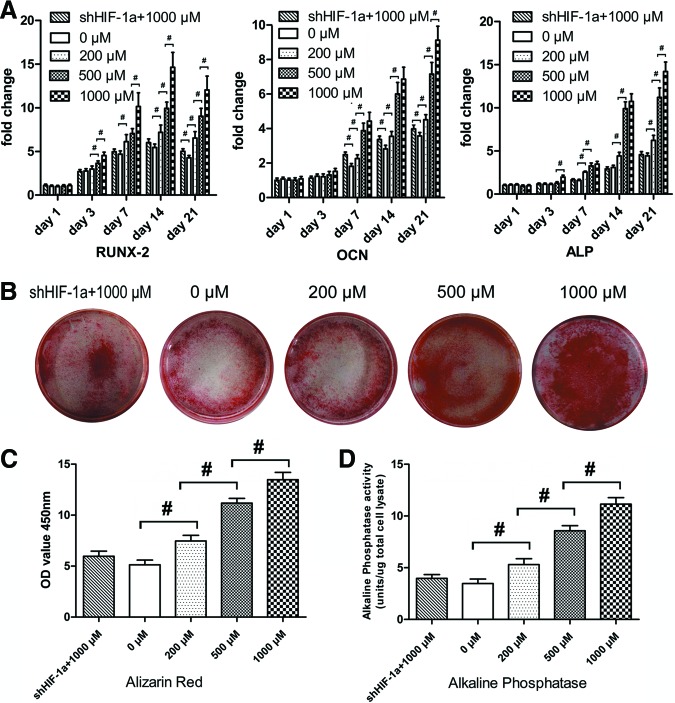
Effect of DMOG on the osteogenic differentiation potential of ASCs. (A) ASCs and shHIF-1α ASCs were cultured in osteogenic differentiation medium with different concentrations of DMOG, and the mRNA expression levels of RUNX-2, osteocalcin (OCN), and alkaline phosphatase (ALP) were detected using quantitative real-time polymerase chain reaction (qRT-PCR). (B) ARS staining of ASCs and shHIF-1α ASCs exposed to different concentrations of DMOG. (C) Spectromorphometric quantification of ARS staining showed that the amount of calcium deposits was significantly increased by DMOG treatment. (D) Semiquantitative analysis of ALP activity (#, significant difference between the two groups, P<0.05). Color images available online at www.liebertpub.com/scd
<b>FIG. 5.</b>
FIG. 5.
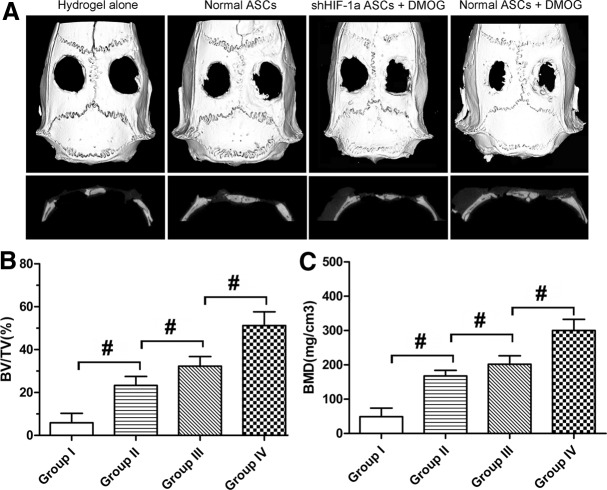
Micro-CT evaluation of the repaired bone defect at 8 weeks after implantation. (A) Micro-CT images of calvarial defects taken 8 weeks after implantation. (B, C) Morphometric analysis showed that the bone volume/total volume (BV/TV) and local bone mineral density (BMD) of the newly formed bone in defects varied in each group (#, significant difference between the two groups, P<0.05).
<b>FIG. 6.</b>
FIG. 6.
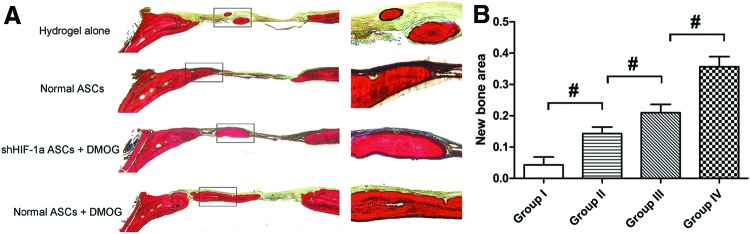
Histological analysis of newly formed bone in the defect area. (A) Representative histological photomicrograph of the newly formed bone in the defect area, which was stained with van Gieson's picrofuchsin. (B) Histomorphometric analysis showed that there were significant differences in the new bone area in the different groups (#, significant difference between the two groups, P<0.05). Color images available online at www.liebertpub.com/scd
<b>FIG. 7.</b>
FIG. 7.
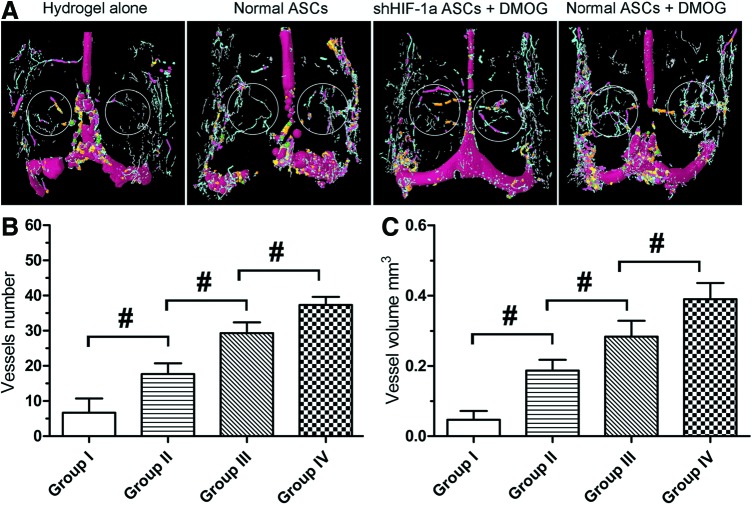
Micro-CT evaluation of revascularization in the defect area at 8 weeks after implantation. (A) Representative images of micro-CT reconstructed three-dimensional microangiography of calvarial defects, which were evaluated from the region of interest (ROI) within the white frame. Vessels with various diameters were marked with different colors (red: 686–999 μm, green: 540–686 μm, yellow: 396–504 μm, orange: 252–360 μm, pink: 144–216 μm, blue: 36–108 μm, and gray: 1–36 μm). (B, C) Quantitative analysis of micro-CT showed mean number of blood vessels and vessel volume in each group (#, significant difference between the two groups, P<0.05). Color images available online at www.liebertpub.com/scd
<b>FIG. 8.</b>
FIG. 8.
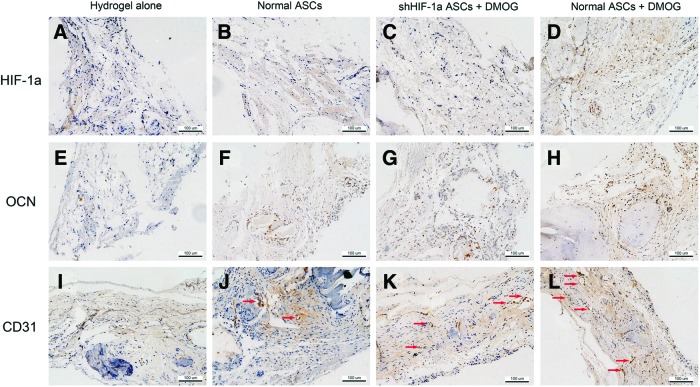
Immunohistochemical analysis of HIF-1α, OCN, and CD31 in the defect area of each group at 8 weeks after implantation. There were no obvious positive staining for HIF-1α in Groups I (A), II (B), and III (C). However, positive brown staining for HIF-1α was apparent in Group IV (D). There were nearly no positive staining for OCN found in Group I (E), a few of positive staining for OCN observed in Groups II (F) and III (G), and more positive staining for OCN in Group IV (H). Blood vessels were defined with the positive CD31 stain and their typical round or oval structure. Immunohistochemistry for CD31 showed that there were more new vessel formation (red arrows) in Group IV (L) than in other three groups (I–K). Color images available online at www.liebertpub.com/scd

References

    1. Louisia S, Stromboni M, Meunier A, Sedel L. and Petite H. (1999). Coral grafting supplemented with bone marrow. J Bone Joint Surg Br 81:719–724 - PubMed
    1. Jo S, Kim S, Cho TH, Shin E, Hwang SJ. and Noh I. (2013). Effects of recombinant human bone morphogenic protein-2 and human bone marrow-derived stromal cells on in vivo bone regeneration of chitosan-poly(ethylene oxide) hydrogel. J Biomed Mater Res A 101:892–901 - PubMed
    1. Mariner PD, Wudel JM, Miller DE, Genova EE, Streubel SO. and Anseth KS. (2013). Synthetic hydrogel scaffold is an effective vehicle for delivery of INFUSE (rhBMP2) to critical-sized calvaria bone defects in rats. J Orthop Res 31:401–406 - PMC - PubMed
    1. Yuan J, Cui L, Zhang WJ, Liu W. and Cao Y. (2007). Repair of canine mandibular bone defects with bone marrow stromal cells and porous beta-tricalcium phosphate. Biomaterials 28:1005–1013 - PubMed
    1. Liu G, Zhao L, Zhang W, Cui L, Liu W. and Cao Y. (2008). Repair of goat tibial defects with bone marrow stromal cells and beta-tricalcium phosphate. J Mater Sci Mater Med 19:2367–2376 - PubMed

Publication types

MeSH terms

Substances

LinkOut - more resources