


The mediating effect of chronic pain on the relationship between obesity and physical function and disability in older adults
- PMID: 24329819
- PMCID: PMC3973183
- DOI: 10.1111/jgs.12512
The mediating effect of chronic pain on the relationship between obesity and physical function and disability in older adults
Abstract
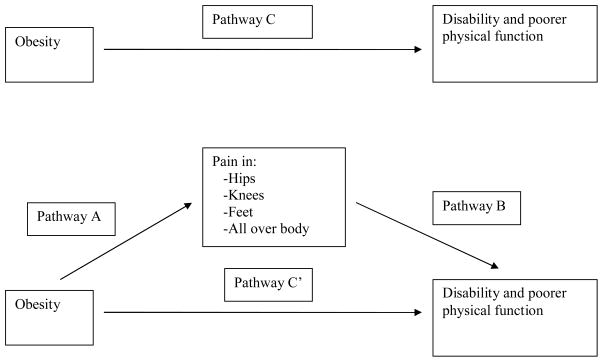
Objectives: To determine the extent to which bodily pain mediates the effect of obesity on disability and physical function.
Design: Cross-sectional analysis.
Setting: Population-based sample of residents in the greater Boston area.
Participants: Community-dwelling adults aged 70 and older (N=736).
Measurements: Body mass index (BMI), obtained from measured height and weight, was categorized as normal weight (19.0-24.9 kg/m2), overweight (25.0-29.9 kg/m2), or obese (≥30.0 kg/m2). Main outcome measures were the Physical Component Summary of the Medical Outcomes Study 12-item Short-Form Survey (PCS), activity of daily living (ADL) disability, and Short Physical Performance Battery (SPPB) score. Chronic pain was assessed according to the number of weight-bearing joint sites that had pain (hips, knees, feet and pain all over).
Results: Older obese adults had greater ADL disability and lower SPPB and PCS scores than their nonobese counterparts, although in sex-stratified adjusted analyses, obesity was adversely associated with outcomes only in women. Obesity was associated with greater number of pain sites; and more pain sites were associated with greater odds of disability. Mediation analysis suggests that pain is a significant mediator (22-44%) of the adverse effect of obesity on disability and physical function in women.
Conclusion: Bodily pain may be an important treatable mediator of the adverse effect of obesity on disability and physical function in women.
Keywords: disability; obesity; pain; physical function.
© 2013, Copyright the Authors Journal compilation © 2013, The American Geriatrics Society.
Conflict of interest statement
Figures
References
-
- Flegal KM, Carroll MD, Ogden CL, et al. Prevalence and trends in obesity among US adults, 1999–2008. JAMA. 2010;303:235–241. - PubMed
-
- Jensen GL. Obesity and functional decline: Epidemiology and geriatric consequences. Clin Geriatr Med. 2005;21:677–87. - PubMed
-
- Jensen GL, Silver HJ, Roy MA, et al. Obesity is a risk factor for reporting homebound status among community-dwelling older persons. Obesity (Silver Spring) 2006;14:509–517. - PubMed
-
- Lee JS, Kritchevsky SB, Tylavsky F, et al. Weight change, weight change intention, and the incidence of mobility limitation in well-functioning community-dwelling older adults. J Gerontol A Biol Sci Med Sci. 2005;60:1007–1012. - PubMed
-
- Bhattacharya J, Choudhry K, Lakdawalla D. Chronic disease and severe disability among working-age populations. Med Care. 2008;46:92–100. - PubMed
Publication types
MeSH terms
Grants and funding
LinkOut - more resources
Full Text Sources
Other Literature Sources
Medical
