Review
. 2014 Mar;39(5):705-19.
doi: 10.1111/ejn.12453. Epub 2013 Dec 13.

Neurosystems: brain rhythms and cognitive processing

Affiliations
Review

Neurosystems: brain rhythms and cognitive processing

Jonathan Cannon et al. Eur J Neurosci. 2014 Mar.

Abstract

Neuronal rhythms are ubiquitous features of brain dynamics, and are highly correlated with cognitive processing. However, the relationship between the physiological mechanisms producing these rhythms and the functions associated with the rhythms remains mysterious. This article investigates the contributions of rhythms to basic cognitive computations (such as filtering signals by coherence and/or frequency) and to major cognitive functions (such as attention and multi-modal coordination). We offer support to the premise that the physiology underlying brain rhythms plays an essential role in how these rhythms facilitate some cognitive operations.

Keywords: attention; beta rhythm; coherence filtering; frequency filtering; gamma rhythm.


Figures

Figure 1
Figure 1
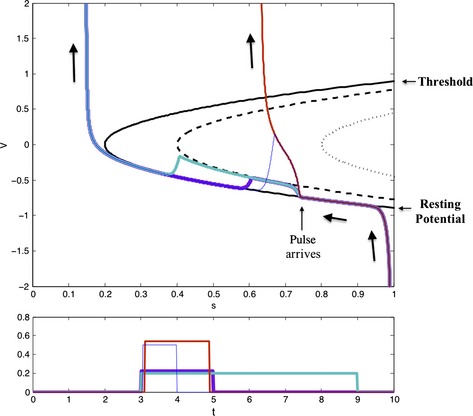
An E–I network acts as a coherence filter. Four different pulses are delivered to the E‐cell after an inhibitory spike. V is the membrane potential of a quadratic integrate and fire neuron (Latham et al., 2000) recovering from inhibition, and s is the strength of the inhibitory current (as a fraction of peak inhibition). V asymptotes to a stable resting voltage, which increases as s decays. The threshold voltage (above which V spikes) decreases with s. When s = 0.2, the stable resting voltage meets the threshold voltage, and the cell spikes. The lower branch of the solid parabola is the stable resting voltage, and the upper branch is the threshold voltage. During a square pulse of height 0.2 (purple, cyan), the resting and threshold voltages shift to the dashed parabola. The membrane potential asymptotes to the new resting voltage and returns after the pulse, so a 6‐ms‐long pulse has the same effect as a 2‐ms‐long pulse. During a square pulse of height 0.4, the resting and threshold voltages shift to the dotted parabola – the leak current is overpowered, and the resting and threshold voltages disappear. A 2‐ms‐long pulse of this height (red) evokes a spike even though it carries less current than the longer, shorter pulse. However, at very short time scales, the amount of current can still be a limiting factor – a 1‐ms‐long pulse of height 0.6 (blue) does not carry enough current to reach a high voltage before the pulse is over.
Figure 2
Figure 2
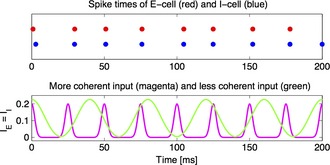
A coherent pulse phase locks a PING circuit and blocks a less coherent signal. The less coherent input is greater not only in temporal average, but also in amplitude. Nonetheless, the target network (an E–I pair) mostly follows the more coherent input, with some perturbations being caused by the less coherent one. Reproduction of fig. 3C of Börgers & Kopell (2008).
Figure 3
Figure 3
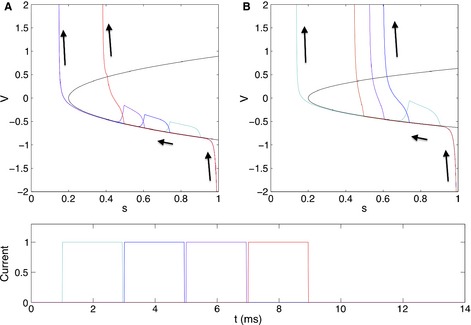
Feedback inhibition determines frequency selectivity. Gamma frequency is more selective for pulse frequency when feedback inhibition is stronger. This is because a pulse can only evoke an excitatory spike and end the gamma cycle if it arrives under sufficiently low inhibition. In this figure, a pulse arrives after an inhibitory spike with four different delays. V is the membrane potential of a quadratic integrate and fire E‐cell, and s is the saturation of the E–I synapse. The lower branch of the parabola is the stable resting voltage, and the upper branch is the threshold voltage. (A) When E–I connections are strong, only the latest pulse arrives under low enough inhibition to evoke an excitatory spike and shorten the period of this gamma cycle. (B) In a system with the same natural frequency but weaker E–I connections, the three later pulses can all evoke excitatory spikes.
Figure 4
Figure 4
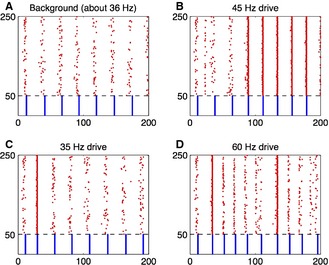
Frequency selectivity occurs in large, heterogeneous E–I networks. Spike rastergram for weak PING. Red dots indicate spike times of E‐cells, and blue dots spike times of I‐cells. The horizontal axis is time in milliseconds. All parameters are as in fig. 1b of Kopell et al. (2010b), with two exceptions: (i) the network is larger here – 200 E‐cells and 50 I‐cells; (ii) synaptic inputs per cell are somewhat stronger – here, using the notation of Kopell et al. (2010b), ĝIE = ĝEI = ĝII = 1.5 (the values used by Kopell et al. were ĝIE = 1.5, ĝEI = ĝII = 0.5.) (A) PING rhythm without forcing. (B–D) Same as (A), but with additional oscillatory input of different frequencies to both E‐cells and I‐cells. The form of the additional input is I(t) = 1 + tanh(10[cos(2πt/T) − 1]), where T is the period, and with a constant of proportionality chosen so that the temporal average of I(t) equals 1 (for E‐cells) and 0.5 (for I‐cells).
Figure 5
Figure 5
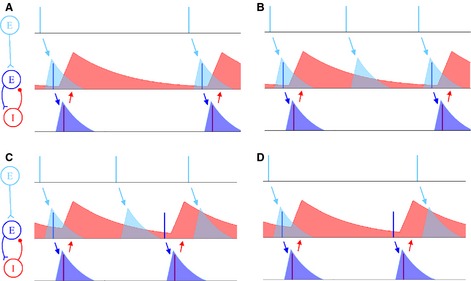
Creation of an optimal phase relationship for CTC. (A) EPSCs from an upstream population successfully induce 1 : 1 phase‐locking by periodically driving the E‐cell above its inhibition and triggering an excitatory volley, which is immediately followed by an inhibitory volley. When the circuit is phase‐locked, input pulses arrive when inhibition is low, an optimal condition for CTC. (B–D) EPSCs fail to phase‐lock the network 1 : 1, owing to frequency mismatch. (B) The forcing period is too short to phase‐lock the PING circuit 1 : 1, but it can phase‐lock the PING circuit 2 : 1 – the second pulse arrives when the E‐cell is under too much inhibition to spike, but the third one evokes an excitatory volley. (C) The forcing period is too short to phase‐lock the circuit. As in B, the second pulse arrives too early to evoke an excitatory spike; unlike in B, the third pulse is too late, and arrives under heavy inhibition. (D) The forcing period is too long to phase‐lock the circuit. The E‐cell recovers from inhibition, spikes, and triggers an inhibitory spike before the second pulse arrives. The second pulse arrives under too much inhibition to evoke another excitatory spike.
Figure 6
Figure 6
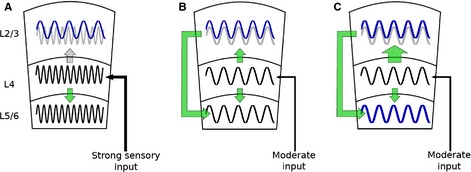
Different inputs to the sensory laminar neocortex may activate different modes of laminar engagement. The laminar schematic shown here illustrates L2/3, L4, and L5/6. Sinusoids depict gamma rhythms in each layer. The light gray sinusoid in L2/3 depicts oscillatory input from L4. Signal flow is depicted by green arrows. The size of the arrow denotes the relative strength of connection. (A) A strong sensory stimulus arrives from the thalamus to L4, producing a gamma rhythm (black trace). The rhythm in L4 is directly coherent with the L5 output layer. We propose that sensory information carried in the gamma frequency goes directly from L4 to L5/6. In contrast, the rhythm in L2/3 is at a lower gamma frequency than that in L4 and L5/6. Although immediate sensory information may not be processed directly by L2/3, the interaction of different gamma rhythms is predicted to create plasticity between L2/3 and L4. (B) In a more difficult task, such as a search task that requires context matching, moderate sensory input engages gamma rhythms in L4 that lock in frequency to L2/3. Sensory information is transmitted from L4 to L2/3. In contrast to A, L2/3 has a direct effect on L5/6 output. (C) Plasticity between E‐cell populations in L4 and L2/3 (denoted by the larger green arrow) is predicted to recruit activity in L2/3 that can increase the output of L5/6.
Figure 7
Figure 7
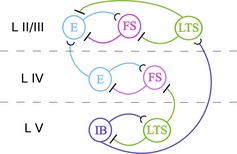
Most relevant cell types and connections for the model of a single cortical column in Lee et al. (2013). E, a population of regular‐spiking pyramidal neurons; FS, a population of FS interneurons; LTS, a population of LTS interneurons; IB, a population of IB pyramidal cells. All interneurons are inhibitory; all pyramidal cells are excitatory.
Figure 8
Figure 8
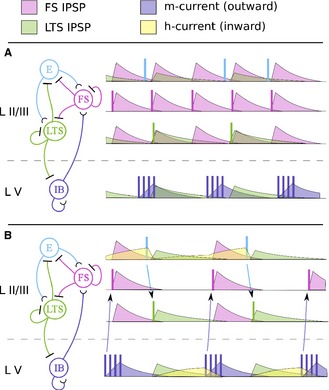
Beta 1 rhythm emerges from concatenation of gamma cycles and beta 2 cycles. Left – circuit diagrams portraying relevant connectivity between superficial FS interneurons, LTS interneurons, regular‐spiking pyramidal neurons (E), and deep‐layer IB neurons. Right – dynamics of each population over time, vertically aligned and color‐coded by cell type. Population spikes are portrayed as vertical lines. The time courses of synaptic and intrinsic currents are color‐coded by current type. (A) Under heavy kainate drive, a column of the cortex generates coexisting gamma and beta 2 rhythms in the superficial layers and deep layers, respectively. Gamma rhythms are paced by the rhythmic production of FS IPSPs, and beta 2 rhythms are paced by the rise and decay of the M‐current in IB neurons. (B) Under less drive and after plasticity, a column of the cortex generates a beta 1 rhythm that is coherent between superficial and deep layers. Owing to low drive, the H‐current builds up in the E and IB populations during IPSPs. When each IPSP wears off, the excitation provided by the H‐current triggers E or IB spikes, which, in turn, trigger LTS or FS spikes, respectively. FS and LTS create IPSPs in alternation, and beta 1 rhythms are paced by the concatenation of the gamma and beta 2 cycles.

References

    1. Agarwal, R. & Sarma, S.V. (2012) The effects of DBS patterns on basal ganglia activity and thalamic relay. J. Comput. Neurosci., 33, 151–167. - PubMed
    1. Ainsworth, M. , Lee, S. , Cunningham, M.O. , Roopun, A.K. , Traub, R.D. , Kopell, N.J. & Whittington, M.A. (2011) Dual gamma rhythm generators control interlaminar synchrony in auditory cortex. J. Neurosci., 31, 17040–17051. - PMC - PubMed
    1. Ainsworth, M. , Lee, S. , Cunningham, M.O. , Traub, R.D. , Kopell, N.J. & Whittington, M.A. (2012) Rates and rhythms: a synergistic view of frequency and temporal coding in neuronal networks. Neuron, 75, 572–583. - PubMed
    1. Akam, T.E. & Kullmann, D.M. (2012) Efficient “communication through coherence” requires oscillations structured to minimize interference between signals. PLoS Comput. Biol., 8, e1002760. - PMC - PubMed
    1. Akam, T. , Oren, I. , Mantoan, L. , Ferenczi, E. & Kullmann, D.M. (2012) Oscillatory dynamics in the hippocampus support dentate gyrus–CA3 coupling. Nat. Neurosci., 15, 763–768. - PMC - PubMed

Publication types

LinkOut - more resources