Review
. 2014 Jan;20(1):3-9.
doi: 10.1111/cns.12166. Epub 2013 Dec 12.

The role of diffusion tensor imaging in detecting microstructural changes in prodromal Alzheimer's disease

Affiliations
Review

The role of diffusion tensor imaging in detecting microstructural changes in prodromal Alzheimer's disease

Bing Zhang et al. CNS Neurosci Ther. 2014 Jan.

Abstract

The MRI technique diffusion tensor imaging (DTI) is reviewed along with microstructural changes associated with prodromal Alzheimer's disease (AD) as a potential biomarker for clinical applications. The prodromal stage of AD is characterized by mild cognitive impairment (MCI), representing a transitional state between normal aging and AD. Microstructural abnormalities on DTI are promising in vivo biomarkers of gray and white matter changes associated with the progression of AD pathology. Elevated mean diffusivity and decreased fractional anisotropy are consistently found in prodromal AD, and even in cognitively normal elderly who progress to MCI. However, quality of parameter maps may be affected by artifacts of motion, susceptibility, and eddy current-induced distortions. The DTI maps are typically analyzed by region-of-interest or voxel-based analytic techniques such as tract-based spatial statistics. DTI-based index of diffusivity is complementary to macrostructural gray matter changes in the hippocampus in detecting prodromal AD. Breakdown of structural connectivity measured with DTI may impact cognitive performance during early AD. Furthermore, assessment of hippocampal connections may help in understanding the cerebral organization and remodeling associated with treatment response.

Keywords: Alzheimer's disease; Diffusion tensor imaging; Microstructural changes; Mild cognitive impairment.


Conflict of interest statement

The authors have no conflict of interest.

Figures
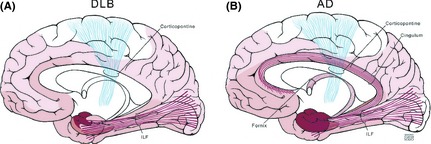
Figure 1
Figure 1
Diffusivity changes that characterize Alzheimer disease (AD) and dementia with Lewy bodies (DLB) follow pathologic progression. Distribution of Lewy body pathology (A) and neurofibrillary pathology of AD (B) are (A). In the cerebral cortex, the earliest and most severe involvement with the Lewy body pathology is in the amygdala (shown in dark red). Lewy body pathology spreads to the temporal, occipital, and basal frontal association cortices as the disease progresses (shown in light red). In keeping with the topography of pathologic involvement, diffusivity changes in the amygdala and the temporo‐occipital connections carried by the inferior longitudinal fasciculus (ILF) (shown in red) characterize the diffusion tensor imaging (DTI) abnormalities in DLB. The primary motor cortex (shown in white) and the corticopontine tracts (shown in blue) are generally spared and do not show DTI changes. (B) Hippocampus and the parahippocampal gyrus are the earliest regions to be involved with the neurofibrillary pathology of AD (shown in dark red). The neurofibrillary pathology spreads to the temporal and parietal lobe association cortices as the disease progresses (shown in light red). Diffusivity changes in AD follow the distribution of the neurofibrillary pathology and the associated neurodegeneration. The most significant DTI abnormalities are in the hippocampus and parahippocampal gyrus, and in the connecting tracts to these regions such as the ILF, cingulum, and fornix (shown in red). The primary motor cortex (shown in white) and the corticopontine tracts (shown in blue) are generally spared and do not show DTI changes (Reprinted, with permission from Mayo foundation and Neurology 12).
Figure 2
Figure 2
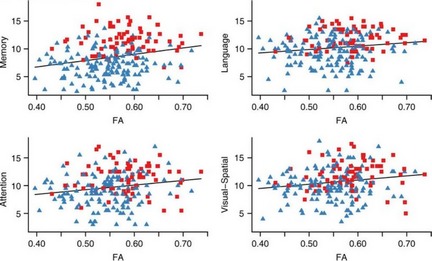
Scatter plots showing the relationship between Mayo Older American Normative Studies (MOANS) scores in cognitive domain and fractional anisotropy (FA) values for posterior cingulum tract. Red squares indicate cognitively normal subjects, while blue triangles represent subjects with mild cognitive impairment. FA in posterior cingulum decreased with the decreasing of clinical rating scores (MOANS) related with all 4 cognitive domain functions (memory, language, attention/executive function, and visual–spatial processing domains), in agreement with the hypothesis that the posterior cingulate cortex is the main connectivity hub for cognitive brain networks. (Reprinted, with permission from Neurology 17).

References

    1. Petersen RC, Roberts RO, Knopman DS, et al. Mild cognitive impairment: Ten years later. Arch Neurol 2009;66:1447–1455. - PMC - PubMed
    1. Petersen RC, Doody R, Kurz A, et al. Current concepts in mild cognitive impairment. Arch Neurol 2001;58:1985–1992. - PubMed
    1. Petersen RC, Smith GE, Waring SC, Ivnik RJ, Tangalos EG, Kokmen E. Mild cognitive impairment: Clinical char‐acterization and outcome. Arch Neurol 1999;56:303–308. - PubMed
    1. Reisberg B, Ferris SH, de Leon M. Stage‐specific behavioral, cognitive, and in vivo changes in community residing subjects with age‐associated memory impairment and primary degenerative dementia of the Alzheimer type. Drug Dev Res 1988;15:101–114.
    1. Jack CR, Lowe VJ, Weigand SD, et al. Serial PIB and MRI in normal, mild cognitive impairment and Alzheimer's disease: Implications for sequence of pathological events in Alzheimer's disease. Brain 2009;132:1355–1365. - PMC - PubMed