. 2013 Dec 13:12:162.
doi: 10.1186/1476-4598-12-162.

Effects of miR-193a and sorafenib on hepatocellular carcinoma cells

Affiliations

Effects of miR-193a and sorafenib on hepatocellular carcinoma cells

Alessandro Salvi et al. Mol Cancer. .

Abstract

Background: Hepatocellular carcinoma (HCC) is a challenging malignancy of global importance, it is the third most common cause of cancer-related mortality worldwide. In the last years the multikinase inhibitor sorafenib has been used for advanced HCC, but some patients do not benefit from this therapy; thus, novel therapeutic options based on molecular approaches are urgently needed. microRNAs are short non coding RNAs involved in several physiological and pathological conditions including HCC and increasing evidence describes miRs as good tools for the molecular targeted therapies in HCC. The purpose of this study was to identify novel approaches to sensitize the HCC cells to sorafenib by microRNAs targeting urokinase-type plasminogen activator (uPA).

Methods: The miR-193a was validated as negative regulator of urokinase-type plasminogen activator (uPA) in 2 HCC undifferentiated cell lines by transient transfection of miR and anti-miR molecules. The molecular interaction between miR-193a and uPA mRNA target was verified by luciferase reporter assay. The miR-193a expression level was evaluated by stem-loop real time PCR in tumoral tissues from 39 HCC patients. The HCC cells were co-treated with sorafenib and miR-193a and the effects on cellular proliferation, apoptosis were tested. The effect of sorafenib on c-met expression levels was assessed by western blotting.

Results: The miR-193a has resulted a negative regulator of uPA in both the HCC cell lines tested. The miR-193a expression has resulted dysregulated in tumoral tissues from 39 HCC patients. We found miR-193a down-regulation in HCC respect to peritumoral (PT) tissues and more in the cirrhotic HCCs than in non-cirrhotic ones. Transfection of HA22T/VGH HCC cells with miR-193a decreased proliferation and increased apoptosis, and combined treatment with miR-193a and sorafenib led to further proliferation inhibition.

Conclusions: Our results present new advances in the post-transcriptional miR-mediated mechanisms of uPA and they suggest a new strategy to impair the aggressive behavior of HCC cells. Our findings could be helpful to explore novel approaches for multi-target and multi-agent therapies of the HCC.


Figures
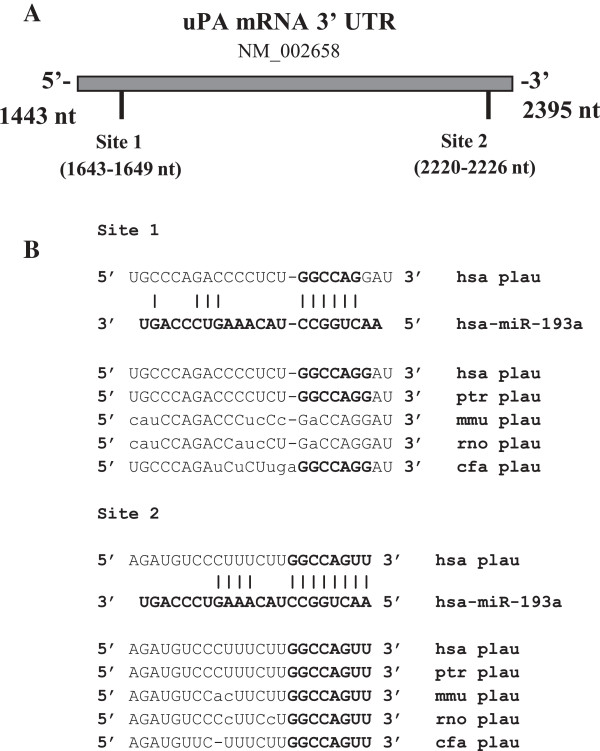
Figure 1
Figure 1
uPA putative binding sites for miR-193a located in the 3′-UTR mRNA and its phylogenetically conservation. (A) 3′-UTR uPA mRNA displays two putative binding sites for miR-193a. (B) The complementarity between miR-193a and the putative uPA 3′-UTR target sites are shown. The conserved bases of the putative miR-193a target sequence are also shown. hsa, Homo sapiens; ptr, P. troglodytes (chimpanzee); mmu, M. musculus (mouse); rno, R. norvegicus (rat); cfa, C. familiaris (dog).
Figure 2
Figure 2
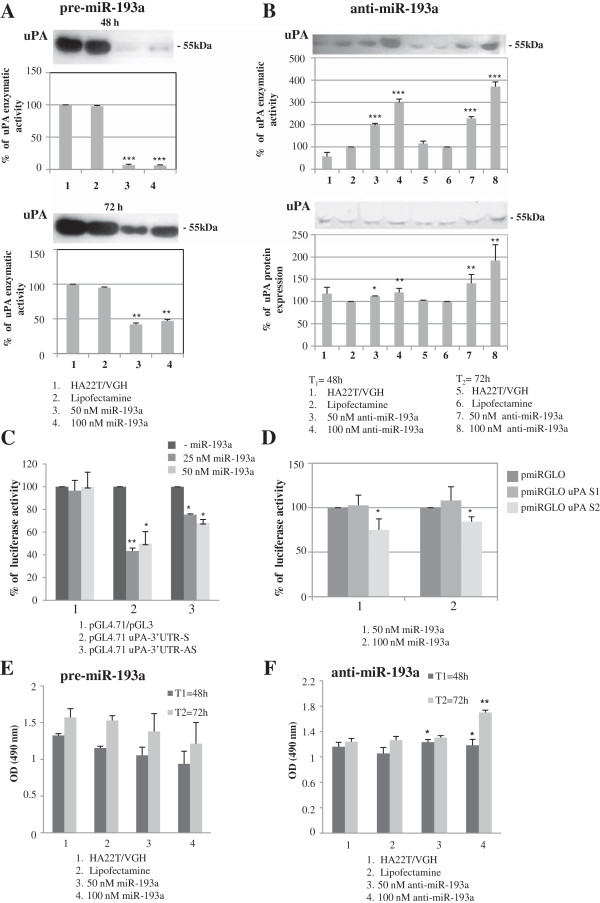
Experimental validation of miR-193a as negative regulator of uPA in HA22T/VGH cells. (A) Enzymatic activity evaluated by zymography after pre-miR-193a transfection in HA22T/VGH cells. Three experiments were performed; histograms represent the mean values, bars are the SE. *p < 0.05; **p < 0.01 ***p < 0.001 versus Lipofectamine in a t-Test analysis for unpaired comparison. (B) anti-miR-193a transfection in HA22T/VGH cells causes increase of uPA protein expression and its correspondent enzymatic activity. Three experiments were performed; histograms represent the mean values, bars are the SE. *p < 0.05; **p < 0.01 ***p < 0.001 versus Lipofectamine in a t-Test analysis for unpaired comparison. (C-F) Dual-luciferase reporter assay and cellular proliferation. (C) The 3′-UTR of uPA was cloned in the pGL4.71 reporter plasmid after the Renilla luciferase CDS in sense (pGL4.71 uPA-3′ UTR-S) and antisense (pGL4.71 uPA-3′ UTR-AS) orientation. The constructs were cotransfected into HA22T/VGH cells with 0, 25 and 50 nM miR-193a mimics. Luciferase activity was normalized relative to a simultaneosly transfected firefly luciferase expression plasmid (pGL3). The construct pGL4.71 uPA-3′ UTR-S determined the inhibition of the luciferase activity, *p < 0.05; **p < 0.01 versus –miR-193a. (D) 30 nt-sequences containing the putative binding site 1 and 2 were cloned after the firefly luciferase CDS of the pmiRGLO plasmids carrying also the Renilla luciferse gene. The 2 plasmids (pmiRGLO uPA S1, pmiRGLO uPA S2) were cotrasfected with 50 nM and 100 nM miR-193a mimics in HA22T/VGH cells. Site 2 resulted in the inhibition of the luciferase activity while site 1 did not, * p < 0.05 versus pmiRGLO. (E-F) The transfection of pre-miR-193a and anti-miR-193a in HA22T/VGH cells led to a low level of proliferation inhibition and induction respectively. The histograms represent the mean of three experiments; bars are the SE. *p < 0.05; **p < 0.01 versus HA22T/VGH.
Figure 3
Figure 3
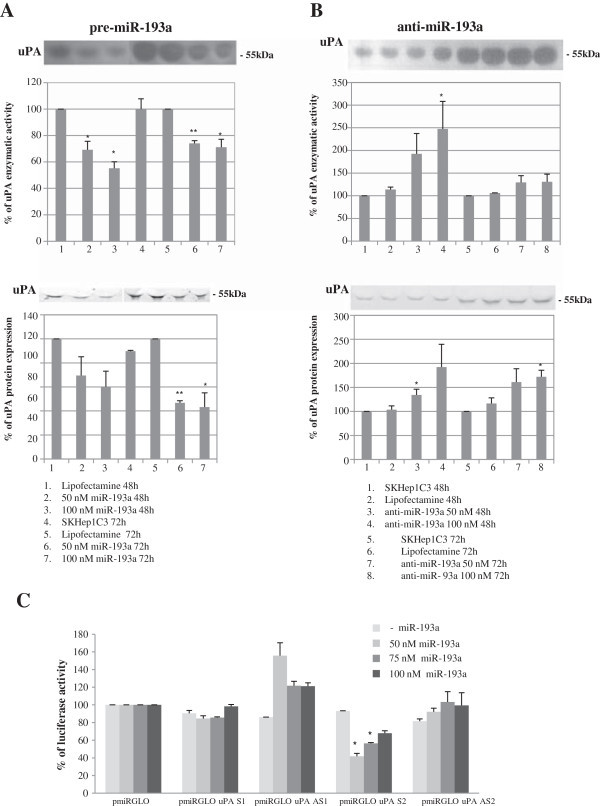
Experimental validation of miR-193a as negative regulator of uPA in SKHep1C3 cells. (A) pre-miR-193a transfections in SKHep1C3 cells inhibited uPA protein expression and the enzymatic activity. (B) Anti-miR-193a transfection in SKHep1C3 cells led to up-regulation of uPA protein expression and the enzymatic activity up-regulation, *p < 0.05; **p < 0.01 versus Lipofectamine in a t-Test analysis for unpaired comparison. (C) The dual luciferase assay shows that the site 2 was directly bound by miR-193a but the site 1 was not. pmiRGLO uPA S1 and pmiRGLO uPA S2 are the luciferase constructs expressing the predicted 3′ UTR mRNA uPA binding site 1 and site 2. The pmiRGLO uPA AS1 and pmiRGLO uPA AS2 are the constructs expressing the corresponding control antisense sequences, *p < 0.05 versus – miR-193a.
Figure 4
Figure 4
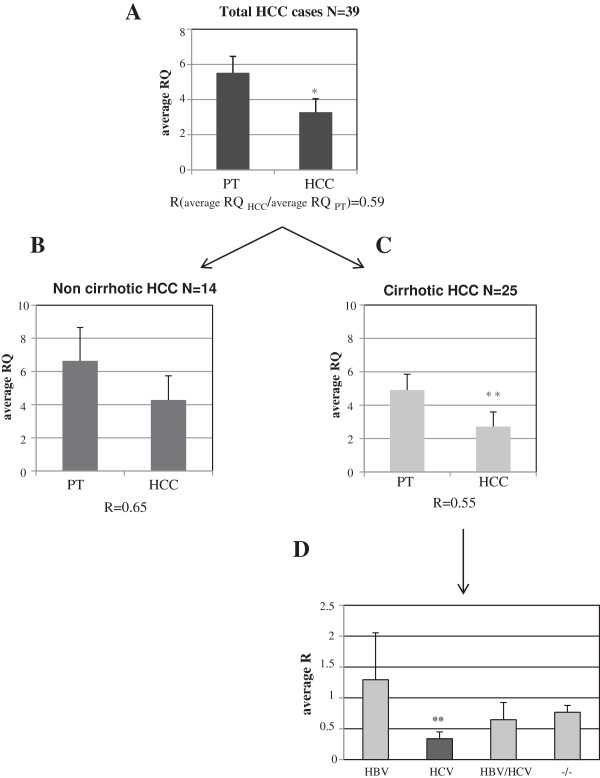
miR-193a expression analysis by Real-Time PCR in tumoral tissues from biopsy samples of HCC patients. (A) The level of mature miR-193a is generally down-regulated in HCC compared with the corresponding PT tissues average RQPT = 5.53 ± 0.93, RQHCC = 3.27 ± 0.77; p < 0.05. (B) miR-193a expression level in HCCs developed in non-cirrhotic and (C) cirrhotic liver. (D) Cirrhotic HCCs stratified on the basis of the type of hepatitis viral infections. The class of HCV showed the lowest average R (average R = 0.338; p < 0.01 in a t-Test analysis for single group mean with expected value = 1).
Figure 5
Figure 5
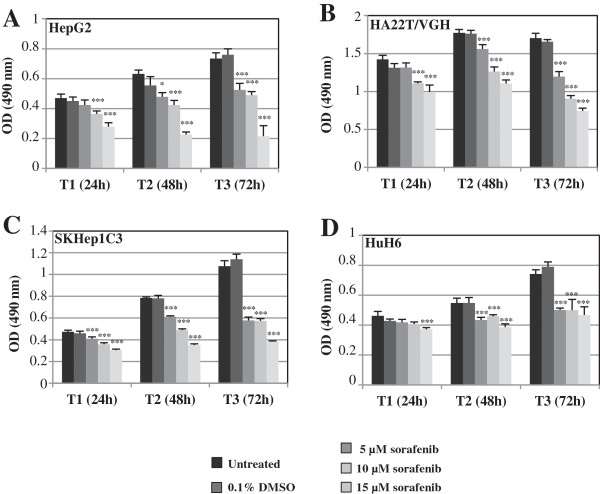
Effects of the sorafenib treatment on HCC cell lines. The HepG2, HA22T/VGH, SKHep1C3 and HuH6 cell lines were treated with sorafenib (5, 10, 15 μM concentration) for 3 days (24, 48 and 72 h). The proliferation was inhibited in a dose-dependent manner in all the cell lines considered (A-D). The most responsive HCC cell line was HepG2 (the highest percentage of the inhibition of proliferation was 72% with 15 μM of sorafenib at T = 72 h) (A). Statistical significance was determined by one way ANOVA with Bonferroni correction *p < 0.05; ***p < 0.001.
Figure 6
Figure 6
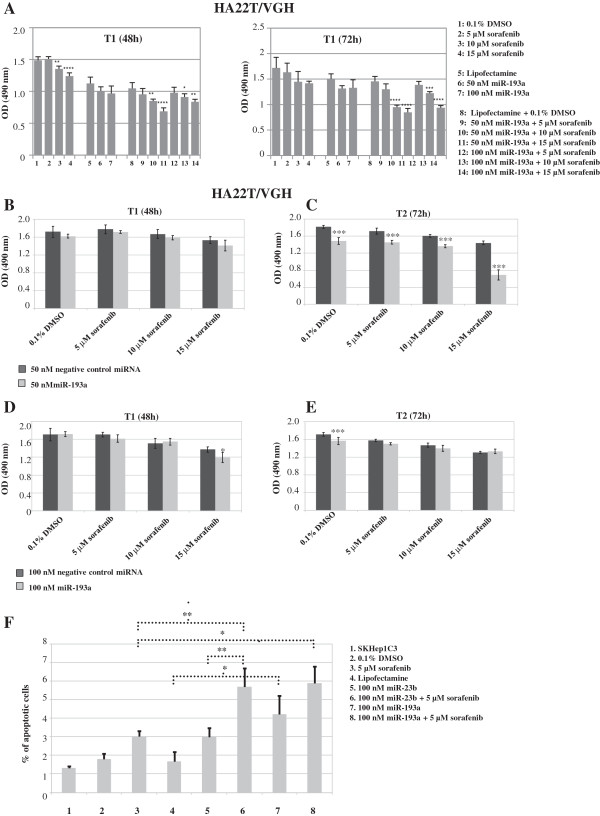
Effects on cellular proliferation and apoptosis of combined treatment with sorafenib and miR-193a/miR-23b in HCC cell lines. (A) The MTT assay showed that the growth of the HA22T/VGH cells was significantly reduced after the combined treatments of sorafenib plus miR-193a. *p < 0.05; **p < 0.01, ***p < 0.001, ****p < 0.0001 in a one-way ANOVA followed by Bonferroni correction: for sorafenib alone versus 0.1% DMSO, for miR alone versus Lipofectamine, for the co-treatments versus Lipofectamine plus 0.1% DMSO. (B-E) The HA22T/VGH cells were transfected with negative control miRNA or miR-193a and treated with either vehicle (0.1% DMSO) or different concentrations of sorafenib (5-10-15 μM). Two-way ANOVA followed by Bonferroni correction was used to establish whether significant difference existed between negative control miRNA transfected cells and miR-193a transfected cells; ***p < 0.001. (F) TUNEL assay in SKHep1C3 cells. The cells transfected with 100 nM miR-23b or miR-193a and then treated with 5 μM sorafenib showed increased percentages of apoptotic cells (up to 1.95 times those of cells treated with sorafenib alone). *p < 0.05; **p < 0.01 in a two-way ANOVA followed by Bonferroni correction.
Figure 7
Figure 7
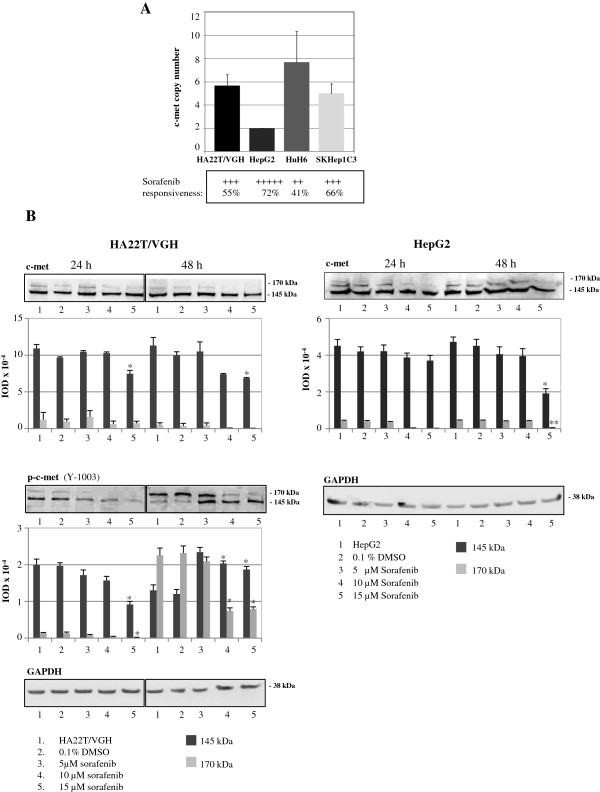
Effects of sorafenib on c-met protein expression levels. (A) c-met copy number analysis in the 4 HCC cell lines considered and comparison with the highest percentage of inhibition of proliferation observed after sorafenib treatments. (B) Western blot and densitometric analysis of c-met, p-c-met (Y1003) and GAPDH in the HA22T/VGH and HepG2 cells treated with sorafenib *p < 0.05; **p < 0.01 versus HA22T/VGH or HepG2 in a t-Test analysis for unpaired comparison.

References

    1. Villanueva A, Hernandez-Gea V, Llovet JM. Medical therapies for hepatocellular carcinoma: a critical view of the evidence. Nat Rev Gastroenterol Hepatol. 2013;12:34–42. - PubMed
    1. De Lope CR, Tremosini S, Forner A, Reig M, Bruix J. Management of HCC. J Hepatol. 2012;12(Suppl 1):S75–S87. - PubMed
    1. Forner A, Llovet JM, Bruix J. Hepatocellular carcinoma. Lancet. 2012;12:1245–1255. doi: 10.1016/S0140-6736(11)61347-0. - DOI - PubMed
    1. Siegel AB, Cohen EI, Ocean A, Lehrer D, Goldenberg A, Knox JJ, Chen H, Clark-Garvey S, Weinberg A, Mandeli J, Christos P, Mazumdar M, Popa E, Brown RS Jr, Rafii S, Schwartz JD. Phase II trial evaluating the clinical and biologic effects of bevacizumab in unresectable hepatocellular carcinoma. J Clin Oncol. 2008;12:2992–2998. doi: 10.1200/JCO.2007.15.9947. - DOI - PMC - PubMed
    1. Llovet JM, Ricci S, Mazzaferro V, Hilgard P, Gane E, Blanc JF, de Oliveira AC, Santoro A, Raoul JL, Forner A, Schwartz M, Porta C, Zeuzem S, Bolondi L, Greten TF, Galle PR, Seitz JF, Borbath I, Häussinger D, Giannaris T, Shan M, Moscovici M, Voliotis D, Bruix J. SHARP Investigators study group: sorafenib in advanced hepatocellular carcinoma. N Engl J Med. 2008;12:378–390. doi: 10.1056/NEJMoa0708857. - DOI - PubMed

Publication types

MeSH terms