


Emergency contraception with a copper IUD or oral levonorgestrel: an observational study of 1-year pregnancy rates
- PMID: 24332433
- PMCID: PMC4076674
- DOI: 10.1016/j.contraception.2013.11.010
Emergency contraception with a copper IUD or oral levonorgestrel: an observational study of 1-year pregnancy rates
Abstract
Objective: We investigated the 1-year pregnancy rates for emergency contraception (EC) users who selected the copper T380 intrauterine device (IUD) or oral levonorgestrel (LNG) for EC.
Study design: This prospective study followed women for 1 year after choosing either the copper T380 IUD or oral LNG for EC. The study was powered to detect a 6% difference in pregnancy rates within the year after presenting for EC.
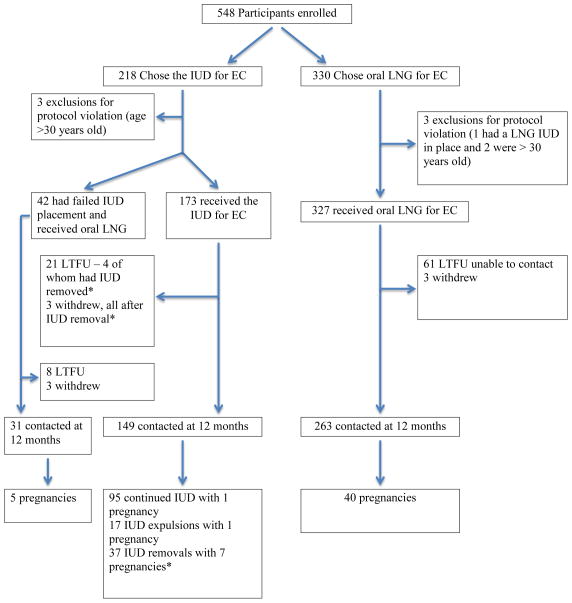
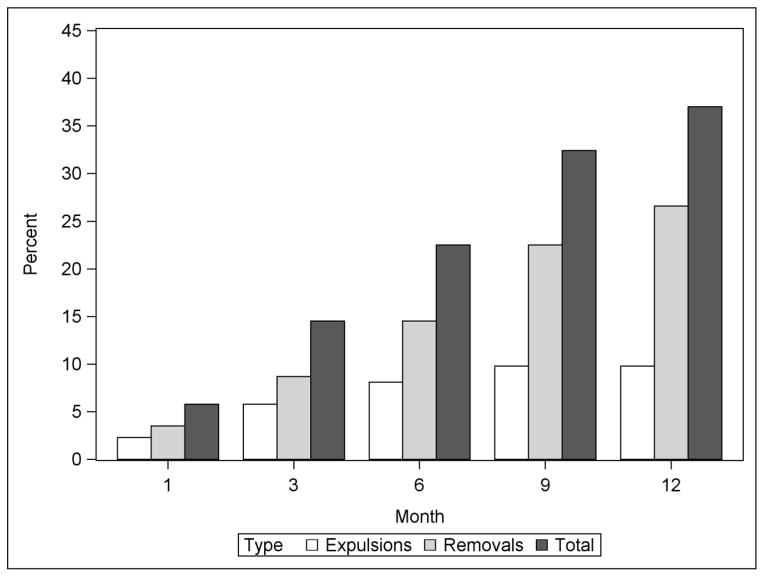
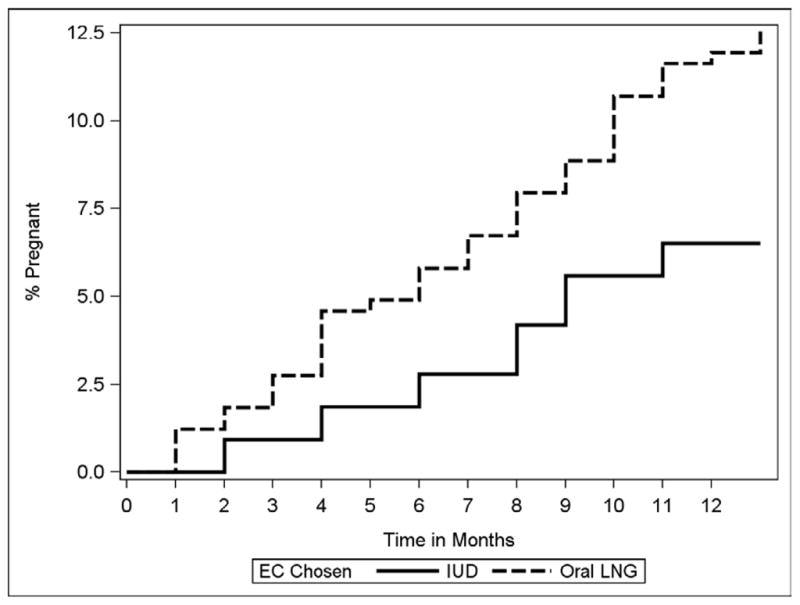
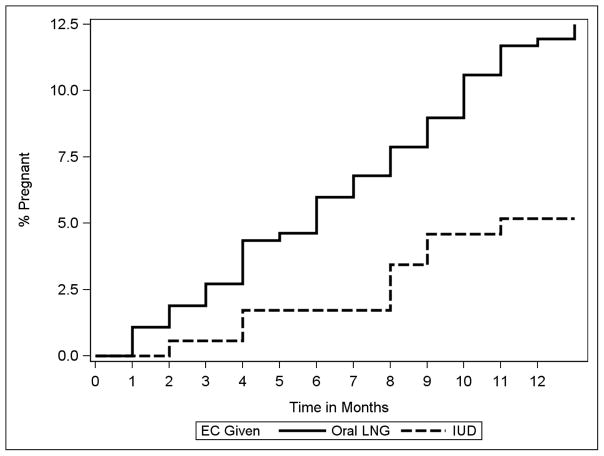
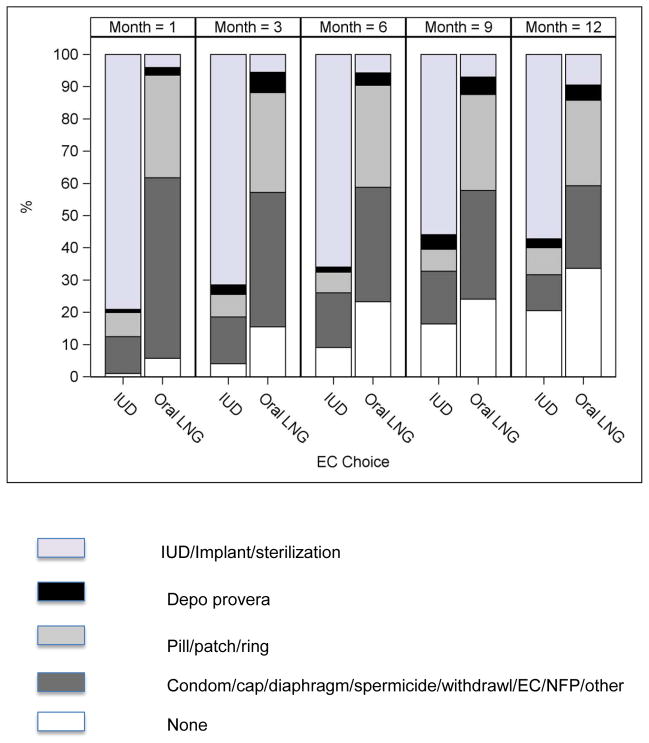
Results: Of the 542 women who presented for EC, agreed to participate in the trial and met the inclusion criteria, 215 (40%) chose the copper IUD and 327 (60%) chose oral LNG. In the IUD group, 127 (59%) were nulligravid. IUD insertion failed in 42 women (19%). The 1-year follow-up rate was 443/542 (82%); 64% of IUD users contacted at 1 year still had their IUDs in place. The 1-year cumulative pregnancy rate in women choosing the IUD was 6.5% vs. 12.2% in those choosing oral LNG [hazard ratio (HR) 0.53, 95% confidence interval (CI): 0.29-0.97, p=.041]. By type of EC method actually received, corresponding values were 5.2% for copper IUD users vs. 12.3% for oral LNG users (HR 0.42, 95% CI: 0.20-0.85, p=.017). A multivariable logistic regression model controlling for demographic variables demonstrates that women who chose the IUD for EC had fewer pregnancies in the following year than those who chose oral LNG (HR 0.50, 95% CI: 0.26-0.96, p=.037).
Conclusion: One year after presenting for EC, women choosing the copper IUD for EC were half as likely to have a pregnancy compared to those choosing oral LNG.
Implications: Compared to EC users who choose oral levonorgestrel, those who select the copper IUD have lower rates of pregnancy in the next year. Greater use of the copper IUD for EC may lower rates of unintended pregnancy in high-risk women.
Keywords: Emergency contraception; IUD; Oral levonrgestrel; Pregnancy.
Copyright © 2014 Elsevier Inc. All rights reserved.
Figures
References
-
- Glasier A, Fairhurst K, Wyke S, Ziebland S, Seaman P, Walker J, et al. Advanced provision of emergency contraception does not reduce abortion rates. Contraception. 2004;69(5):361–6. - PubMed
-
- Raymond EG, Trussell J, Polis CB. Population effect of increased access to emergency contraceptive pills: a systematic review. Obstet Gynecol. 2007;109(1):181–8. - PubMed
-
- Fasoli M, Parazzini F, Cecchetti G, La Vecchia C. Post-coital contraception: an overview of published studies. Contraception. 1989;39(4):459–68. - PubMed
-
- Zhou L, Xiao B. Emergency contraception with Multiload Cu-375 SL IUD: a multicenter clinical trial. Contraception. 2001;64(2):107–12. - PubMed
-
- Wu S, Godfrey EM, Wojdyla D, Dong J, Cong J, Wang C, et al. Copper T380A intrauterine device for emergency contraception: a prospective, multicentre, cohort clinical trial. BJOG. 2010;117(10):1205–10. - PubMed
Publication types
MeSH terms
Substances
Grants and funding
LinkOut - more resources
Full Text Sources
Other Literature Sources
Miscellaneous
