


Childhood and current ADHD symptom dimensions are associated with more severe cannabis outcomes in college students
- PMID: 24332802
- PMCID: PMC3904106
- DOI: 10.1016/j.drugalcdep.2013.11.013
Childhood and current ADHD symptom dimensions are associated with more severe cannabis outcomes in college students
Abstract
Background: Numerous studies have shown that attention deficit/hyperactivity disorder (ADHD) is associated higher risk of cannabis use disorders (CUD). However, these studies are limited in that most did not: (a) differentiate the role of hyperactivity-impulsivity (HI) and inattention (IN); (b) control for associated psychopathology; and (c) consider more fine-grained CUD-related measures. Our aim was to clarify the unique and interactive contributions of inattention and hyperactivity symptoms to age of cannabis initiation and DSM-IV cannabis dependence, craving, and severity of problems related to cannabis use while statistically controlling for symptoms of comorbid psychopathology in a non-clinical sample of young adults.
Methods: Cannabis variables, current use of cigarettes and alcohol, current and childhood ADHD, and comorbid internalizing and externalizing psychopathology were assessed in 376 male and female undergraduates.
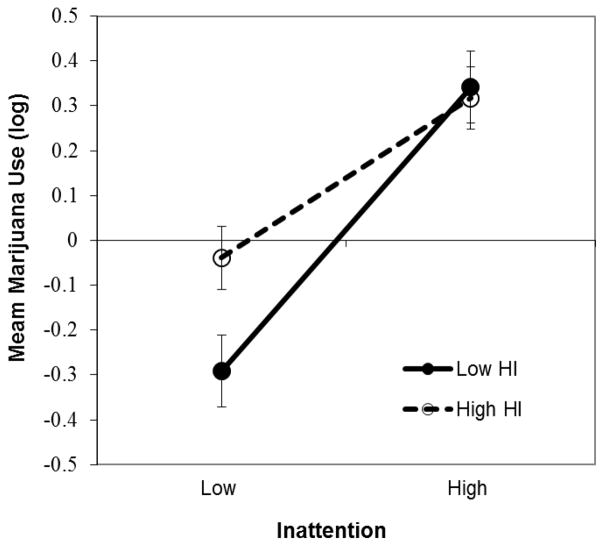
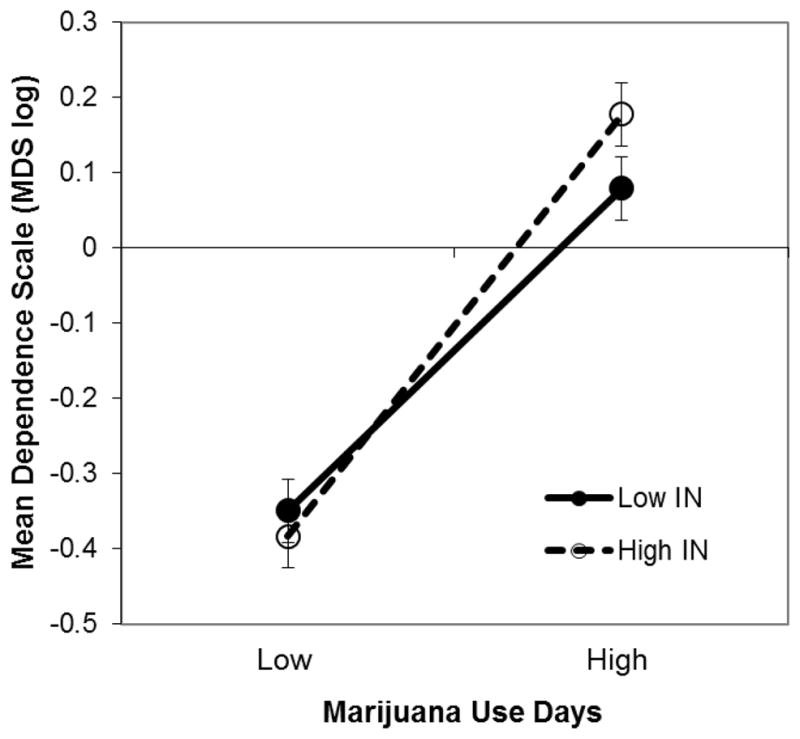
Results: Results indicate that current and childhood IN were independently associated with more severe cannabis use, craving, and problem use-related outcomes in young adulthood (p's<.01) and that childhood HI symptoms were associated with earlier initiation of cannabis (p<.01). Further, current IN symptoms moderated the relationships between level of use and more severe outcomes (p's<.01), such that higher IN strengthened positive associations among use and problem cannabis use. Associations with ADHD symptom dimensions and current use of alcohol and cigarettes were also present.
Conclusions: Thus, current and childhood inattention symptoms as well as childhood hyperactive-impulsive symptoms emerged as significant factors in cannabis-related outcomes in young adults, even after statistically controlling for important confounding variables.
Keywords: ADHD; Hyperactivity; Inattention; Substance dependence; Substance use.
Copyright © 2013 Elsevier Ireland Ltd. All rights reserved.
Conflict of interest statement
The authors have no conflicts of interest to report.
Figures
References
-
- Achenbach TM, Rescorla LA. Manual for the ASEBA Adult Forms and Profiles. University of Vermont, Research Center for Children, Youth, and Families; Burlington, VT: 2003.
-
- Aiken LS, West SG. Multiple Regression: Testing and Interpreting Interactions. Sage Publications; Newberry Park, CA: 1991.
-
- Barkley RA, Knouse LE, Murphy KR. Correspondence and disparity in the self- and other ratings of current and childhood ADHD symptoms and impairment in adults with ADHD. Psychol Assess. 2011;23:437–446. - PubMed
-
- Barkley RA, Murphy K. Attention-deficit Hyperactivity Disorder: A Clinical Workbook. Vol. 2. Guilford Press; New York, NY: 1998.
-
- Barkley RA, Murphy KR, Fischer M. ADHD in Adults: What the Science Says. Guilford Press; New York, NY: 2008.
MeSH terms
Grants and funding
LinkOut - more resources
Full Text Sources
Other Literature Sources
Medical
