


Estimation of the prevalence and rate of acute transfusion reactions occurring in Windhoek, Namibia
- PMID: 24333079
- PMCID: PMC4111817
- DOI: 10.2450/2013.0143-13
Estimation of the prevalence and rate of acute transfusion reactions occurring in Windhoek, Namibia
Abstract
Background: Acute transfusion reactions are probably common in sub-Saharan Africa, but transfusion reaction surveillance systems have not been widely established. In 2008, the Blood Transfusion Service of Namibia implemented a national acute transfusion reaction surveillance system, but substantial under-reporting was suspected. We estimated the actual prevalence and rate of acute transfusion reactions occurring in Windhoek, Namibia.
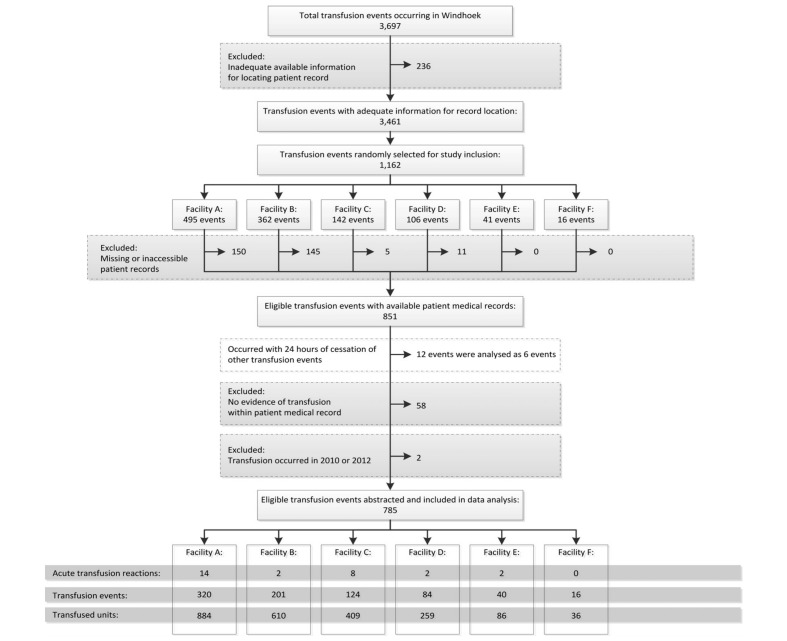
Methods: The percentage of transfusion events resulting in a reported acute transfusion reaction was calculated. Actual percentage and rates of acute transfusion reactions per 1,000 transfused units were estimated by reviewing patients' records from six hospitals, which transfuse >99% of all blood in Windhoek. Patients' records for 1,162 transfusion events occurring between 1(st) January - 31(st) December 2011 were randomly selected. Clinical and demographic information were abstracted and Centers for Disease Control and Prevention National Healthcare Safety Network criteria were applied to categorize acute transfusion reactions.
Results: From January 1 - December 31, 2011, there were 3,697 transfusion events (involving 10,338 blood units) in the selected hospitals. Eight (0.2%) acute transfusion reactions were reported to the surveillance system. Of the 1,162 transfusion events selected, medical records for 785 transfusion events were analysed, and 28 acute transfusion reactions were detected, of which only one had also been reported to the surveillance system. An estimated 3.4% (95% confidence interval [CI]: 2.3-4.4) of transfusion events in Windhoek resulted in an acute transfusion reaction, with an estimated rate of 11.5 (95% CI: 7.6-14.5) acute transfusion reactions per 1,000 transfused units.
Conclusion: The estimated actual rate of acute transfusion reactions is higher than the rate reported to the national haemovigilance system. Improved surveillance and interventions to reduce transfusion-related morbidity and mortality are required in Namibia.
Figures
References
-
- The National Healthcare Safety Network (NHSN) Manual: Biovigilance Component. Division of Healthcare Quality Promotion, National Center for Emerging and Zoonotic Infectious Diseases, Centers for Disease Control and Prevention; [Accessed on 25/07/2013]. Available at: http://www.cdc.gov/nhsn/PDFs/Biovigilance/BV-Protocol-1-3-1-June-2011.pdf.
-
- World Health Organization. WHO. AIDE-MEMOIRE for National Blood Programmes. [Accessed on 03/02/2011]. Available at: http://www.searo.who.int/entity/bloodsafety/Blood_Safety_Eng.pdf.
-
- McFarland W, Mvere D, Shandera W, Reingold A. Epidemiology and prevention of transfusion-associated human immunodeficiency virus transmission in sub-Saharan Africa. Vox Sang. 1997;72:85–92. - PubMed
-
- Fleming AF. HIV and blood transfusion in sub-Saharan Africa. Transfus Sci. 1997;18:167–79. - PubMed
-
- Moore A, Herrera G, Nyamongo J, et al. Estimated risk of HIV transmission by blood transfusion in Kenya. Lancet. 2001;358:657–60. - PubMed
Publication types
MeSH terms
LinkOut - more resources
Full Text Sources
Medical
