Review
. 2014 Feb:47:57-67.
doi: 10.1016/j.biocel.2013.11.005. Epub 2013 Dec 9.

Trafficking mechanisms of extracellular matrix macromolecules: insights from vertebrate development and human diseases

Affiliations
Review

Trafficking mechanisms of extracellular matrix macromolecules: insights from vertebrate development and human diseases

Gokhan Unlu et al. Int J Biochem Cell Biol. 2014 Feb.

Abstract

Cellular life depends on protein transport and membrane traffic. In multicellular organisms, membrane traffic is required for extracellular matrix deposition, cell adhesion, growth factor release, and receptor signaling, which are collectively required to integrate the development and physiology of tissues and organs. Understanding the regulatory mechanisms that govern cargo and membrane flow presents a prime challenge in cell biology. Extracellular matrix (ECM) secretion remains poorly understood, although given its essential roles in the regulation of cell migration, differentiation, and survival, ECM secretion mechanisms are likely to be tightly controlled. Recent studies in vertebrate model systems, from fishes to mammals and in human patients, have revealed complex and diverse loss-of-function phenotypes associated with mutations in components of the secretory machinery. A broad spectrum of diseases from skeletal and cardiovascular to neurological deficits have been linked to ECM trafficking. These discoveries have directly challenged the prevailing view of secretion as an essential but monolithic process. Here, we will discuss the latest findings on mechanisms of ECM trafficking in vertebrates.

Keywords: Cartilage and bone; Collagen secretion; ECM; Membrane traffic; Vertebrate animal models.


Conflict of interest statement

COMPETING INTERESTS

The authors declare that they do not have any competing or financial interests.

Figures
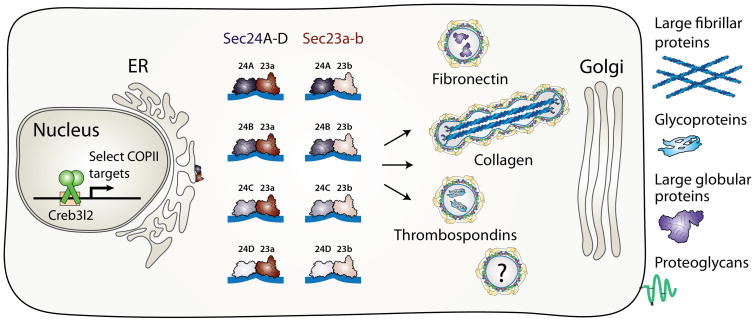
Figure 1
Figure 1. The secretory module, Transcription Factor–COPII Adaptor–ECM Cargo, operates in a spatio-temporal manner
Recent discovery of a “secretory module” consisting of Creb3L2, a transcription factor that regulates the expression of Sec23A-Sec24D, which then facilitate procollagen cargo traffic during embryonic skeletal development, provided the first evidence for the “secretory code”. The existence of such a secretory code is supported by studies with mutant animal models and human patient samples discussed in this review. To date only the secretory modules for type I and type II collagens were tested, which were conducted primarily in the zebrafish system using feelgood-crusher-bulldog mutations (creb3L2-sec23A-sec24D, respectively). It is hypothesized that unknown transcription factors regulate the expression of distinct COPII cargo adaptors (Sec24A-D and Sec23A-B), leading to preferential availability of the various coat components that are required for transport of distinct ECM cargos, such as fibronectin and thrombospondins, at any given time point. Evidence suggests that a diverse array of COPII coats containing specific combinations of core components and associated proteins is required for transport of structurally divergent cargos, such as globular, fibrillar, or transmembrane proteins. Further studies will be required to unravel the complexity of the secretory code to understand how the system integrates cellular operations at regulatory and structural levels to a spatio-temporal manner in a living organism.
Figure 2
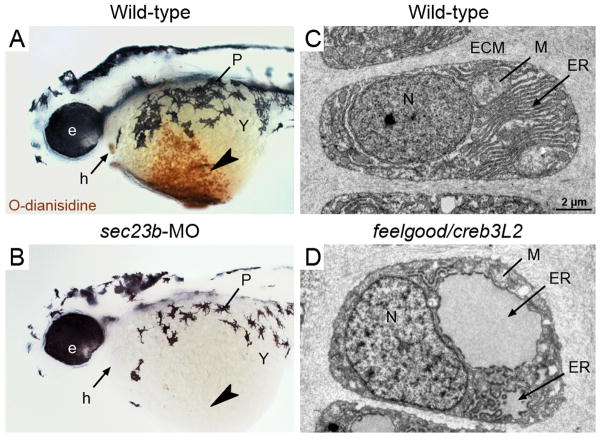
Figure 2. Deficits in secretory machinery lead to tissue-specific phenotypes
A,B. Wild-type 2 day zebrafish embryos stained with o-dianisidine, which is oxidized by heme in the presence of peroxide and colored brown, display abundant hemoglobin within the ducts of Cuvier (arrowhead) and the heart (arrow). B. Sec23b morphants, which have defects in erythrocyte development, are deficient of hemoglobin at 2 days. C,D. Transmission Electron Micrographs (TEM) images of wild-type zebrafish chondrocytes (3-day old) show characteristics of highly secretory cells, including abundant rough ER (arrow), mitochondria (line), and Golgi. D. feelgood/creb3L2 mutant chondrocytes contain highly distended rER (arrow) due to collagen backlog. Symbols: e, eye; h, heart; P, pigment; Y, yolk; ECM, extracellular matrix; ER, endoplasmic reticulum; M, mitochondria; N, nucleus.
Figure 3
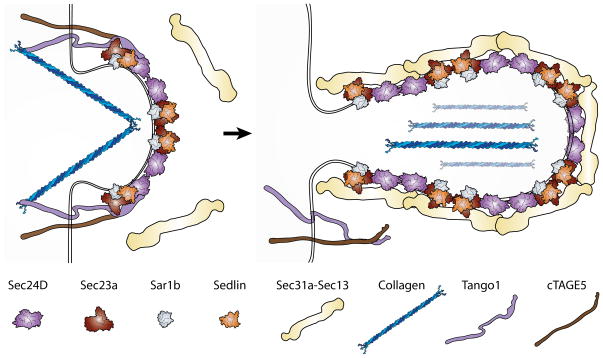
Figure 3. Packaging of procollagen fibrils into large COPII carriers
Procollagen is a rigid, fibrillar protein aggregate that is significantly larger than the typical size COPII-coated vesicles. Recent work has uncovered auxiliary proteins that aid in the packaging and transport of procollagen into mega-sized COPII carriers. Procollagen is initially loaded into budding vesicles through the concerted action of transmembrane proteins TANGO1 and cTAGE5, which both bind to the Sec23-Sec24 inner coat complex on the cytoplasmic side and collagen on the luminal side. TANGO1/cTAGE5 interaction with the inner coat is thought to inhibit the association of the COPII outer coat complex with the inner coat, which delays the fission of vesicles from the ER exit sites and results in the formation of large-size carriers. TANGO1 is also essential for recruiting Sedlin, which interacts with Sar1 and provides efficient cycling of Sar1-GTP hydrolysis, further delaying coat dissociation from the membranes. After procollagen loading is completed, TANGO1 undergoes a conformational change and dissociates from both procollagen and the inner coat complex but is left behind in the ER membrane after COPII carrier fission. Recruitment of Sec13-Sec31 outer coat is the final step of coat formation before fission.

References

    1. Abrams EW, Andrew DJ. CrebA regulates secretory activity in the Drosophila salivary gland and epidermis. Development. 2005;132:2743–58. - PubMed
    1. Adams JC, Lawler J. The thrombospondins. Int J Biochem Cell Biol. 2004;36:961–8. - PMC - PubMed
    1. Adams JC, Lawler J. The thrombospondins. Cold Spring Harb Perspect Biol. 2011;3:a009712. - PMC - PubMed
    1. Angers S, Li T, Yi X, MacCoss MJ, Moon RT, Zheng N. Molecular architecture and assembly of the DDB1-CUL4A ubiquitin ligase machinery. Nature. 2006;443:590–3. - PubMed
    1. Aridor M, Fish KN, Bannykh S, Weissman J, Roberts TH, Lippincott-Schwartz J, et al. The Sar1 Gtpase Coordinates Biosynthetic Cargo Selection with Endoplasmic Reticulum Export Site Assembly. J Cell Biol. 2001;152:213–30. - PMC - PubMed

Publication types