


Connexin 26 null mice exhibit spiral ganglion degeneration that can be blocked by BDNF gene therapy
- PMID: 24333301
- PMCID: PMC3946535
- DOI: 10.1016/j.heares.2013.11.009
Connexin 26 null mice exhibit spiral ganglion degeneration that can be blocked by BDNF gene therapy
Abstract
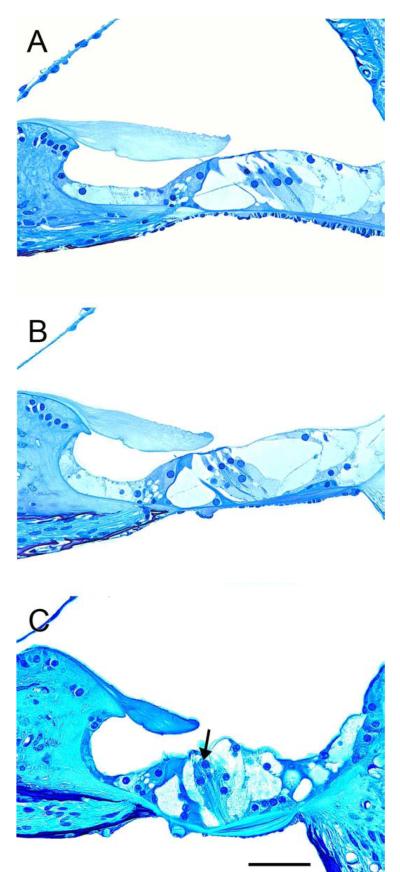
Mutations in the connexin 26 gene (GJB2) are the most common genetic cause of deafness, leading to congenital bilateral non-syndromic sensorineural hearing loss. Here we report the generation of a mouse model for a connexin 26 (Cx26) mutation, in which cre-Sox10 drives excision of the Cx26 gene from non-sensory cells flanking the auditory epithelium. We determined that these conditional knockout mice, designated Gjb2-CKO, have a severe hearing loss. Immunocytochemistry of the auditory epithelium confirmed absence of Cx26 in the non-sensory cells. Histology of the organ of Corti and the spiral ganglion neurons (SGNs) performed at ages 1, 3, or 6 months revealed that in Gjb2-CKO mice, the organ of Corti began to degenerate in the basal cochlear turn at an early stage, and the degeneration rapidly spread to the apex. In addition, the density of SGNs in Rosenthal's canal decreased rapidly along a gradient from the base of the cochlea to the apex, where some SGNs survived until at least 6 months of age. Surviving neurons often clustered together and formed clumps of cells in the canal. We then assessed the influence of brain derived neurotrophic factor (BDNF) gene therapy on the SGNs of Gjb2-CKO mice by inoculating Adenovirus with the BDNF gene insert (Ad.BDNF) into the base of the cochlea via the scala tympani or scala media. We determined that over-expression of BDNF beginning around 1 month of age resulted in a significant rescue of neurons in Rosenthal's canal of the cochlear basal turn but not in the middle or apical portions. This data may be used to design therapies for enhancing the SGN physiological status in all GJB2 patients and especially in a sub-group of GJB2 patients where the hearing loss progresses due to ongoing degeneration of the auditory nerve, thereby improving the outcome of cochlear implant therapy in these ears.
Copyright © 2013 Elsevier B.V. All rights reserved.
Figures



References
-
- Aarnisalo AA, Pirvola U, Liang XQ, Miller J, Ylikoski J. Apoptosis in auditory brainstem neurons after a severe noise trauma of the organ of Corti: intracochlear GDNF treatment reduces the number of apoptotic cells. ORL. J. Otorhinolaryngol. Relat. Spec. 2000;62:330–4. - PubMed
-
- Abrashkin KA, Izumikawa M, Miyazawa T, Wang CH, Crumling MA, Swiderski DL, Beyer LA, Gong TW, Raphael Y. The fate of outer hair cells after acoustic or ototoxic insults. Hear. Res. 2006;218:20–9. - PubMed
-
- Agterberg MJ, Versnel H, de Groot JC, Smoorenburg GF, Albers FW, Klis SF. Morphological changes in spiral ganglion cells after intracochlear application of brain-derived neurotrophic factor in deafened guinea pigs. Hear. Res. 2008;244:25–34. - PubMed
-
- Anselmi F, Hernandez VH, Crispino G, Seydel A, Ortolano S, Roper SD, Kessaris N, Richardson W, Rickheit G, Filippov MA, Monyer H, Mammano F. ATP release through connexin hemichannels and gap junction transfer of second messengers propagate Ca2+ signals across the inner ear. Proc. Natl. Acad. Sci. U. S. A. 2008;105:18770–5. - PMC - PubMed
Publication types
MeSH terms
Substances
Grants and funding
LinkOut - more resources
Full Text Sources
Other Literature Sources
Medical
Molecular Biology Databases
Miscellaneous
