. 2014 Feb 14;114(4):677-88.
doi: 10.1161/CIRCRESAHA.114.302221. Epub 2013 Dec 13.

Evidence for the involvement of type I interferon in pulmonary arterial hypertension

Affiliations

Evidence for the involvement of type I interferon in pulmonary arterial hypertension

Peter M George et al. Circ Res. .

Abstract

Rationale: Evidence is increasing of a link between interferon (IFN) and pulmonary arterial hypertension (PAH). Conditions with chronically elevated endogenous IFNs such as systemic sclerosis are strongly associated with PAH. Furthermore, therapeutic use of type I IFN is associated with PAH. This was recognized at the 2013 World Symposium on Pulmonary Hypertension where the urgent need for research into this was highlighted.

Objective: To explore the role of type I IFN in PAH.

Methods and results: Cells were cultured using standard approaches. Cytokines were measured by ELISA. Gene and protein expression were measured using reverse transcriptase polymerase chain reaction, Western blotting, and immunohistochemistry. The role of type I IFN in PAH in vivo was determined using type I IFN receptor knockout (IFNAR1(-/-)) mice. Human lung cells responded to types I and II but not III IFN correlating with relevant receptor expression. Type I, II, and III IFN levels were elevated in serum of patients with systemic sclerosis associated PAH. Serum interferon γ inducible protein 10 (IP10; CXCL10) and endothelin 1 were raised and strongly correlated together. IP10 correlated positively with pulmonary hemodynamics and serum brain natriuretic peptide and negatively with 6-minute walk test and cardiac index. Endothelial cells grown out of the blood of PAH patients were more sensitive to the effects of type I IFN than cells from healthy donors. PAH lung demonstrated increased IFNAR1 protein levels. IFNAR1(-/-) mice were protected from the effects of hypoxia on the right heart, vascular remodeling, and raised serum endothelin 1 levels.

Conclusions: These data indicate that type I IFN, via an action of IFNAR1, mediates PAH.

Keywords: IFNAR1 subunit, interferon alpha-beta receptor; chemokine CXCL10; endothelin-1; inflammation; interferon type I; pulmonary arterial hypertension; scleroderma, systemic.


Figures
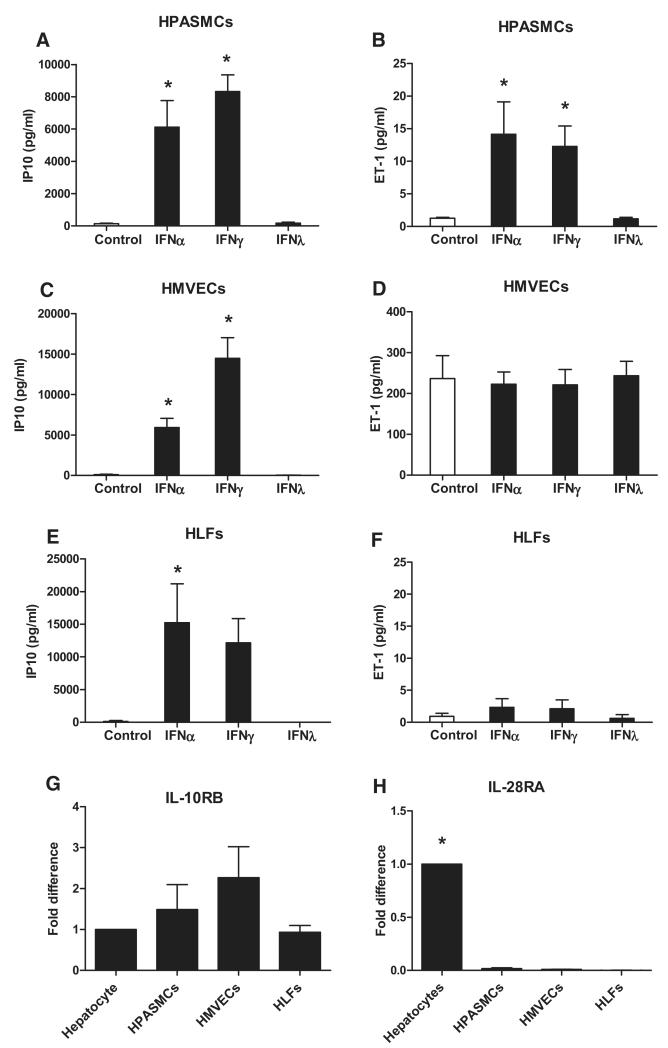
Figure 1
Figure 1
Response of pulmonary vascular cells to types I, II, and III interferons (IFNs) and type III IFN receptor expression in pulmonary vascular cells as compared with hepatocytes. Human pulmonary artery smooth muscle cells (HPASMCs; A and B), human lung microvascular endothelial cells (HMVECs; C and D), and human lung fibroblasts (HLFs; E and F) were treated with IFNα (10 ng/mL), IFNγ (10 ng/mL), and IFNλ (1000 ng/mL) in the presence of tumor necrosis factor (TNFα; 10 ng/mL) and assayed for IFN γ inducible protein 10 (IP10; A, C, and E) and endothelin 1 (ET-1; B, D, and F). Data are presented as mean±SEM from n=3 to 6 experiments performed in singlicate. Statistical significance (*P<0.05) compared with control was determined by 1-way ANOVA with Dunnett multiple comparison post-test adjustment. IL10RB (G) and IL28RA (H) gene expressed as mean±SEM fold difference compared with hepatocytes from n=3 experiments in the absence of TNFα. Statistical significance (*P<0.05) compared with hepatocytes was determined by 1-way ANOVA with Dunnett multiple comparison post-test adjustment.
Figure 2
Figure 2
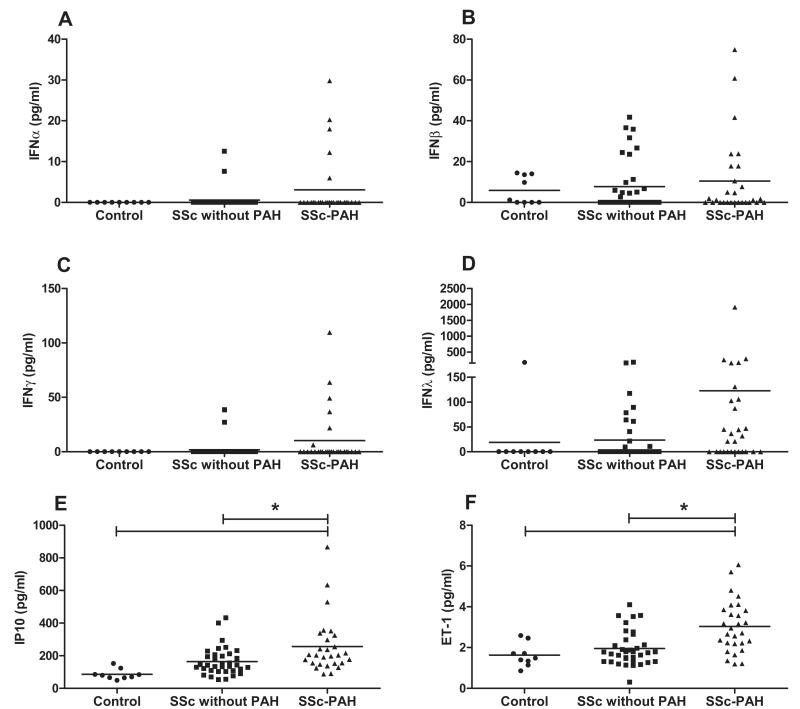
Serum interferon (IFN) γ inducible protein 10 (IP10), endothelin 1 (ET-1), and IFN levels in patients with systemic sclerosis (SSc)-pulmonary arterial hypertension (PAH), SSc without PAH, and healthy controls. Serum levels of IFNα (A), IFNβ (B), IFNγ (C), IFNλ (D), IP10 (E), and ET-1 (F) were analyzed from controls, n=9, patients with SSc without PAH, n=35, and patients with SSc-PAH, n=28. Individual data points refer to each patient, and means of all patients in the cohort are represented by horizontal lines. Statistical significance (*P<0.05) for all 3 groups compared with each other was determined by Kruskal–Wallis test followed by Dunn multiple comparison post-test for nonparametric data (A–D) and by 1-way ANOVA followed by Bonferroni multiple comparison post-test for normally distributed data (E and F).
Figure 3
Figure 3
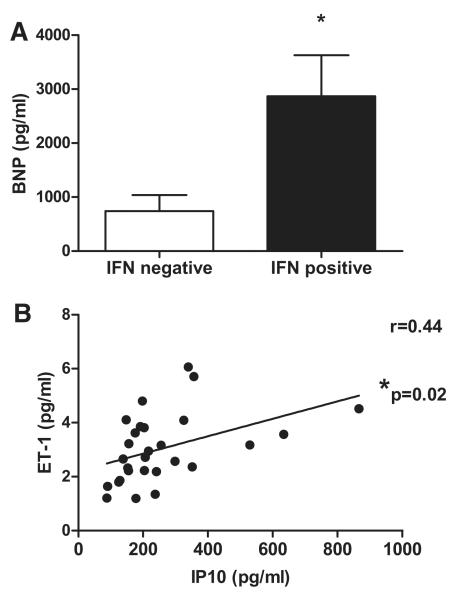
Serum brain natriuretic peptide (BNP), interferon (IFN) γ inducible protein 10 (IP10), and endothelin 1 (ET-1) levels measured in a cohort of patients with systemic sclerosis (SSc)-pulmonary arterial hypertension (PAH). Serum BNP levels in IFN-positive and IFN-negative patients (A). Data expressed as mean±SEM. Statistical significance (*P<0.05) determined using a t test. Serum IP10 and ET-1 levels measured in patients with SSc-PAH, n=28 (B). Data points represent individual patient readouts. Correlation was determined using Pearson correlation coefficient, and r and P values are shown.
Figure 4
Figure 4
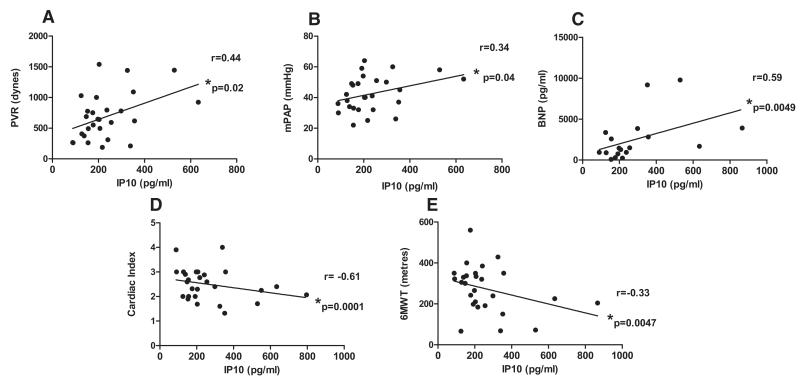
Correlation of interferon γ inducible protein 10 (IP10) with clinical and hemodynamic parameters in patients with systemic sclerosis (SSc)-pulmonary arterial hypertension (PAH). Pearson correlation coefficient was determined between IP10 and pulmonary vascular resistance (PVR; dynes), n=27 (A); and mean pulmonary artery pressure (mPAP; mm Hg), n=27 (B); Spearman rank correlation coefficient was determined between IP10 and serum brain natriuretic peptide (BNP) levels (pg/mL), n=18 (C); cardiac index, n=27 (D); and 6-minute walk test (6MWT; meters), n=27 (E). Data points represent individual patient readouts.
Figure 5
Figure 5
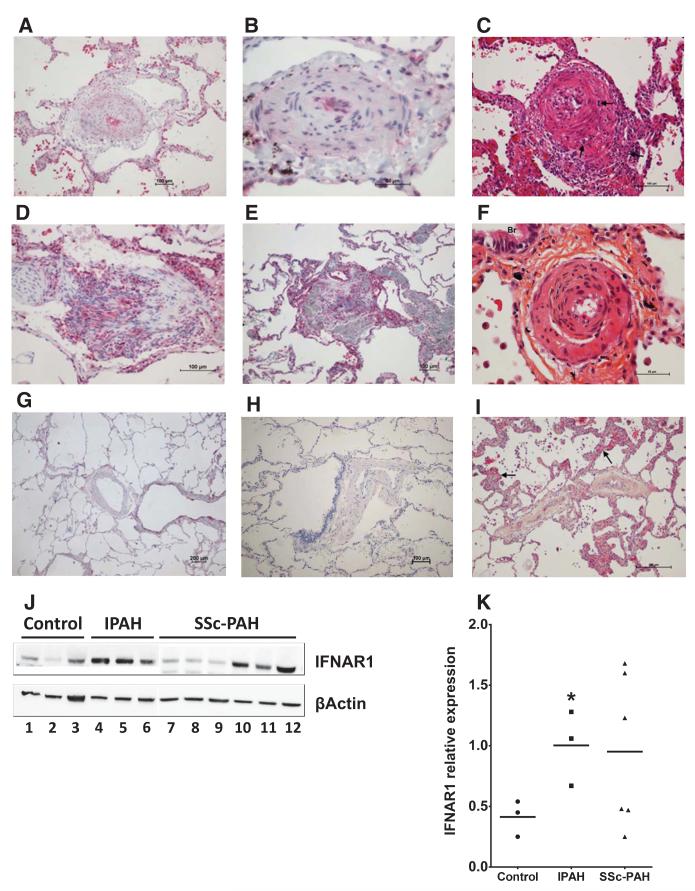
Immunohistochemistry and Western blotting demonstrating type I interferon receptor (IFNAR1) in pulmonary arterial hypertension (PAH) lung. IFNAR1 staining in lung sections from a patient with systemic sclerosis (SSc)-PAH (A and B), Idiopathic (I) PAH (D and E), and non-PAH controls (G and H). Figures shown are representative images from n=3 patients. Lung samples from patients with SSc-PAH with high (C and F) and low (I) IFNAR1 expression; hematoxylin and eosin and hematoxylineosin-saffron staining. C, A small pulmonary artery displaying arteritis with transmural inflammatory infiltrate (arrows) and important intimal thickening. F, A pulmonary artery adjacent to a small bronchiole (Br) showing quasiocclusive fibrosis of the intima. I, Small pulmonary vein displaying important fibrotic occlusive remodeling, a feature frequently encountered in SSc-PAH; note the surrounding alveolar septa with capillary hemangiomatosis-like appearance (arrows). IFNAR1 expression (J); 1 to 3, n=3 controls; 4 to 6, n=3 patients with IPAH; (separate blot) 7 to 9, n=3 SSc-PAH with predominantly venous disease and 10 to 12, n=3 SSc-PAH with predominantly arterial disease. Blot (J) quantified as expression relative to β actin (K). Statistical significance (*P<0.05) was determined by 1-way ANOVA with Bonferroni multiple comparison post-test.
Figure 6
Figure 6
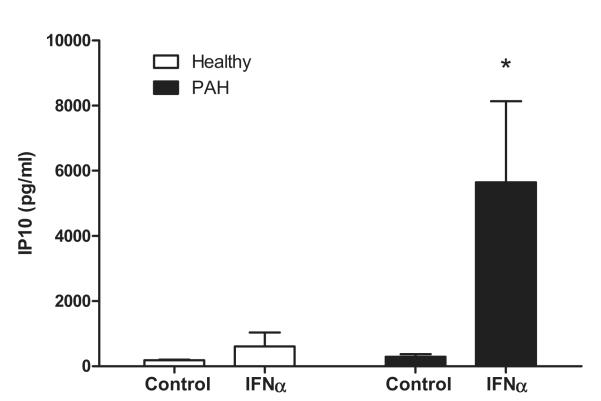
Interferon γ inducible protein 10 (IP10) release from interferon α (IFNα)-stimulated endothelial cells grown from the blood of patients with pulmonary arterial hypertension (PAH) and healthy controls. Endothelial cells grown from the blood of patients (blood outgrowth endothelial cells from patients with PAH, n=4 and healthy controls, n=4 were treated with IFNα (30 ng/mL) and assayed for IP10. Data are presented as mean±SEM, and statistical significance (*P<0.05) was determined by 2-way ANOVA with Bonferroni multiple comparison post-test.
Figure 7
Figure 7
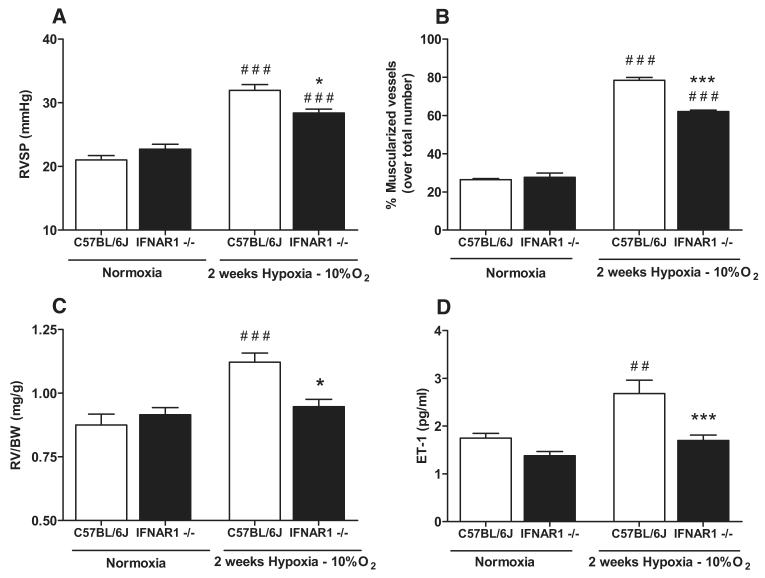
Influence of type I interferon (IFN) signaling on the development of pulmonary arterial hypertension (PAH) explored using the chronic hypoxic mouse model and mice lacking a functional type I IFN receptor. Mice lacking a functional type I IFN receptor (IFNAR1−/−) exposed to hypoxia (10% O2) or normoxia (room air) compared with wild-type (C57Bl/6J) mice exposed to the same conditions. Data presented as mean±SEM from n=4 to 15 mice. Right ventricular systolic pressure (RVSP; mm Hg; A), percentage of muscularized pulmonary vessels over total number of vessels (B), ratio of right ventricular (RV) mass to body weight (BW) (RV/BW; mg/g; C), and serum endothelin (ET)-1 levels (pg/mL; D) were measured. Statistical significance was determined by 1-way ANOVA followed by Bonferroni multiple comparison post-test (###P<0.0001 and ##P<0.005 for normoxic vs hypoxic conditions) and (***P<0.0001, **P<0.005, and *P<0.05 for IFNAR1−/− vs C57Bl/6J mice).
Figure 8
Figure 8
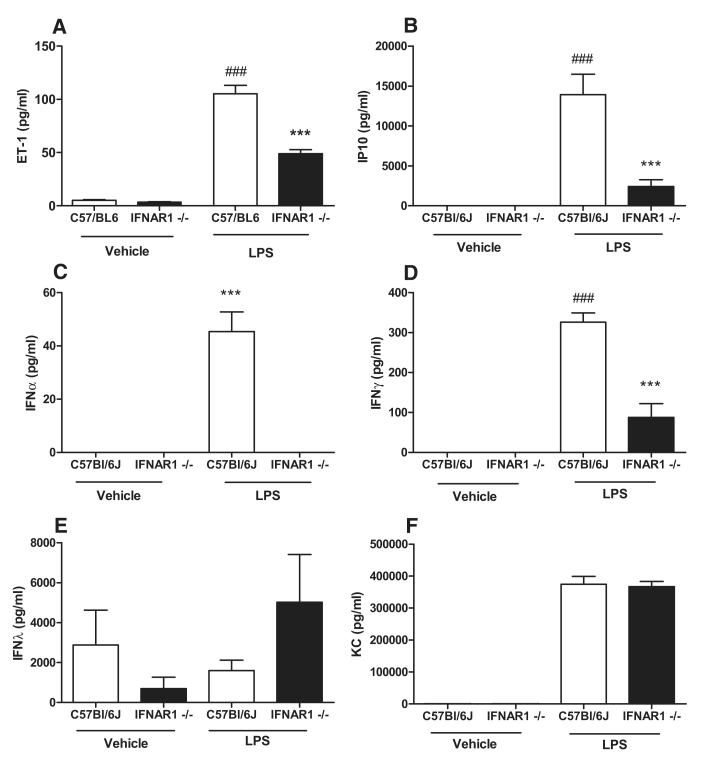
Influence of type I interferon (IFN) signaling on lipopolysaccharide (LPS)-induced endothelin 1 (ET-1) generation explored using mice lacking a functional type I IFN receptor. Mice lacking a functional type I IFN receptor (IFNAR1−/−) injected with either LPS or vehicle control for 4 hours and compared with wild-type (C57Bl/6J) mice. Data presented as mean±SEM from n=6 mice. Serum levels of ET-1 (A), interferon γ inducible protein 10 (IP10) (B), IFNα (C), IFNγ (D), IFNλ (E), and keratinocyte-derived chemokine (KC) (F) were measured. Statistical significance determined by 1-way ANOVA followed by Bonferroni multiple comparison post-test (###P<0.0001 for LPS vs Vehicle) and (***P<0.0001 for IFNAR1−/− vs C57Bl/6J mice).

References

    1. Voelkel NF, Gomez-Arroyo J, Abbate A, Bogaard HJ, Nicolls MR. Pathobiology of pulmonary arterial hypertension and right ventricular failure. Eur Respir J. 2012;40:1555–1565. - PMC - PubMed
    1. D’Alonzo GE, Barst RJ, Ayres SM, Bergofsky EH, Brundage BH, Detre KM, Fishman AP, Goldring RM, Groves BM, Kernis JT. Survival in patients with primary pulmonary hypertension. Results from a national prospective registry. Ann Intern Med. 1991;115:343–349. - PubMed
    1. Nicolls MR, Taraseviciene-Stewart L, Rai PR, Badesch DB, Voelkel NF. Autoimmunity and pulmonary hypertension: a perspective. Eur Respir J. 2005;26:1110–1118. - PubMed
    1. George PM, Badiger R, Alazawi W, Foster GR, Mitchell JA. Pharmacology and therapeutic potential of interferons. Pharmacol Ther. 2012;135:44–53. - PubMed
    1. Al-Zahrani H, Gupta V, Minden MD, Messner HA, Lipton JH. Vascular events associated with alpha interferon therapy. Leuk Lymphoma. 2003;44:471–475. - PubMed

Publication types

MeSH terms