


Epigenomics and the concept of degeneracy in biological systems
- PMID: 24335757
- PMCID: PMC4031454
- DOI: 10.1093/bfgp/elt050
Epigenomics and the concept of degeneracy in biological systems
Abstract
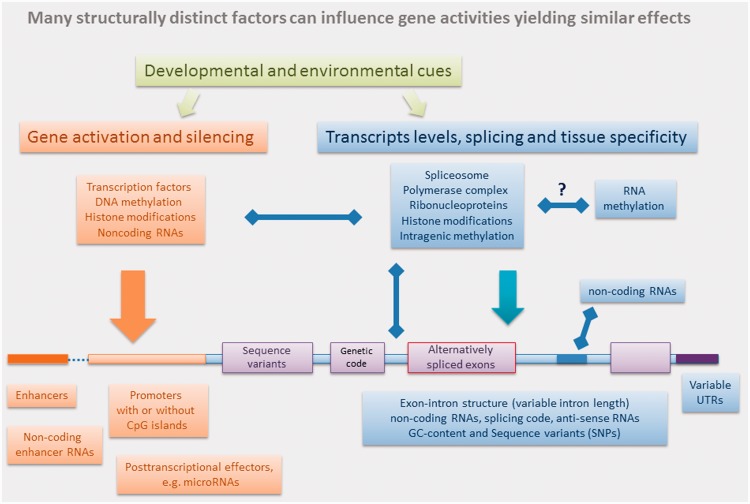
Researchers in the field of epigenomics are developing more nuanced understandings of biological complexity, and exploring the multiple pathways that lead to phenotypic expression. The concept of degeneracy-referring to the multiple pathways that a system recruits to achieve functional plasticity-is an important conceptual accompaniment to the growing body of knowledge in epigenomics. Distinct from degradation, redundancy and dilapidation; degeneracy refers to the plasticity of traits whose function overlaps in some environments, but diverges in others. While a redundant system is composed of repeated identical elements performing the same function, a degenerate system is composed of different elements performing similar or overlapping functions. Here, we describe the degenerate structure of gene regulatory systems from the basic genetic code to flexible epigenomic modifications, and discuss how these structural features have contributed to organism complexity, robustness, plasticity and evolvability.
Keywords: DNA methylation; epigenetic code; histone modifications; honey bee; pluripotentiality; redundancy; robustness; social insect.
© The Author 2013. Published by Oxford University Press.
Figures
References
-
- Tononi G, Edelman GM. A Universe of Consciousness: How Matter Becomes Imagination. New York: Basic Books; 2000.
-
- Maleszka R. Elucidating the path from genotype to behaviour in honey bees: insights from epigenomics. In: Eisenhardt D, Galizia G, Giurfa M, editors. Honeybee Neurobiology and Behavior: A Tribute to Randolf Menzel. Amsterdam: Springer Publisher; 2012. pp. 373–86.
-
- Miklos GL, Maleszka R. Deus ex genomix. Nat Neurosci. 2000;3:424–5. - PubMed
-
- Atamas SP. Les affinités electives. Pour Sci. 2005;46:39–43.
Publication types
MeSH terms
LinkOut - more resources
Full Text Sources
Other Literature Sources
