


Secondhand exposure to vapors from electronic cigarettes
- PMID: 24336346
- PMCID: PMC4565991
- DOI: 10.1093/ntr/ntt203
Secondhand exposure to vapors from electronic cigarettes
Abstract
Introduction: Electronic cigarettes (e-cigarettes) are designed to generate inhalable nicotine aerosol (vapor). When an e-cigarette user takes a puff, the nicotine solution is heated and the vapor is taken into lungs. Although no sidestream vapor is generated between puffs, some of the mainstream vapor is exhaled by e-cigarette user. The aim of this study was to evaluate the secondhand exposure to nicotine and other tobacco-related toxicants from e-cigarettes.
Materials and methods: We measured selected airborne markers of secondhand exposure: nicotine, aerosol particles (PM(2.5)), carbon monoxide, and volatile organic compounds (VOCs) in an exposure chamber. We generated e-cigarette vapor from 3 various brands of e-cigarette using a smoking machine and controlled exposure conditions. We also compared secondhand exposure with e-cigarette vapor and tobacco smoke generated by 5 dual users.
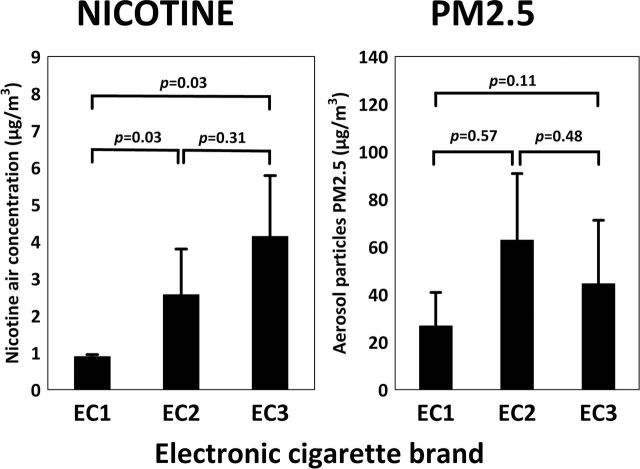
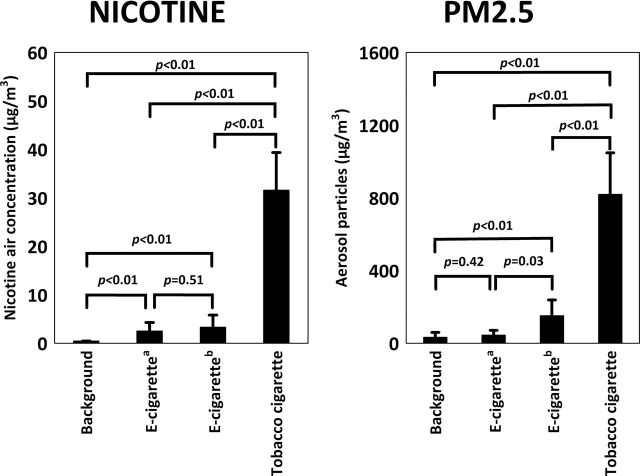
Results: The study showed that e-cigarettes are a source of secondhand exposure to nicotine but not to combustion toxicants. The air concentrations of nicotine emitted by various brands of e-cigarettes ranged from 0.82 to 6.23 µg/m(3). The average concentration of nicotine resulting from smoking tobacco cigarettes was 10 times higher than from e-cigarettes (31.60±6.91 vs. 3.32±2.49 µg/m(3), respectively; p = .0081).
Conclusions: Using an e-cigarette in indoor environments may involuntarily expose nonusers to nicotine but not to toxic tobacco-specific combustion products. More research is needed to evaluate health consequences of secondhand exposure to nicotine, especially among vulnerable populations, including children, pregnant women, and people with cardiovascular conditions.
Figures
References
-
- Bullen C., McRobbie H., Thornley S., Glover M., Lin R., Laugesen M. (2010). Effect of an electronic nicotine delivery device (e cigarette) on desire to smoke and withdrawal, user preferences and nicotine delivery: Randomised cross-over trial. Tobacco Control, 19, 98–103. 10.1136/tc.2009.031567 - PubMed
-
- California Environmental Protection Agency. Air Resources Board. (2005). Proposed identification of environmental tobacco smoke as a toxic air contaminant. Part A. Exposure assessment. Sacramento, CA: California Environmental Protection Agency.
-
- Czogala J., Goniewicz M. L. (2005). The complex analytical method for assessment of passive smokers’ exposure to carbon monoxide. Journal of Analytical Toxicology, 29, 830–834. 10.1093/jat/29.8.830 - PubMed
-
- Dawkins L., Corcoran O. (2013). Acute electronic cigarette use: Nicotine delivery and subjective effects in regular users. Psychopharmacology (Berl). Advance online publication. 10.1007/s00213-013-3249-8 - PubMed
-
- Etter J. F., Bullen C. (2011). Saliva cotinine levels in users of electronic cigarettes. European Respiratory Journal, 38, 1219–1220. 10.1183/09031936.00066011 - PubMed
Publication types
MeSH terms
Substances
Grants and funding
LinkOut - more resources
Full Text Sources
Other Literature Sources
Medical
