Review
. 2014 Jan;13(1):63-79.
doi: 10.1038/nrd4161. Epub 2013 Dec 13.

The two faces of Hippo: targeting the Hippo pathway for regenerative medicine and cancer treatment

Affiliations
Review

The two faces of Hippo: targeting the Hippo pathway for regenerative medicine and cancer treatment

Randy Johnson et al. Nat Rev Drug Discov. 2014 Jan.

Abstract

The Hippo signalling pathway is an emerging growth control and tumour suppressor pathway that regulates cell proliferation and stem cell functions. Defects in Hippo signalling and hyperactivation of its downstream effectors Yes-associated protein (YAP) and transcriptional co-activator with PDZ-binding motif (TAZ) contribute to the development of cancer, which suggests that pharmacological inhibition of YAP and TAZ activity may be an effective anticancer strategy. Conversely, YAP and TAZ can also have beneficial roles in stimulating tissue repair and regeneration following injury, so their activation may be therapeutically useful in these contexts. A complex network of intracellular and extracellular signalling pathways that modulate YAP and TAZ activities have recently been identified. Here, we review the regulation of the Hippo signalling pathway, its functions in normal homeostasis and disease, and recent progress in the identification of small-molecule pathway modulators.


Figures
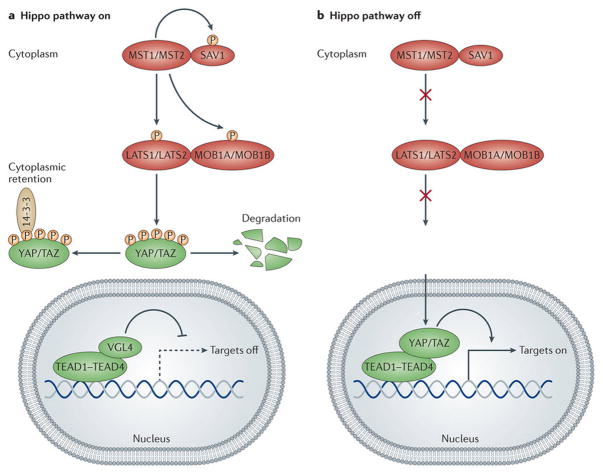
Figure 1
Figure 1. The core of the Hippo pathway and its mode of action
Schematics of the core pathway components and how they interact. (A) When the Hippo pathway is ON, MST1/2 phosphorylate SAV1 and together they phosphorylate and activate MOB1A/B and LATS1/2, which then phosphorylate YAP and TAZ. Phosphorylated YAP and TAZ are sequestered in the cytoplasm by the 14-3-3 phosphopeptide binding proteins and shunted for proteasomal degradation. As a result, the TEAD transcription factors associate with VGL4 and suppress target gene expression. (B) When the Hippo pathway is OFF, the MST1/2 and LATS1/2 kinases are inactive, YAP and TAZ are not phosphorylated and accumulate in the nucleus where they displace VGL4 and complex with TEADs. YAP and TAZ are transcriptional co-activators and in complex with TEADs promote the expression of target genes.
Figure 2
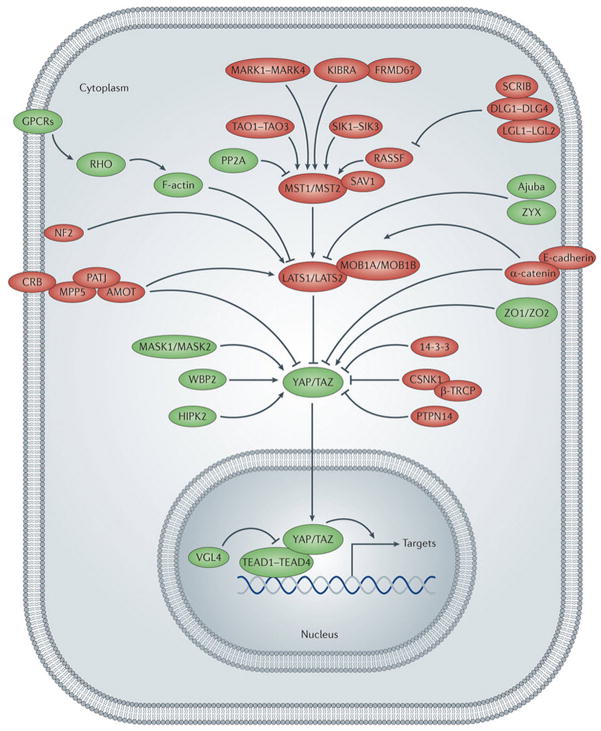
Figure 2. The Hippo pathway network
Outline of a cell with nucleus and the Hippo pathway network. Hippo pathway components are shown in green when they promote YAP/TAZ activity or in red when they inhibit YAP/TAZ activity. Pointed and blunt arrowheads indicate activating and inhibitory interactions, respectively. Abbreviations: α-CAT (α-Catenin), AJUB (Ajuba), AMOT (Angiomotin), β-TRCP (β-transducing repeat containing protein), CK1 (Casein Kinase 1), CRB (Crumbs), E-CAD (E-cadherin), EX (Expanded), GPCR (G-protein coupled receptor), HIPK (Homeodomain interacting protein kinase), KIBRA (Kidney brain), LATS (Large tumor suppressor), LGL (Lethal giant larvae), MASK (Multiple ankyrin single KH), MER (Merlin), MOB (Mps one binder), MST (Mammalian sterile 20 like), PALS (Protein Associated with Lin-7), PATJ (Pals1-associated tight junction protein), PP2A (Protein phosphatase 2A), PTPN14 (Protein tyrosine phosphatase non-receptor type 14), RASSF (Ras associated factor), SAV (Salvador), SCRIB (Scribble), SIK (Salt inducible kinase), TAO (Thousand and one amino acid protein), TAZ (transcriptional coactivator with PDZ-binding motif), TEAD (TEA domain protein), VGL4 (Vestigial-like 4), WBP2 (WW domain binding protein 2), YAP (Yes associated protein), ZO (Zonula occludens), ZYX (Zyxin).
Figure 3
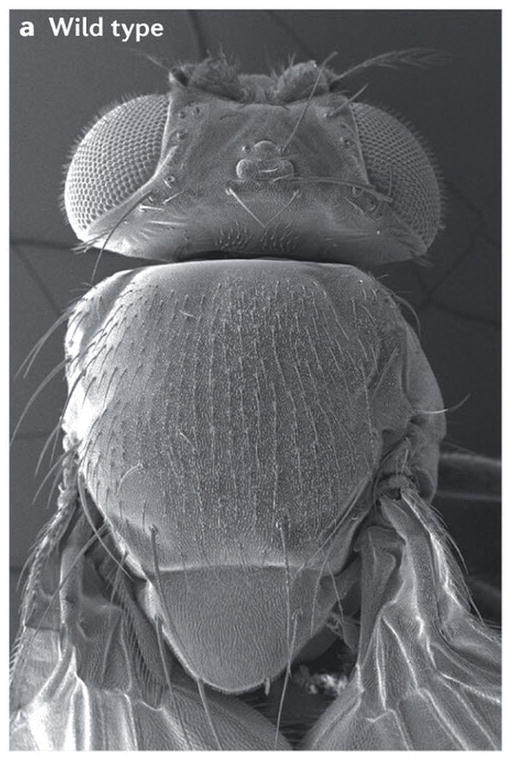
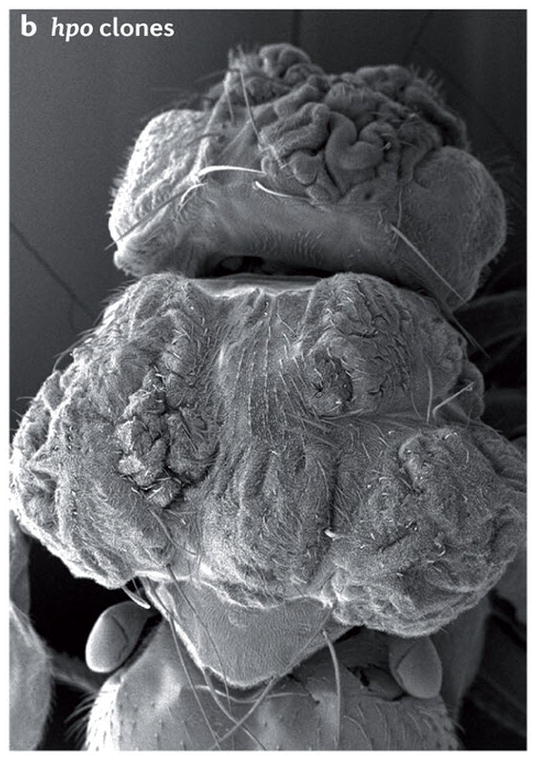
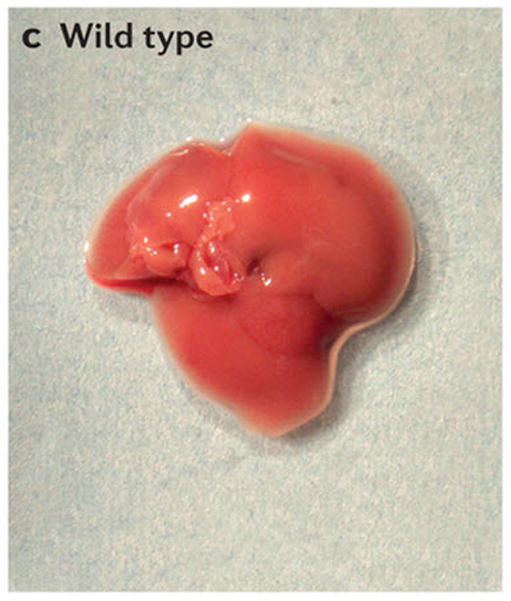
Figure 3. Hippo mutant phenotypes in flies and mice
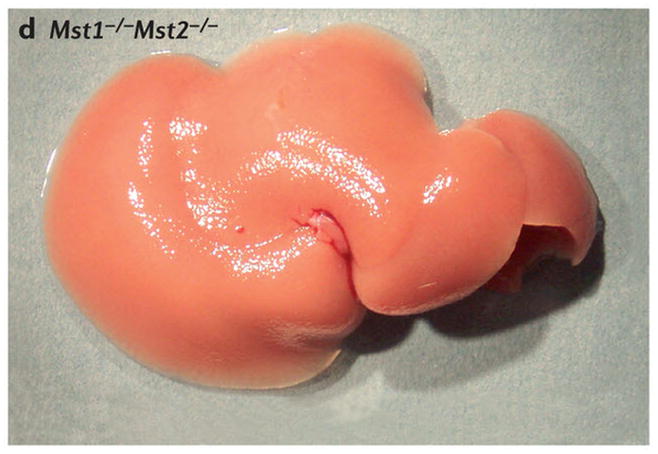
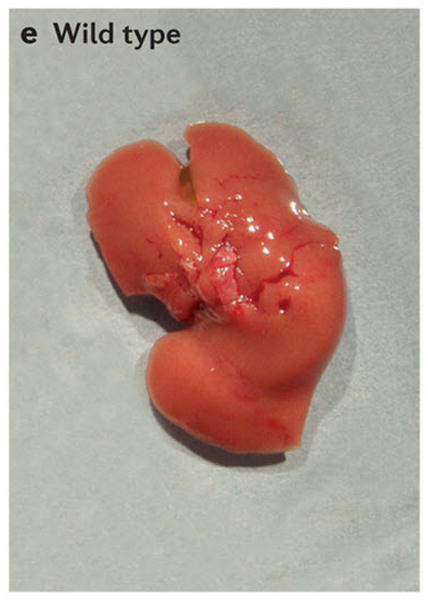
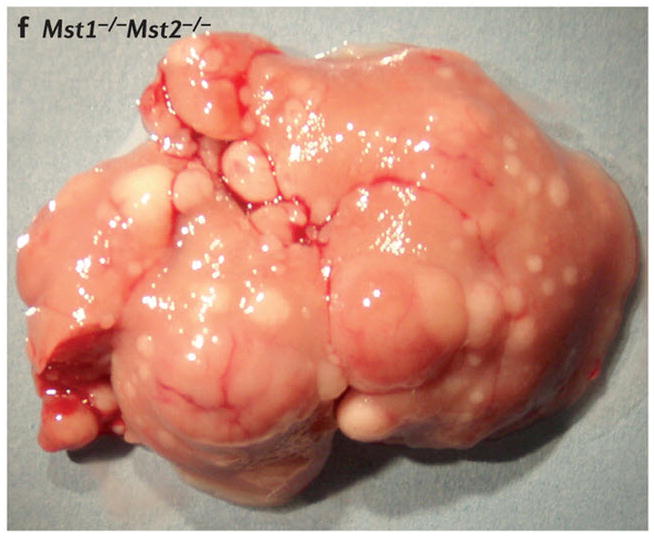
Scanning electron micrographs of (A) a wild-type fly and (B) a fly with patches (clones) of cells homozygous mutant for the hippo kinase. The hippo mutant tissues exhibit overgrowth of the adult cuticle. (C) A mouse liver at two months of age from a wild-type animal and (D) a liver at two months of age from a mouse mutant in which the two hippo homologs Mst1 and Mst2 have been conditionally deleted in the developing liver. (E) Normal mouse liver at 6 months and (F) a Mst1/2 double mutant liver at 6 months which is not only overgrown but also developed foci of hepatocellular carcinoma (HCC).
Figure 3
Figure 3. Hippo mutant phenotypes in flies and mice
Scanning electron micrographs of (A) a wild-type fly and (B) a fly with patches (clones) of cells homozygous mutant for the hippo kinase. The hippo mutant tissues exhibit overgrowth of the adult cuticle. (C) A mouse liver at two months of age from a wild-type animal and (D) a liver at two months of age from a mouse mutant in which the two hippo homologs Mst1 and Mst2 have been conditionally deleted in the developing liver. (E) Normal mouse liver at 6 months and (F) a Mst1/2 double mutant liver at 6 months which is not only overgrown but also developed foci of hepatocellular carcinoma (HCC).
Figure 3
Figure 3. Hippo mutant phenotypes in flies and mice
Scanning electron micrographs of (A) a wild-type fly and (B) a fly with patches (clones) of cells homozygous mutant for the hippo kinase. The hippo mutant tissues exhibit overgrowth of the adult cuticle. (C) A mouse liver at two months of age from a wild-type animal and (D) a liver at two months of age from a mouse mutant in which the two hippo homologs Mst1 and Mst2 have been conditionally deleted in the developing liver. (E) Normal mouse liver at 6 months and (F) a Mst1/2 double mutant liver at 6 months which is not only overgrown but also developed foci of hepatocellular carcinoma (HCC).
Figure 3
Figure 3. Hippo mutant phenotypes in flies and mice
Scanning electron micrographs of (A) a wild-type fly and (B) a fly with patches (clones) of cells homozygous mutant for the hippo kinase. The hippo mutant tissues exhibit overgrowth of the adult cuticle. (C) A mouse liver at two months of age from a wild-type animal and (D) a liver at two months of age from a mouse mutant in which the two hippo homologs Mst1 and Mst2 have been conditionally deleted in the developing liver. (E) Normal mouse liver at 6 months and (F) a Mst1/2 double mutant liver at 6 months which is not only overgrown but also developed foci of hepatocellular carcinoma (HCC).
Figure 3
Figure 3. Hippo mutant phenotypes in flies and mice
Scanning electron micrographs of (A) a wild-type fly and (B) a fly with patches (clones) of cells homozygous mutant for the hippo kinase. The hippo mutant tissues exhibit overgrowth of the adult cuticle. (C) A mouse liver at two months of age from a wild-type animal and (D) a liver at two months of age from a mouse mutant in which the two hippo homologs Mst1 and Mst2 have been conditionally deleted in the developing liver. (E) Normal mouse liver at 6 months and (F) a Mst1/2 double mutant liver at 6 months which is not only overgrown but also developed foci of hepatocellular carcinoma (HCC).
Figure 3
Figure 3. Hippo mutant phenotypes in flies and mice
Scanning electron micrographs of (A) a wild-type fly and (B) a fly with patches (clones) of cells homozygous mutant for the hippo kinase. The hippo mutant tissues exhibit overgrowth of the adult cuticle. (C) A mouse liver at two months of age from a wild-type animal and (D) a liver at two months of age from a mouse mutant in which the two hippo homologs Mst1 and Mst2 have been conditionally deleted in the developing liver. (E) Normal mouse liver at 6 months and (F) a Mst1/2 double mutant liver at 6 months which is not only overgrown but also developed foci of hepatocellular carcinoma (HCC).
Figure 4
Figure 4. Cellular functions of YAP/TAZ and TEAD
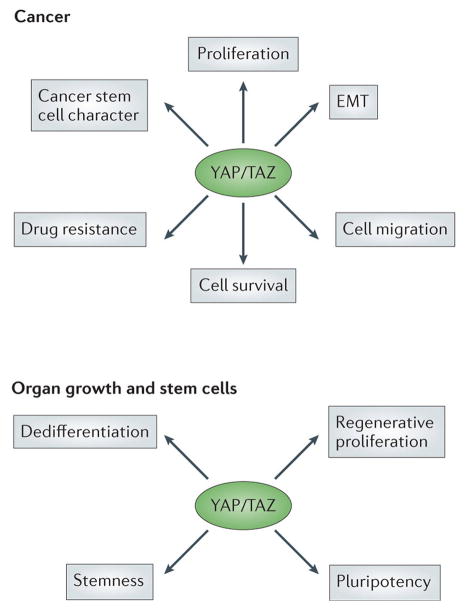
YAP and TAZ regulate several cellular properties that are important for the development of cancer and the regulation of stem cell behavior and regeneration. Some of these, such as the promotion of stemness and proliferation are important for cancer development and in regeneration, while others such as the regulation of EMT may be important only for the development of cancer. However, the function of YAP and TAZ in reprogramming mature and differentiated cells during regenerative behavior may be exploited during the development of cancer and help drive EMT and other phenotypes.

References

    1. Halder G, Johnson RL. Hippo signaling: growth control and beyond. Development. 2011;138:9–22. - PMC - PubMed
    1. Staley BK, Irvine KD. Hippo signaling in Drosophila: recent advances and insights. Dev Dyn. 2012;241:3–15. - PMC - PubMed
    1. Genevet A, Tapon N. The Hippo pathway and apico-basal cell polarity. Biochem J. 2011;436:213–24. - PubMed
    1. Ramos A, Camargo FD. The Hippo signaling pathway and stem cell biology. Trends Cell Biol. 2012;22:339–46. - PMC - PubMed
    1. Pan D. The hippo signaling pathway in development and cancer. Dev Cell. 2010;19:491–505. - PMC - PubMed

MeSH terms

Substances